Kinkaku-ji and Kitayama
A practical guide to Kinkaku-ji's Golden Pavilion, Ryoan-ji's rock garden, Ninna-ji, and Daitoku-ji, with real prices, hours, and transit.
Kyoto: Kinkaku-ji Guided Tour with Entry Ticket
Quick facts
- Kinkaku-ji admission
- ¥500, view-only, no interior access
- Ryoan-ji admission
- ¥600, famous 15-rock dry garden
- Ninna-ji grounds admission
- ~¥500, later-blooming Omuro cherries
- Getting between sights
- City bus (101, 102, 205) or taxi — not walkable temple-to-temple
A scattered cluster, not a walkable temple row
Northern Kyoto’s Kitayama district holds some of the city’s most recognizable sights — the gold-leafed Kinkaku-ji, the rock garden at Ryoan-ji, the cherry trees of Ninna-ji, and the sprawling Zen complex of Daitoku-ji — but unlike the temple-lined lanes of Higashiyama in the east, these sights are spread across a wide area of northern Kyoto that isn’t practically walkable between stops. Most visitors move between them by city bus or taxi, which changes how you should plan a visit here: pick two or three sights rather than assuming you can casually stroll from one to the next.
Kinkaku-ji is the anchor and, for most first-time visitors, the single most-anticipated sight in the city. It’s worth understanding both what makes it significant and where the visit differs from expectations before you go.
Kinkaku-ji: real gold leaf, a 1950 fire, and a view-only visit
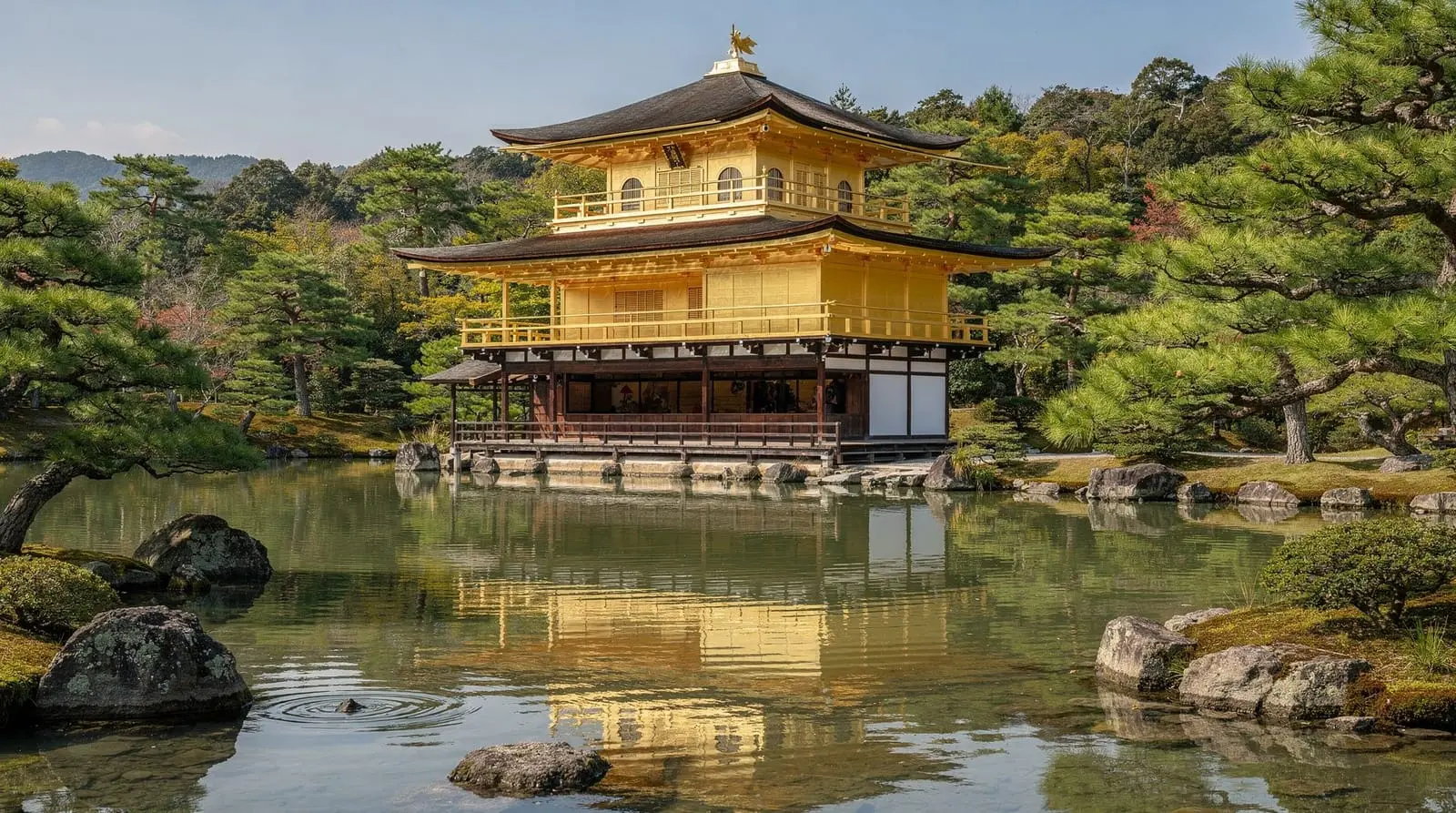
Kinkaku-ji, formally Rokuon-ji and known in English as the Golden Pavilion, is a UNESCO World Heritage Site and one of Kyoto’s most photographed buildings. The top two of its three floors are covered in genuine gold leaf, not gold paint or a gilded appearance achieved some other way. The pavilion was originally built in 1397 as a retirement villa for the shogun Ashikaga Yoshimitsu and later converted to a Zen temple after his death, following a common pattern in which a shogun’s residence became a temple.
The building visible today isn’t the original structure. In 1950, a young monk at the temple set fire to the pavilion, destroying it completely — an event significant enough in Japanese cultural memory that novelist Yukio Mishima later fictionalized it in his 1956 novel “The Temple of the Golden Pavilion.” The current building is a reconstruction completed in 1955, based closely on the original design.
Admission is ¥500 (raised in recent years from ¥400), and the temple is open roughly 9am to 5pm daily. The detail that surprises a meaningful number of first-time visitors: you cannot enter the pavilion. The visit follows a fixed, one-way path around the reflecting pond (Kyoko-chi, “mirror pond”) in front of the building, with the pavilion viewed only from across the water at a few designated points, then continues through the rest of the temple grounds to an exit. If your expectation is a Nijo Castle-style interior visit with rooms to walk through, Kinkaku-ji doesn’t offer that — the entire visit is exterior viewing, which takes most visitors 30-45 minutes at an unhurried pace.
Crowding is heaviest at midday, roughly 11am to 2pm, when the viewing points across from the pavilion get genuinely packed and photos without other visitors in frame become difficult. The first hour after the 9am opening is consistently the best window, both for crowd levels and for the way morning light hits the gold leaf across the pond.
A guided Kinkaku-ji tour with entry ticket bundles admission with historical context on the 1950 fire and the temple’s role in Kyoto’s shogunate history, useful since on-site signage is fairly minimal. For a more personal pace without a group, a private 90-minute Kinkaku-ji tour covers the same ground on a schedule built around your questions rather than a fixed group timetable.
Ryoan-ji: 15 rocks, and you can only ever see 14
Ryoan-ji is home to what’s generally considered Japan’s most famous karesansui (dry landscape) garden — a rectangular bed of raked white gravel containing 15 rocks arranged in five small groupings, with no plants, water, or other features. It’s a short bus ride or roughly 20-minute walk from Kinkaku-ji, making it the natural pairing for a combined visit.
The garden’s best-known detail is a geometric quirk of its layout: from any single point along the viewing veranda, only 14 of the 15 rocks are visible at once — one is always hidden from view behind another, regardless of where you stand. Traditional interpretations read this as a deliberate statement about the limits of human perception or the impossibility of complete understanding, though some garden historians argue it may simply be a byproduct of the composition rather than an intentional message.
Either way, visitors reliably spend time trying to find the vantage point where all 15 are visible (there isn’t one from the veranda), which is part of what makes the garden a lasting point of interest rather than a static thing to glance at and move on from.
Admission is ¥600. Set aside 30-45 minutes to sit with the garden rather than just walk past it — the design specifically rewards a slower, seated viewing from the veranda over a quick walkthrough. A combined Kinkaku-ji and Ryoan-ji walking tour covers both sights with the transit between them handled for you, which removes the main logistical friction of this district.
If you want to focus specifically on Ryoan-ji’s garden in more depth, an 80-minute Ryoan-ji Zen garden guided tour spends more time unpacking the design history and rock-garden tradition than a bundled multi-stop tour typically allows.
Ninna-ji: a UNESCO temple with a later cherry blossom season
Ninna-ji, founded in 888, is a UNESCO World Heritage Site a short distance from Ryoan-ji, notable for its five-story pagoda and for a grove of Omuro cherry trees that grow unusually short — low enough that you can view the blossoms nearly at eye level rather than looking up into a canopy. These trees also bloom later than most of Kyoto’s cherry trees, typically in mid-to-late April rather than late March or early April, which means Ninna-ji effectively offers a second cherry blossom season after the main citywide bloom has already finished elsewhere. This is a genuinely useful piece of planning information for visitors arriving slightly later in April who assume they’ve missed cherry blossom season entirely.
Grounds admission is around ¥500; the inner Goten palace area and the Kondo hall (the temple’s main worship hall, itself a National Treasure) carry separate additional admission. Most visitors touring the grounds and pagoda without the inner palace can cover Ninna-ji in about 45 minutes.
Daitoku-ji: a Zen complex of sub-temples, mostly quiet
Daitoku-ji is a large Zen temple complex rather than a single building — a walled compound containing numerous individual sub-temples, several of which (Daisen-in, Ryogen-in, and Koto-in among them) charge their own separate admission, typically ¥400-600 each, and which sub-temples are open to the public rotates over time. This is a meaningfully different visiting model from Kinkaku-ji or Ryoan-ji: there’s no single ticket covering the whole complex, and planning a Daitoku-ji visit means picking specific sub-temples in advance rather than showing up and wandering freely into everything.
The complex is historically associated with the tea ceremony tradition, most notably through its connection to the 16th-century tea master Sen no Rikyu, and several of its sub-temples reflect that lineage through dry garden design and tea house architecture rather than the large-scale ornamental gardens seen elsewhere in Kyoto. Daitoku-ji sees noticeably less foot traffic than Kinkaku-ji, and is a better fit for visitors specifically interested in garden design, tea history, or a quieter Zen setting than for anyone chasing the district’s most iconic photo.
Kinkaku-ji’s lesser counterpart: Ginkaku-ji is not in this district
A common point of confusion worth addressing directly: Kinkaku-ji (Golden Pavilion) is sometimes mixed up with Ginkaku-ji (Silver Pavilion), a differently located temple near the northern end of the Philosopher’s Path in eastern Kyoto. Despite the similar names and the shared “pavilion” framing, they’re unrelated in location — Ginkaku-ji is nowhere near Kitayama, and confusing the two when planning transit is a genuine, recurring mistake among first-time visitors mapping out a day. If your itinerary mentions both, treat them as separate outings on separate days, or at minimum budget significant transit time between them, since the routes connecting Kitayama to the Philosopher’s Path area aren’t direct.
Sub-temple etiquette and photography restrictions
Several of Kitayama’s temples, particularly the sub-temples within Daitoku-ji and parts of Ryoan-ji, restrict photography inside specific buildings or rooms, most commonly where original painted sliding doors (fusuma) or other fragile historic artwork is on display. Signage at each entrance generally makes this clear, but the restriction is enforced by staff more strictly here than at some other Kyoto sights, and visitors who ignore posted no-photography signs are asked directly to stop rather than simply reminded once. Ryoan-ji’s outdoor rock garden itself is fully photographable; the restrictions, where they exist, tend to apply to interior corridors and specific painted rooms rather than the main garden views.
Removing shoes before entering temple interiors is standard practice across all four sights in this district, as it is throughout Kyoto, and most temples provide simple shoe storage — a plastic bag or a numbered shelf — near the entrance. Wearing socks without holes and shoes that slip on and off easily makes the frequent removal and re-wearing across a multi-temple day noticeably less tedious.
Getting between the sights
This district doesn’t reward walking between temples. Kinkaku-ji, Ryoan-ji, Ninna-ji, and Daitoku-ji are spread across several kilometers of northern Kyoto, and while Kinkaku-ji to Ryoan-ji is a manageable 20-minute walk if you want it, the fuller circuit including Ninna-ji and Daitoku-ji is not realistically walkable in a single day without significant fatigue.
City buses — routes 101, 102, and 205 among others — connect the main sights, with fares on the flat-rate city zone system (¥230 per ride, paid with an IC card or cash on board). A taxi is a reasonable option for the Ninna-ji to Daitoku-ji leg specifically, since bus routing between them isn’t direct. Many visitors instead join a half-day tour that bundles two or three of these temples with transit handled, which is generally more time-efficient than assembling bus connections independently for a single day trip.
Nearby food options are limited near Kinkaku-ji itself
Unlike Arashiyama, which has a concentrated shopping and food street connecting its main sights, the immediate area around Kinkaku-ji has relatively few dining options directly adjacent to the temple gate — mostly a handful of small souvenir and snack stalls near the exit selling matcha soft-serve and simple snacks in the ¥300-500 range.
For an actual meal, most visitors either eat before arriving, or travel a short distance toward the Kitano Tenmangu shrine area or back toward downtown, where options are considerably more plentiful. This is worth factoring into a half-day plan: if you’re combining Kinkaku-ji and Ryoan-ji, neither has much in the way of substantial dining nearby, so eating beforehand or budgeting transit time afterward for a proper meal is the more reliable approach than expecting to find something on-site.
How this compares to Arashiyama and central Kyoto
Kitayama’s temples are architecturally and historically distinct from what you’ll see in Arashiyama to the west — there’s no bamboo grove or river scenery here, and the character is drier, more formal Zen garden design rather than Arashiyama’s natural landscape draw.
If you’re building a multi-day itinerary, it’s common to treat Kitayama and Arashiyama as separate half-day or full-day outings rather than combining them, since the transit between the two districts adds a meaningful amount of travel time. For visitors also interested in Sagano’s quieter temples, note that Sagano’s atmosphere — rural, low-crowd, walkable — is a closer match to Kitayama’s Daitoku-ji sub-temples than to Kinkaku-ji’s high-traffic main circuit.
Seasonal notes specific to this district
Kitayama’s four main sights each carry a slightly different seasonal peak, which is useful for spreading visits across a trip rather than trying to see everything in one crowded window. Kinkaku-ji looks distinct in winter when light snow settles on the pavilion’s roof and the surrounding pines — a relatively rare event in Kyoto given its mild winters, but one that draws a specific rush of visitors and photographers whenever it happens, since the combination of gold leaf and snow is considered one of the more striking seasonal images in the city.
Ryoan-ji’s rock garden is deliberately unseasonal by design — the raked gravel and stone arrangement don’t change with the calendar, which is part of the point of karesansui gardening, though the maple trees framing the garden do turn color in November. Ninna-ji’s main seasonal draw, as noted above, is its later-blooming Omuro cherries in mid-to-late April, offering a second spring peak after the rest of the city has moved past cherry blossom season. Daitoku-ji’s sub-temples vary individually, with several noted for autumn maple color within their smaller, enclosed garden spaces.
Given these staggered peaks, a visitor with more than one day in Kyoto and a specific interest in this district might reasonably split a Kitayama visit across two separate days at different times of year rather than trying to catch every seasonal highlight in a single trip — though for most travelers on a standard one-time visit, seeing Kinkaku-ji and Ryoan-ji together, in whatever season you happen to be in Kyoto, remains the higher priority than timing a return visit around a specific bloom.
Comparing the four Kitayama sights
Since this district doesn’t reward trying to see everything in one visit, it helps to compare the four main sights directly when deciding which two or three to prioritize.
| Kinkaku-ji | Ryoan-ji | Ninna-ji | Daitoku-ji | |
|---|---|---|---|---|
| Admission | ¥500 | ¥600 | ~¥500 (grounds) | ¥400-600 per sub-temple |
| Time needed | 30-45 min | 30-45 min | ~45 min | 30-45 min per sub-temple |
| Crowd level | Heaviest, especially midday | Moderate | Lighter | Lightest |
| Signature feature | Gold-leafed pavilion, exterior only | 15-rock dry garden | Five-story pagoda, later cherries | Tea-ceremony history, sub-temple gardens |
For a first visit, Kinkaku-ji and Ryoan-ji together cover the district’s two most essential sights in half a day. Ninna-ji and Daitoku-ji are additions for a second day or for travelers specifically interested in cherry blossom timing or Zen garden and tea history beyond the headline sights.
Food near Ryoan-ji and Ninna-ji
Dining options thin out further the deeper into Kitayama you go — Ryoan-ji and Ninna-ji have even less immediately adjacent food than Kinkaku-ji’s handful of souvenir stalls. Kinugasa, the neighborhood between Kinkaku-ji and Ryoan-ji, has a scattering of small local restaurants and cafes serving simple set meals, generally aimed at residents rather than tour groups, which makes them a reasonable if unglamorous option if you need a proper sit-down lunch between temples. The more reliable approach for most visitors is still to eat before starting the Kitayama circuit or to save a fuller meal for the return toward downtown Kyoto or the Kitano Tenmangu shrine area, where options multiply considerably.
Planning a visit
For a first Kyoto trip, Kinkaku-ji and Ryoan-ji together make a solid half-day, arriving at Kinkaku-ji right at 9am opening and moving to Ryoan-ji by late morning before its own crowd levels build. Visitors with more time or a specific interest in garden design or tea history should add Ninna-ji or Daitoku-ji, ideally on a separate day given the transit involved.
Our suggested itineraries show where a Kitayama half-day or full day fits alongside other districts like downtown Kyoto or the Philosopher’s Path, and the travel essentials tool covers IC card transit for the bus connections this district requires. For a broader look at Kyoto’s other tour options, see our tours overview and full destination list, and for background on temple and garden design across the city, our guides section.
Frequently asked questions about visiting Kinkaku-ji and Kitayama
Can I go inside Kinkaku-ji?
No. The visit is a fixed, one-way outdoor path around the reflecting pond, with the pavilion viewed only from across the water. There’s no interior access for the general public at any price.
Is the gold on Kinkaku-ji real?
Yes, the top two floors are covered in genuine gold leaf. The current building dates to a 1955 reconstruction after the original was destroyed by an arson fire in 1950.
How much time do I need for Kinkaku-ji and Ryoan-ji together?
Roughly 2.5 to 3.5 hours including the walk or short bus ride between them: about 30-45 minutes at Kinkaku-ji, 20 minutes in transit, and 30-45 minutes at Ryoan-ji, plus buffer for crowds and photos.
Why can I only see 14 of the 15 rocks at Ryoan-ji?
The garden’s layout is designed so that from any fixed viewing point on the veranda, at least one of the 15 rocks is always blocked from view by another. There’s no vantage point, including from the veranda’s ends, where all 15 are simultaneously visible.
When do the cherry trees at Ninna-ji bloom?
Typically mid-to-late April, later than most of Kyoto’s cherry blossoms, because the Omuro cherry variety grown there blooms on a delayed schedule. This makes Ninna-ji a good option for visitors arriving after the main citywide bloom has finished.
Do I need separate tickets for each sub-temple at Daitoku-ji?
Yes. Daitoku-ji itself has no single all-access ticket; individual sub-temples like Daisen-in, Ryogen-in, and Koto-in each charge their own admission, roughly ¥400-600, and which ones are open to visitors changes over time.
What’s the best time of day to visit Kinkaku-ji to avoid crowds?
The first hour after 9am opening. Crowds build through the late morning and peak around 11am to 2pm, when the main viewing points across the pond get genuinely congested.
Can I walk between all four temples in this guide in one day?
Not comfortably. Kinkaku-ji to Ryoan-ji is a manageable 20-minute walk, but adding Ninna-ji and Daitoku-ji requires bus or taxi transit between stops rather than walking, given the distances involved across northern Kyoto.
Which two sights should I prioritize if I only have half a day?
Kinkaku-ji and Ryoan-ji. Together they cover the district’s most iconic building and its most famous garden in roughly 2.5-3.5 hours including transit, and both are within a manageable 20-minute walk or short bus ride of each other.
Is there anywhere to eat near Ryoan-ji or Ninna-ji?
Very little directly adjacent to either temple. The Kinugasa neighborhood between Kinkaku-ji and Ryoan-ji has a few small local restaurants, but most visitors eat before starting the circuit or wait until they’re back near downtown Kyoto or the Kitano Tenmangu area.
Top experiences
Bookable activities with verified prices and instant confirmation on GetYourGuide.