Sagano
Beyond Arashiyama's crowds: the Sagano Scenic Railway, Adashino Nenbutsu-ji's 8,000 stone Buddhas, and the moss garden at Gio-ji.
Kyoto Hozugawa River Boat Sagano Romantic Train Tour
Quick facts
- Sagano Scenic Railway
- ~¥880 one-way, ~25 min, Torokko Saga to Torokko Kameoka
- Adashino Nenbutsu-ji admission
- ~¥500, roughly 8,000 stone jizo statues
- Gio-ji admission
- ~¥300, small moss garden
- How to reach it
- Walk north/west past Arashiyama's Bamboo Grove and Nison-in
The quiet half of a district most people only half-see
Sagano is the rural, thinly visited area immediately north and west of Arashiyama’s famous core. It’s not a separate trip — there’s no clear boundary line, no gate, no change of train station — but the character shifts noticeably once you walk past the far end of the Bamboo Grove and the temple Nison-in. Crowds thin, the terrain opens into small farm plots and thatched-roof houses, and the sights that remain are smaller, older, and far less photographed. Most visitors to Kyoto see Arashiyama’s bamboo path and bridge and never make it this far; the ones who do generally describe Sagano as the better half of the visit.
This guide covers what’s specifically in Sagano: the Sagano Scenic Railway, Adashino Nenbutsu-ji, Gio-ji, and the general character of the area. For the Bamboo Grove, Tenryu-ji, Iwatayama Monkey Park, and Togetsukyo Bridge — the busier, more central sights — see our separate Arashiyama guide.
It’s worth being upfront about what Sagano is not: it’s not a compact, single-loop attraction with one obvious highlight, and it doesn’t reward a rushed hour between other plans. The sights are spread thinly across farmland and quiet lanes, and the appeal is cumulative — the walk itself, the near-total absence of other visitors, and a handful of genuinely distinctive stops rather than one unmissable landmark. If you’re the kind of traveler who wants a clear “must-see” to justify a detour, Adashino Nenbutsu-ji’s field of stone statues is the closest Sagano gets to that; everything else here is more about atmosphere than a single checklist item.
The Sagano Scenic Railway (the “Romantic Train”)
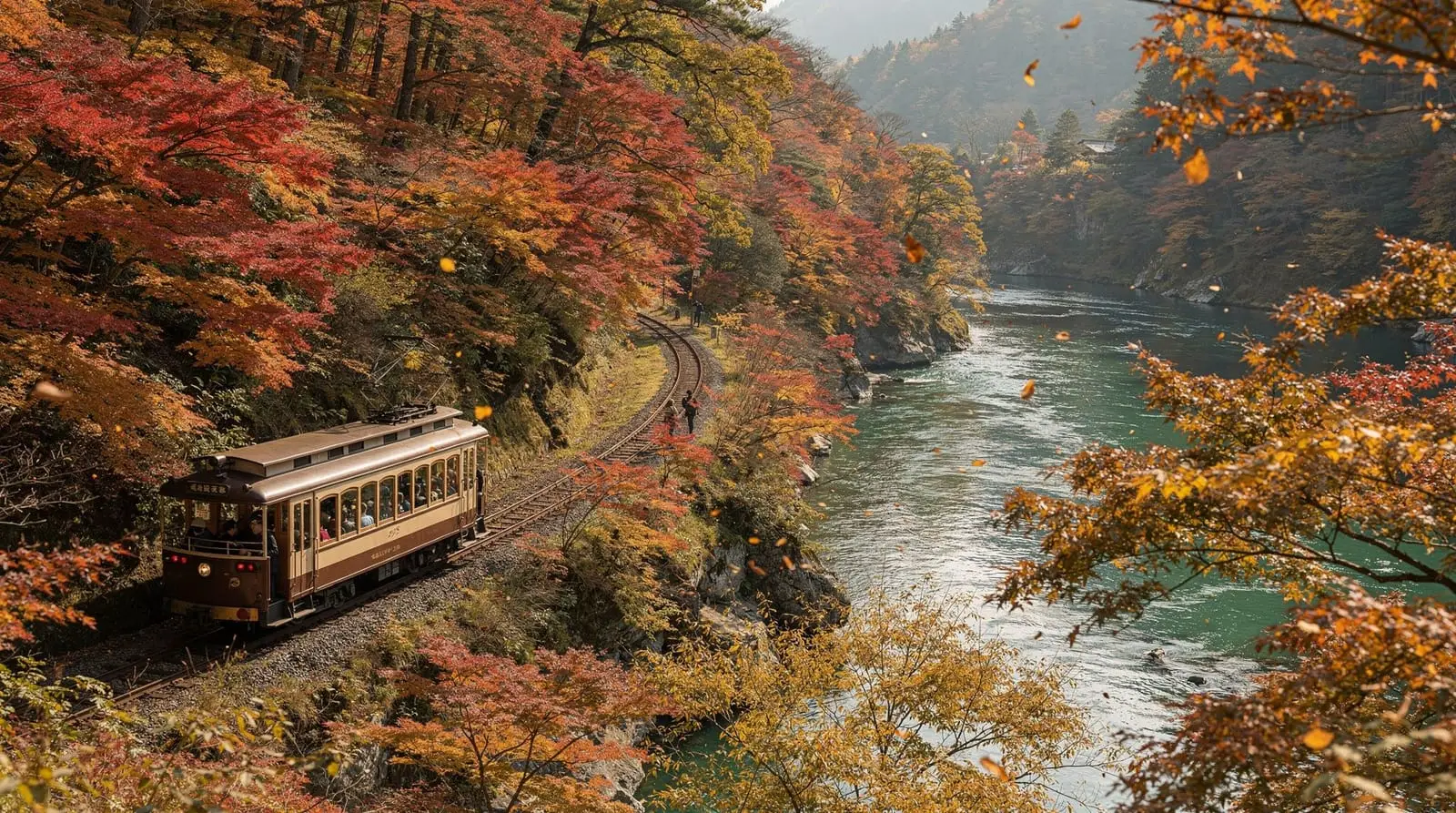
The Sagano Scenic Railway, commonly called the Romantic Train (Torokko Ressha), is an open-window sightseeing train that runs along the Hozugawa river gorge between Torokko Saga Station, on the edge of Arashiyama, and Torokko Kameoka Station, further upriver. The ride takes about 25 minutes and follows the river through a wooded gorge that isn’t visible from any road, which is the whole appeal — slow, scenic, and inaccessible any other way short of hiking.
One-way fare is roughly ¥880 (about US$5.90 at ¥150 per dollar, rates fluctuate). This is worth flagging specifically because a lot of older travel blogs and even some printed guidebooks still list the previous fare of ¥630 — the railway raised prices, and outdated sources are common enough that it’s worth double-checking current pricing at the station or through an official source rather than trusting a blog post from a few years ago.
The train doesn’t run every day of the year: it’s typically closed on some Wednesdays (the exact dates vary by month and are published on the railway’s own schedule), and it runs a reduced timetable in winter. During cherry blossom and autumn foliage season, seats sell out, so reserving in advance is genuinely necessary rather than a formality.
Most visitors ride the train one-way from Saga to Kameoka, then either walk back or continue to the Hozugawa river boat, which departs from near Kameoka and floats back down to Arashiyama by water rather than rail — a loop that uses train and boat as two halves of the same trip rather than two separate outings.
A combined Hozugawa river boat and Sagano Romantic Train tour books both legs as a single reserved package, which removes the risk of showing up to a sold-out train or boat departure on your own. For a longer version that adds a hot spring stop, an Arashiyama day tour with train, boat, and onsen turns the same river loop into a full-day outing with a soak included at the end.
Adashino Nenbutsu-ji: roughly 8,000 stone Buddhas
Adashino Nenbutsu-ji is a small temple a short walk northwest of the Bamboo Grove’s far end, notable for a dense field of roughly 8,000 stone jizo (Buddhist guardian) statues arranged across its grounds. The statues weren’t originally sculpted for this site — they were gathered over time from abandoned and unmarked graves scattered around Kyoto, where the area historically served as a burial ground for those without family to maintain a grave, and consolidated here in the early 20th century as a memorial. The result is genuinely different from a typical ornamental temple garden: rows and clusters of weathered stone figures, many mossy and worn nearly featureless, covering most of the visible ground.
Admission is around ¥500 (about US$3.30). It’s small enough to see thoroughly in 30-45 minutes, and even during Arashiyama’s peak crowding it tends to stay quiet — the walk to get here filters out most casual visitors who don’t make it past the main bamboo path. A candle-lighting ceremony (Sento Kuyo) is held here in late August, when the statues are lit with candles in the evening, a notable exception to the otherwise low-key year-round visiting experience.
Gio-ji: a small moss temple with a 12th-century story
Gio-ji is a tiny temple, easy to miss if you’re not specifically looking for it, built around a moss garden that’s among the most photographed small gardens in Kyoto despite the temple itself being modest in size. Admission is around ¥300 (about US$2). The temple is associated with the story of Gio, a shirabyoshi (a type of dancer-entertainer) from the late 12th century who, according to the account preserved in the Heike Monogatari, retreated here after being replaced in the affections of a powerful patron by a younger performer. Whether or not every detail of the story is literally accurate, the temple has carried the association for centuries and takes its name from her.
The garden itself is small — walkable in 15-20 minutes — but the moss coverage is dense and well maintained, and unlike Sagano’s other stops, Gio-ji rarely has more than a handful of visitors at a time even in high season. It rewards a slow, unhurried walk rather than a quick photo stop.
Otagi Nenbutsu-ji: a second, less-known stone statue temple
Further west and slightly uphill from Adashino Nenbutsu-ji is Otagi Nenbutsu-ji, a separate temple that’s easy to confuse with its similarly named neighbor but distinct in character. Where Adashino Nenbutsu-ji’s roughly 8,000 statues are somber and memorial in tone, Otagi Nenbutsu-ji’s approximately 1,200 stone rakan (disciples of Buddha) statues were carved over about ten years starting in 1981, when the temple’s head priest invited ordinary visitors to carve their own statue under guidance. The result is unusually informal and varied for a Japanese temple: statues with sunglasses, statues holding sake cups, statues mid-laugh, alongside more traditional serene expressions, all weathered now by four decades of exposure to moss and rain.
Admission is around ¥300. It’s a genuine uphill walk to reach, further from the Bamboo Grove than Adashino Nenbutsu-ji, and as a result sees even fewer visitors — often close to empty on weekday mornings. It’s not for visitors seeking historical gravitas so much as those curious about a more recent, participatory chapter of Kyoto temple history, and it pairs naturally with a stop at Adashino Nenbutsu-ji on the same walk given their proximity.
Sagano’s stone-statue temples compared
Adashino Nenbutsu-ji and Otagi Nenbutsu-ji share a similar name and a similar idea — fields of stone statues — but the tone couldn’t be more different, and it’s worth knowing which one fits what you’re after.
| Adashino Nenbutsu-ji | Otagi Nenbutsu-ji | |
|---|---|---|
| Statues | ~8,000 jizo, gathered from abandoned graves | ~1,200 rakan, carved by visitors from 1981 |
| Tone | Somber, memorial | Playful, informal, varied expressions |
| Admission | About ¥500 | About ¥300 |
| Distance from Bamboo Grove | 15-20 min walk | Further, uphill |
| Crowd level | Quiet | Even quieter |
Rakushisha: a haiku poet’s thatched hut
A short walk from Adashino Nenbutsu-ji, Rakushisha (“The House of Fallen Persimmons”) is a small thatched-roof hut associated with Mukai Kyorai, a 17th-century disciple of the haiku master Matsuo Basho. Basho himself is recorded as having stayed here on visits to Kyoto, and the modest garden and structure are preserved as a literary site rather than a religious one — a rare non-temple stop in a district otherwise built around Buddhist sites.
It’s a minor detour, easy to see in ten minutes, but a genuinely different flavor of “old Kyoto” for visitors interested in classical Japanese poetry rather than another garden or statue field. For more on Kyoto’s lesser-known historic corners, our hidden temples of Kyoto roundup covers several similarly overlooked stops across the city.
Nison-in and the edge of Sagano proper
Nison-in sits roughly at the transition point between Arashiyama’s busier core and quieter Sagano, and functions almost as a gateway between the two. It’s known for a long, maple-lined stone approach path leading up to the main temple buildings, which turns bright red and orange during autumn foliage season (mid-to-late November) and draws a moderate crowd specifically for that reason, though nothing close to the density seen at the Bamboo Grove or Togetsukyo Bridge. If you’re walking from Arashiyama into Sagano, Nison-in is a natural first stop and a reasonable marker that you’ve left the most crowded section behind.
Walk it slowly, or rent a bicycle
Sagano’s sights — the Bamboo Grove’s far end, Nison-in, Adashino Nenbutsu-ji, Gio-ji, and the railway stations — are spread across roughly two kilometers of quiet lanes, farmland, and small residential streets. This isn’t a district built around a single fixed tour route the way some temple clusters are; it rewards wandering at a slow pace, whether on foot or by rented bicycle, with detours down side lanes that don’t necessarily lead anywhere marked on a map but are part of what makes the area feel different from central Arashiyama.
Bicycle rental shops are available near the main Arashiyama train stations, and cycling is a genuinely practical way to cover Sagano’s wider spread without the fatigue of a long walk in both directions; see our cycling in Kyoto guide for rental logistics and other routes worth considering if biking appeals beyond just this one district.
If you’d rather have a guide handle the routing and point out temples that aren’t obvious from the main path, a Arashiyama hidden temples and Bamboo Grove guided tour is built specifically around this kind of lesser-visited stop, rather than the handful of sights everyone already knows to look for. For visitors who want the Bamboo Grove itself without the crowd, but in a structured, guided format rather than freelance early-rising, a serene morning walk through the Arashiyama Bamboo Grove times the walk for the quiet early window and can extend naturally into Sagano afterward.
Food and rest stops in a district with few of either
Sagano has far fewer restaurants and cafes than central Arashiyama, and this is worth planning around rather than discovering on arrival hungry. There are a handful of small tofu restaurants and traditional teahouses scattered along the road toward Adashino Nenbutsu-ji, some occupying converted farmhouses, serving yudofu (simmered tofu) set meals typically priced ¥1,500-2,500 (roughly US$10-17).
These tend to be quieter and less tourist-oriented than the food stalls on Arashiyama’s main shopping street, but there are meaningfully fewer of them, and some close by mid-afternoon rather than staying open into the evening. If you’re planning a full day covering both Arashiyama and Sagano, it’s generally more reliable to eat in Arashiyama’s more concentrated food area either before heading into Sagano or after returning, rather than counting on finding a specific place open once you’re deep in the quieter district.
Public rest stops (toilets, benches, shaded seating) are also sparser here than in central Arashiyama, spaced further apart along the walking route. This is a minor point but worth knowing if you’re traveling with young children or anyone who needs more frequent breaks — the walk between Adashino Nenbutsu-ji and Gio-ji in particular has a longer stretch without facilities than most short walks within Kyoto’s temple districts.
Cash is also worth carrying more of than you might in central Kyoto. Several of Sagano’s tofu restaurants and smaller temple admission counters are cash-only or prefer it, and the district’s rural character means fewer of the card readers and IC-card-linked convenience stores you’d rely on in Gion or downtown. Withdraw or exchange what you need before heading out here rather than assuming you’ll find an ATM along the way — there generally isn’t one once you’re past the main Arashiyama station cluster.
Why bother with Sagano if you’ve already seen Arashiyama’s highlights
The honest case for Sagano isn’t that its individual sights outrank Tenryu-ji or the Bamboo Grove — they don’t, in terms of historical significance or scale. The case is crowding. Arashiyama’s core sights are consistently among the most crowded in Kyoto, particularly from mid-morning onward and throughout cherry blossom and autumn foliage seasons, as detailed in our Arashiyama guide.
Sagano offers a genuinely comparable atmosphere — bamboo, temples, river, wooded hillsides — without that density, because most visitors simply don’t walk far enough past the main bamboo path to reach it. If your main frustration with Arashiyama is the crowd rather than the sights themselves, Sagano is the direct answer to that problem rather than a compromise.
Seasonal timing in Sagano
Sagano follows the same broad seasonal calendar as the rest of Kyoto but with noticeably lower crowd pressure at every point in the year. Autumn foliage (typically peaking mid-November) is the strongest single reason to prioritize Sagano over a repeat visit to Arashiyama’s core — Nison-in’s maple-lined approach and the wooded stretches around Adashino Nenbutsu-ji turn color in the same window as Arashiyama’s more famous foliage spots, but with a fraction of the visitors competing for the same view; see our autumn foliage in Kyoto guide for how Sagano’s peak lines up with the rest of the city’s.
Spring cherry blossoms are present but less concentrated here than at Arashiyama’s riverside, since Sagano’s landscape is more agricultural and residential than ornamentally planted.
Summer brings the same heat and humidity as the rest of Kyoto, and the shaded lanes toward Gio-ji and Adashino Nenbutsu-ji offer some relief, though there’s less continuous tree cover here than the Bamboo Grove itself provides. Winter is arguably Sagano’s best-kept secret: the Sagano Scenic Railway runs a reduced schedule but still operates, the stone statues at Adashino Nenbutsu-ji take on a stark, quiet character against bare branches, and the near-total absence of other visitors makes for a genuinely different atmosphere than the same route in April or November.
Getting to and around Sagano
Sagano has no dedicated train station of its own in the way Arashiyama does; visitors typically arrive via JR Saga-Arashiyama Station or Randen Arashiyama Station (the same stations used for Arashiyama) and then walk north and west, or take the Sagano Scenic Railway from Torokko Saga Station, which sits right at the boundary between the two areas. On foot, it’s roughly a 15-20 minute walk from the Bamboo Grove’s northern end to Adashino Nenbutsu-ji, and another 10-15 minutes to Gio-ji. There’s no meaningful bus network within Sagano itself — this is a walking-and-cycling district, not one built around transit stops.
Planning your visit
Sagano works best as the second half of an Arashiyama day rather than a standalone destination: spend the morning at the Bamboo Grove, Tenryu-ji, and the monkey park while they’re still relatively quiet, then continue north into Sagano for the afternoon once the core Arashiyama sights have filled up with the day’s tour groups anyway.
Our suggested itineraries lay out how a combined Arashiyama-Sagano day fits alongside other districts like Kinkaku-ji and northern Kyoto or downtown Kyoto, and the travel essentials tool covers IC card transit and other logistics relevant to a full day out this way. For broader background on Kyoto’s temples and gardens, see our guides section.
Frequently asked questions about visiting Sagano
Is Sagano a separate destination from Arashiyama, or the same trip?
They’re adjacent and typically visited together. Arashiyama is the busier core cluster (Bamboo Grove, Tenryu-ji, Togetsukyo Bridge, monkey park); Sagano is the quieter area immediately north and west, reached by continuing on foot past the Bamboo Grove’s far end. There’s no separate train station or clear boundary — it’s a continuous walk.
How much does the Sagano Scenic Railway cost, and has the price changed recently?
One-way fare is currently around ¥880. This is higher than the ¥630 figure still listed in a lot of older travel content, so it’s worth checking current pricing directly rather than relying on an outdated blog post.
Do I need to book the Sagano Scenic Railway in advance?
During cherry blossom and autumn foliage season, yes — the train sells out and reservations are effectively required. Outside peak season, same-day tickets are more often available, though booking ahead removes the risk.
What are the 8,000 stone statues at Adashino Nenbutsu-ji?
They’re stone jizo statues gathered from abandoned, unmarked graves around Kyoto and consolidated on this site in the early 20th century as a memorial. Admission is around ¥500. The temple holds a candle-lighting ceremony in late August.
Is Gio-ji worth the detour for a small garden?
Most visitors who make the walk say yes — the moss coverage is dense and the temple is small enough to see in 15-20 minutes, and it’s rarely crowded even in high season, unlike almost anywhere in central Arashiyama.
Can I cycle around Sagano instead of walking?
Yes, and it’s a practical option given the roughly two-kilometer spread between sights. Bicycle rental shops operate near the main Arashiyama train stations.
Is Sagano actually quieter than Arashiyama, or is that overstated?
It’s a real difference, not just marketing language. The physical filtering effect of a 15-20 minute walk past the Bamboo Grove’s main path removes most casual visitors, so sights like Adashino Nenbutsu-ji and Gio-ji see a fraction of the foot traffic that the Bamboo Grove or Togetsukyo Bridge do, even during Kyoto’s busiest seasons.
Should I visit Sagano before or after Arashiyama’s main sights?
Either order works, but visiting Arashiyama’s core sights early (before 8-9am) and moving into Sagano afterward is generally more efficient, since Arashiyama’s crowd levels rise through the morning while Sagano stays comparatively quiet all day.
What is Rakushisha?
Rakushisha is a small thatched hut in Sagano associated with Mukai Kyorai, a 17th-century haiku poet and disciple of Matsuo Basho, who is recorded as having stayed there. It’s a literary rather than religious site, worth a short detour for anyone interested in classical Japanese poetry.
Which stone-statue temple should I visit if I only have time for one?
Adashino Nenbutsu-ji if you want the larger, more somber field of roughly 8,000 memorial jizo statues; Otagi Nenbutsu-ji if you prefer the smaller, more playful collection of visitor-carved rakan statues from the 1980s. Both are quiet by Kyoto standards, with Otagi seeing even fewer visitors.
Should I bring cash to Sagano?
Yes. Several tofu restaurants and smaller temple admission counters in Sagano are cash-only or strongly prefer it, and there’s essentially no ATM access once you’re past the main Arashiyama station cluster, unlike central Kyoto.
Top experiences
Bookable activities with verified prices and instant confirmation on GetYourGuide.


