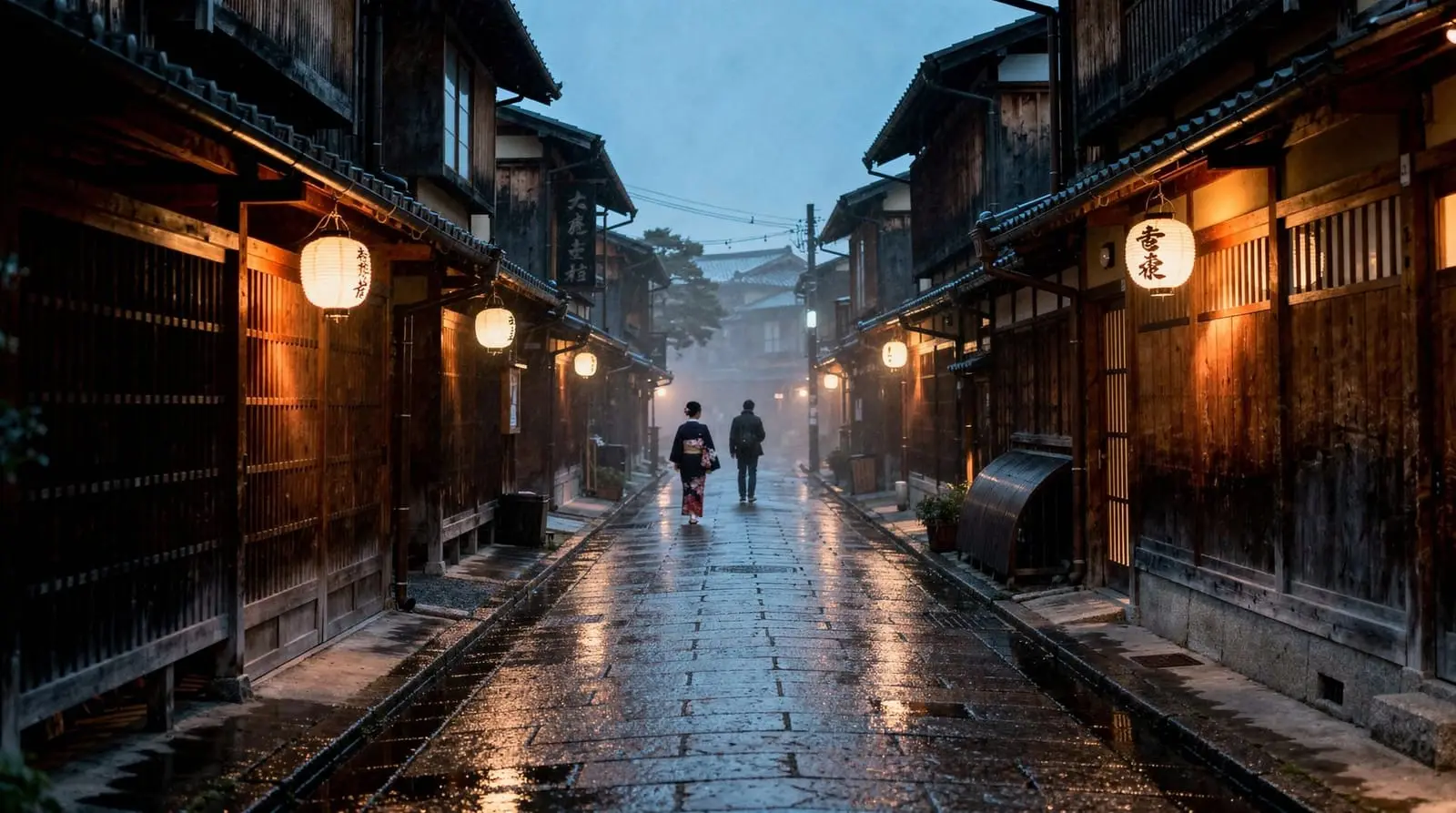
Gion
A factual guide to Gion, Kyoto's geisha district: Hanamikoji-dori, Shirakawa canal, Yasaka Shrine, and the 2024 photography restrictions.
Kyoto: Gion Geisha District Walking Tour - Stories of Geisha
Duration: 2 hours
Quick facts
- Main street
- Hanamikoji-dori
- Private street fine
- Up to ¥10,000 for entering banned streets
- Yasaka Shrine admission
- Free, always open
- Nearest station
- Gion-Shijo (Keihan)
A working neighborhood, not a theme park
Gion is Kyoto’s best-known hanamachi, literally “flower town,” the traditional term for a geisha district. It sits on the eastern side of the Kamo River, bordered roughly by Shijo-dori to the north and Yasaka Shrine to the east, and is centered on Hanamikoji-dori, a preserved street of wooden machiya townhouses, teahouses (ochaya), and exclusive restaurants. Geiko (Kyoto’s specific term for what’s known elsewhere in Japan as geisha) and maiko (apprentice geiko) genuinely still live, train, and work here — this is not a recreated or performance-only district, and treating it as one has caused real problems, covered below.
That distinction matters for how you should approach a visit. The wooden buildings, stone-paved streets, and lantern-lit evenings are real and photogenic, but they’re also somebody’s workplace and, in the case of the ochaya’s residents, effectively somebody’s home. The neighborhood’s appeal and its friction with mass tourism come from the same source: it looks like a set, but it isn’t one.
Hanamikoji-dori and the Shirakawa canal
Hanamikoji-dori runs north-south through the heart of Gion, roughly 1km from Shijo-dori south to Kenninji Temple. The northern stretch, between Shijo-dori and Shimbashi-dori, is the most visited and most photographed section, lined with ochaya facades that are largely closed to walk-in visitors — these are reservation-only, often requiring an existing relationship with the house. The southern stretch, closer to Kenninji, is quieter and less commercial.
One block north and slightly west, the Shirakawa canal is a smaller, quieter waterway lined with willow trees and low wooden buildings, running through what’s sometimes called the Shirakawa Minamidori district. It draws a fraction of Hanamikoji’s foot traffic and is arguably more atmospheric for that reason — a better choice if your priority is a quiet photo or an unhurried walk rather than ticking off the most famous street.
Evening, after most day-trippers have left but before full dark, is a good window here. Tatsumi Bridge, a small stone bridge over the canal near Tatsumi Daimyojin shrine, is one of the more photographed single spots in the district precisely because it’s compact and easy to frame — expect to share it with other visitors doing the same thing, particularly during cherry blossom season when the canal-side trees bloom.
At the southern end of Hanamikoji, near where the street meets Kenninji Temple, Ichiriki Chatei is worth knowing by name even though most visitors will only see its exterior. It’s one of Gion’s oldest and most storied ochaya, with a history tied to 18th-century political intrigue (it appears in accounts connected to the Chushingura, the historical incident behind the story of the 47 ronin), and it remains an operating teahouse today.
Like most ochaya, it operates on an introduction-only basis — a practice known as ichigen-san okotowari, “first-time customers respectfully declined” — meaning walk-in visitors, however well-dressed or well-funded, generally cannot book a visit without an existing relationship, often through a regular patron or a connected ryokan. This isn’t a scam or snobbery so much as a centuries-old system built on trust and repeat relationships rather than transactional bookings, and it’s a useful thing to understand before assuming any ochaya in Gion can simply be walked into and paid for like a restaurant.
For visitors who want a legitimate, bookable introduction to the performing arts historically associated with this district — dance, shamisen music, tea ceremony — without needing an ochaya connection, Gion Corner is a long-running theater near Yasaka Shrine that stages condensed programs covering several traditional art forms in a single sitting. It’s unmistakably aimed at visitors rather than being an authentic ochaya substitute, and it should be understood as an accessible introduction rather than the same thing as a genuine geiko performance, but it fills a real gap for travelers who want structured, respectful exposure to these traditions.
Yasaka Shrine
At the eastern end of Shijo-dori, where it meets Gion, Yasaka Shrine marks the boundary between Gion and the Higashiyama district beyond it. Admission is free and the grounds are always open, making it a reasonable stop regardless of time of day. The shrine is lit with rows of hanging lanterns in the evening, a genuinely different experience from a daytime visit, and it’s the site of the Gion Matsuri festival each July, one of Japan’s most significant annual festivals. Even outside festival dates, it functions as a natural transition point if you’re combining a Gion walk with time in Higashiyama to the east.
Geiko and maiko: what’s real and what isn’t
This is the part of a Gion visit that generates the most confusion, so it’s worth being direct about it. The women in elaborate kimono and white makeup that most visitors photograph during the day are, in the large majority of cases, tourists in rental kimono, not real geiko or maiko. Real maiko and geiko are typically visible, if at all, in the early evening — roughly 5:30 to 6:30pm — moving briskly between an okiya (their residence and training house) and an ochaya appointment. They are working during these moments, not posing for photographs, and they generally do not stop, slow down, or acknowledge onlookers.
If you do see one, the accepted etiquette is straightforward: don’t approach, don’t block their path, don’t touch them or their clothing, and don’t photograph them up close without consent — a respectful photo from a distance, without flash, without following them, is generally tolerated, but assume otherwise if there’s any ambiguity. If you want a guaranteed, consensual encounter with geiko/maiko culture rather than a hoped-for street sighting, book a legitimate teahouse experience or show instead of trying to engineer a candid photo.
The 2024 photography restrictions
In 2024, Kyoto City introduced restrictions barring tourists from entering several private side streets within Gion, following a sustained pattern of complaints — maiko being grabbed, chased down streets, and photographed at close range without consent, in some cases repeatedly by the same visitors. Fines of up to ¥10,000 (about US$67) apply to anyone entering those specific private streets. The main thoroughfares, including Hanamikoji-dori itself, remain open to the public and are not part of the ban.
The practical takeaway: stick to the main streets, respect any posted signage (which is generally in both Japanese and English), and treat any interaction with a geiko or maiko as an encounter with someone at work, not a photo opportunity you’re entitled to. This isn’t an unusual or excessive ask by local standards — it reflects ordinary norms around photographing strangers that happen to be widely ignored by visitors specifically in Gion.
Understanding the culture properly, rather than guessing
Given how much misinformation and gawking surrounds this topic, a guided approach is genuinely useful here in a way it might not be elsewhere. A Gion geisha district walking tour focused on the stories of geisha covers the actual history, training process, and daily life of geiko and maiko with a guide who can explain what you’re looking at rather than leaving you to guess from a distance.
For an evening focused specifically on food alongside the district’s atmosphere, a Kyoto evening Gion food tour combines dinner-hour dining with a walk through the neighborhood at its most atmospheric time of day. A dedicated night walk through Gion’s geisha district is a lighter option if you want the atmosphere and context without a meal built in.
If you want the kimono experience yourself rather than photographing others in one, a traditional kimono rental near Gion with a photoshoot, extending toward Kiyomizu-dera is the honest way to get those photos — you’re the one in costume, not photographing someone else’s actual profession. If you specifically want to see traditional performing arts (dance, music) associated with maiko training in a legitimate, consensual setting, a structured one-hour geisha show is a reasonable alternative to loitering on Hanamikoji hoping for a street sighting, and is one of the tour options listed for this district below.
Pontocho: a related but separate street
One block west of Hanamikoji, across the Kamo River, Pontocho is a narrow, atmospheric alley of restaurants and bars, many with seasonal outdoor terraces (yuka) overlooking the river in summer. It’s often mentioned in the same breath as Gion because of its proximity and similar traditional-alley aesthetic, but it functions primarily as a dining and nightlife street rather than a geisha district in its own right, though some ochaya operate here too. It’s worth a visit on its own terms rather than as an afterthought tacked onto a Gion walk; we cover it in more detail as part of the broader downtown and riverside dining scene.
Seasonal notes
Gion Matsuri, one of Japan’s most significant festivals, runs throughout July, with its main float processions (Yamaboko Junko) on July 17 and 24 passing near the district’s western edge along Shijo-dori, and the preceding evening festivals (yoiyama) drawing dense crowds to the surrounding streets, including parts of Gion itself, in the days before each procession. Yasaka Shrine, as the festival’s originating shrine, is particularly active during this period.
Outside festival dates, cherry blossom season (typically late March into early April) brings the heaviest general crowding to Gion’s main streets and the Shirakawa canal specifically, given the willow-and-blossom combination there; visiting before 9am or after 6pm noticeably thins the crowds during this period. Autumn foliage (mid-to-late November) has a smaller effect on Gion itself, since the district isn’t foliage-dense the way Higashiyama’s temple grounds are, but citywide crowding still spills over into fuller trains and buses on the approach.
Daytime versus evening: which visit to prioritize
Gion genuinely offers two different experiences depending on when you show up, and it’s worth being deliberate about which one matters more to your trip.
| Daytime (before 5pm) | Evening (5:30-6:30pm onward) | |
|---|---|---|
| Streets | Quieter, easier photography of machiya architecture | Busier, lantern-lit, more atmospheric |
| Geiko/maiko chance | Very low | Best (if unpredictable) window for a genuine sighting |
| Photography | Straightforward, few restrictions in effect | Same rules apply, but low light and crowds make respectful distance harder |
| Dining | Cafes and lunch spots open, ochaya closed to walk-ins | Restaurants busiest; some require reservations |
Neither is objectively better — a quiet morning walk along Shirakawa canal and an evening pass through Hanamikoji are different visits, and many travelers do both on the same day rather than choosing one.
Eating in Gion without an ochaya connection
Most of Gion’s ochaya operate on the introduction-only ichigen-san okotowari system described above, but that doesn’t mean the district is closed to walk-in dining. Regular restaurants, cafes, and a handful of more accessible kaiseki venues sit alongside the ochaya, particularly toward the southern end of Hanamikoji near Kenninji and along the streets bordering Shirakawa. A kaiseki dinner at Hanasaki in Gion is a bookable way to experience a multi-course Kyoto meal in the neighborhood without needing an existing relationship with a teahouse, and it pairs naturally with an evening walk timed for the geiko/maiko window described above.
Dress and behavior norms worth knowing
Beyond the photography restrictions already covered, a few general behavior norms are worth noting even though they carry no formal penalty. Loud conversation, blocking narrow streets for group photos, and stepping into the entryways of private homes or ochaya for a better camera angle are all considered inconsiderate by local standards, and residents have become increasingly vocal about tourist behavior in recent years given the volume of visitors relative to the district’s small residential population.
None of this requires special preparation beyond ordinary courtesy — keep to the street, be aware of who’s trying to get past you, and treat the machiya buildings as private property, which most of them are, rather than as a photogenic backdrop with no owner behind the door.
Practical logistics
Gion is reachable via Gion-Shijo Station on the Keihan Main Line, which puts you directly at the Shijo-dori entrance to the district. Kawaramachi Station on the Hankyu line, in downtown Kyoto, is a short walk across the river. From Kyoto Station, city bus routes 100 and 206 both run to Gion in about 15-20 minutes depending on traffic, or it’s a roughly 30-minute walk if you’d rather see the city at street level.
Most visitors pair a Gion visit with Higashiyama, given the two districts are directly adjacent and share a similar preserved-streetscape character — a single afternoon or evening can reasonably cover Yasaka Shrine, Hanamikoji, Shirakawa, and into the stone-paved lanes of Higashiyama without excessive backtracking.
A practical route many visitors follow: start in Higashiyama in the late afternoon while the light is still good for photos of Sannenzaka and Ninenzaka, work west and north toward Yasaka Shrine as the sun sets, then finish in Gion proper around the 5:30-6:30pm window when there’s the best (if unpredictable) chance of a genuine geiko or maiko sighting on their way to an evening appointment, before continuing on to dinner in Gion, Pontocho, or downtown.
Accommodation directly within Gion itself is limited and tends toward higher-end ryokan and boutique hotels, given the neighborhood’s small footprint and residential character. Most visitors stay in downtown Kyoto or near Kyoto Station and treat Gion as a destination to visit rather than a base, which also has the advantage of leaving the district quieter for residents once evening sightseeing wraps up. For temple-focused walking beyond Higashiyama, the Philosopher’s Path is a further extension north, though it’s a separate outing rather than a same-day add-on for most paces of travel.
For broader trip planning, see our suggested itineraries, which generally schedule Gion as an evening activity given the geiko/maiko visibility window, and the travel essentials tool for transit cards and other logistics. If you’d rather book a structured experience in advance than plan around a chance sighting, our tours section lists bookable options across the city, including several focused on Gion itself.
Our guides section covers geisha culture and etiquette in more depth beyond what fits here, and the full destinations overview situates Gion within eastern Kyoto’s other neighborhoods, including the morning stop many visitors make at Fushimi Inari before an afternoon or evening in Gion.
Frequently asked questions about Gion
Is it true that most people I see in kimono in Gion are tourists, not geisha?
Yes. The large majority of people photographed in elaborate kimono and white makeup during daytime hours in Gion are tourists using kimono rental services, not working geiko or maiko. Real geiko and maiko are most likely to be seen briefly in early evening, moving quickly between appointments.
What happens if I enter one of the banned private streets in Gion?
Fines of up to ¥10,000 apply to entering the private side streets restricted since 2024. The restriction followed repeated incidents of maiko being harassed, chased, or photographed without consent. Main streets, including Hanamikoji-dori, are unaffected and remain open.
Can I take photos of geiko or maiko if I see them on the street?
A respectful photo from a distance, without flash and without following or blocking them, is generally tolerated on public streets, though there’s no guaranteed right to do so. Close-range photography, touching, or impeding their path is not acceptable anywhere in the district, banned streets or not.
What time of day am I most likely to see a real geiko or maiko?
Roughly 5:30 to 6:30pm, when they move between their okiya (residence) and ochaya appointments. There’s no guarantee of a sighting on any given evening, and they typically move quickly rather than lingering.
Is Gion worth visiting during the day, or only in the evening?
Both have value. Daytime offers quieter streets (especially early morning) and easier photography of the architecture itself, without the crowding of a prime evening slot. Evening offers better atmosphere, lantern lighting, and the (unguaranteed) chance of seeing working geiko or maiko.
Is Pontocho part of Gion?
No, though they’re adjacent and often visited together. Pontocho is a separate narrow dining and nightlife alley across the Kamo River, primarily known for restaurants and riverside terraces rather than as a geisha district, though it does host some ochaya of its own.
How do I get to Gion from Kyoto Station?
City bus routes 100 or 206 run directly to Gion in about 15-20 minutes. Alternatively, take a train to Kawaramachi or Gion-Shijo Station via a transfer, or walk the roughly 30 minutes along the Kamo River.
Is it worth booking a geisha show or teahouse experience instead of hoping to see one on the street?
If genuinely experiencing geiko/maiko culture matters to your trip, yes — a booked show or teahouse experience guarantees a respectful, consensual encounter with the art form, rather than relying on an unpredictable and increasingly restricted street sighting.
Can I eat at a restaurant in Gion without an ochaya connection?
Yes. Ochaya are introduction-only, but regular restaurants, cafes, and several bookable kaiseki venues operate openly in the district, particularly toward the southern end of Hanamikoji and around Shirakawa, with no existing relationship required.
Should I visit Gion in the morning or the evening?
Both, if your schedule allows it. Morning offers quieter streets and easier architectural photography; evening (roughly 5:30-6:30pm) offers the best atmosphere and the only realistic, if unpredictable, chance of seeing a working geiko or maiko.
Top experiences
Bookable activities with verified prices and instant confirmation on GetYourGuide.

