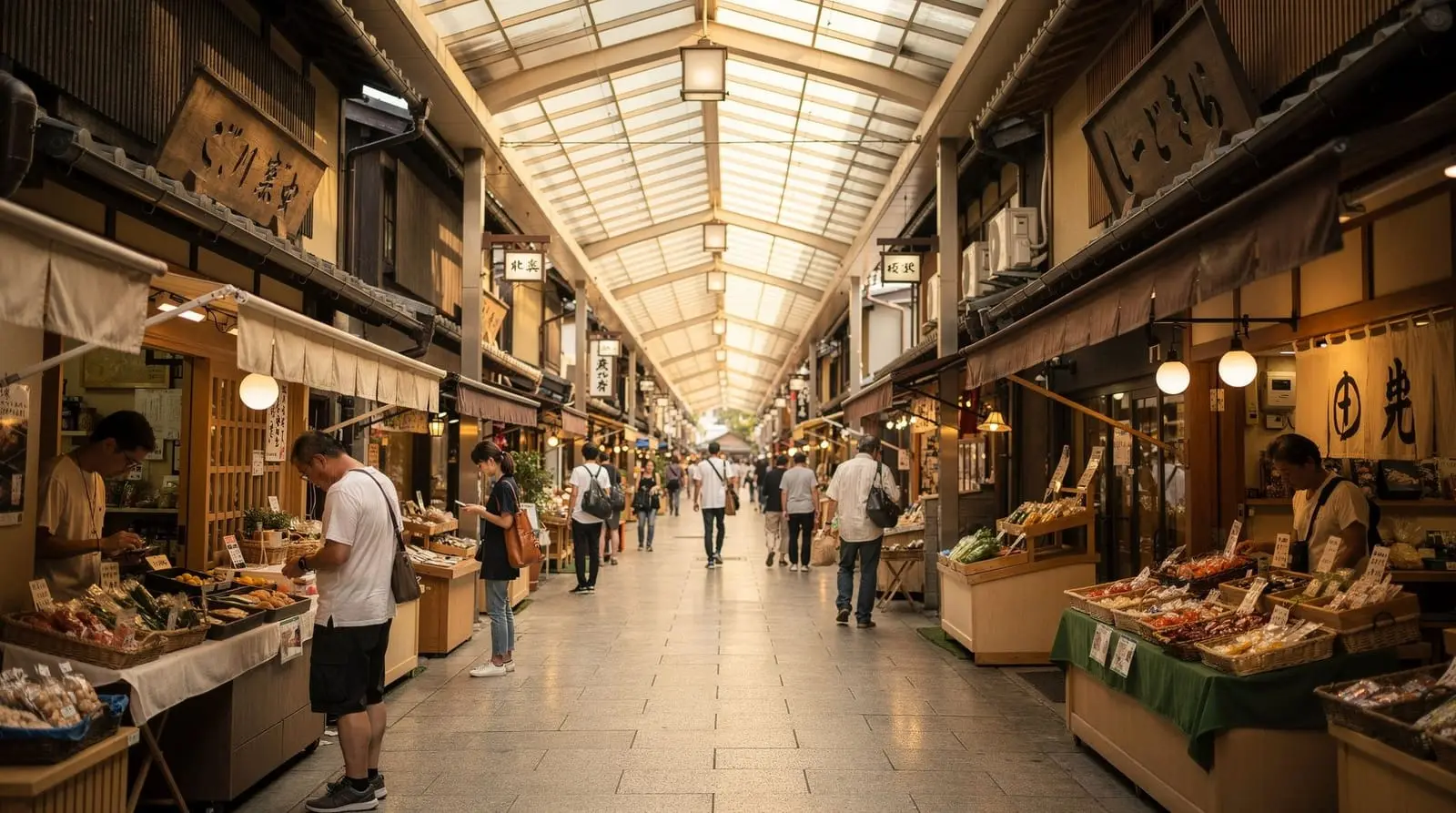
Downtown Kyoto
A practical guide to Kyoto's central shopping and dining core: Nishiki Market, Nijo Castle, Kawaramachi-dori, and the Teramachi arcades.
Kyoto: Nishiki Market Food Tour-7 Tastings
Quick facts
- Main streets
- Kawaramachi-dori, Teramachi, Shinkyogoku
- Nijo Castle admission
- ¥1,300 (grounds + Ninomaru Palace)
- Nishiki Market length
- About 400m, roughly 130 shops
- Nearest stations
- Kawaramachi (Hankyu), Sanjo/Shijo (Keihan)
Nakagyo ward: Kyoto’s working center
Downtown Kyoto sits in Nakagyo ward, roughly midway between Kyoto Station to the south and the temple districts of Higashiyama to the east. Unlike Gion or Arashiyama, it isn’t a single sight — it’s the city’s commercial core, where residents shop, eat, and commute, and where visitors end up whether or not it’s on their itinerary. The area is flat, walkable, and dense enough that most of what matters is within a 20-minute walk of the Kawaramachi-Shijo intersection. If you’re staying anywhere central, you’ll likely pass through here daily.
The district rewards loose planning more than a fixed checklist. A morning at Nishiki Market, an afternoon at Nijo Castle, and an evening wandering Teramachi or Kawaramachi-dori covers the essentials without feeling rushed. It also works well as a base: Kawaramachi and Sanjo stations put you within a 15-20 minute train or bus ride of Gion, Fushimi Inari, or Arashiyama.
Nishiki Market: Kyoto’s kitchen, with caveats
Nishiki Market (Nishiki Ichiba) is a roughly 400-meter covered arcade one block north of Shijo-dori, lined with about 130 shops selling fresh seafood, pickles (tsukemono), knives, tea, sweets, and prepared food. It has operated on this site since the Edo period, and the “Kyoto’s kitchen” nickname is accurate in the sense that many of the stalls supply local restaurants, not just tourists.
The honest caveat: by late morning the market is genuinely crowded, single-file in places, with tour groups and cruise-ship-style clusters stopping to film every stall. It is not a pleasant browsing experience at midday in high season. Arrive before 10am and it’s a different place — vendors setting up, locals doing actual grocery shopping, room to walk normally. Many stalls also close relatively early, around 6pm, so this isn’t a late-evening destination.
Individual skewers, small servings of pickles, or a piece of tamagoyaki (rolled omelette) typically run ¥200-¥500 (roughly US$1.30-$3.30 at ¥150 per dollar, though exchange rates fluctuate). Eating while walking is tolerated at most stalls but not universally — some ask you to finish in front of the shop rather than continue down the arcade, and a few have signs specifically prohibiting walk-and-eat.
If you want structure rather than guesswork, a Nishiki Market food tour with seven tastings gets you a guide who knows which stalls are worth the queue and which are aimed purely at tour groups. For a smaller-group option that goes deeper into the depachika (department store basement food halls) alongside the market itself, a Nishiki Market and depachika food tour with a local guide covers both in one outing, which is useful if you don’t otherwise plan to explore a depachika on your own.
Depachika are worth a specific mention even outside a tour. The basement floors of Takashimaya and Daimaru, both a short walk from the market, sell prepared food, bento boxes, and desserts of a quality well above typical department store fare elsewhere. They’re less crowded than Nishiki itself and a reliable option for a picnic-style dinner if you’re staying somewhere with no kitchen.
A few individual shops inside Nishiki are worth knowing by name rather than browsing blind. Aritsugu, near the eastern end of the arcade, is a knife and kitchenware maker with a history stretching back to the 16th century, originally as a swordsmith; it still hand-forges and sharpens professional-grade kitchen knives on-site and is a legitimate destination for anyone shopping for a serious souvenir rather than a trinket, though prices for a good knife run well into the tens of thousands of yen.
Konna Monja, a few doors down, is one of the more photographed stalls for its soft-serve warabimochi (a jiggly mochi-like sweet made from bracken starch), which draws a queue most of the day — expect to wait 10-20 minutes at peak times. Partway along the arcade, Nishiki Tenmangu, a small Shinto shrine dedicated to the deity of learning, sits almost incongruously between shopfronts; it’s easy to miss and takes only a couple of minutes to see, but it’s a reminder that the market grew up around an older neighborhood rather than being purpose-built for commerce.
Nijo Castle: nightingale floors and a recently reopened palace
Nijo Castle (Nijo-jo) is a UNESCO World Heritage Site built in 1603 as the Kyoto residence of the Tokugawa shoguns — a political statement of power aimed at the nearby Imperial Palace as much as a functional residence. Admission to the grounds and Ninomaru Palace is ¥1,300 (about US$8.70). The castle is roughly a 15-minute walk northwest of the Kawaramachi-Shijo area, or reachable directly by subway to Nijojo-mae Station on the Tozai Line.
The Ninomaru Palace interior is the main draw: original sliding-door paintings, and the “nightingale floors” (uguisubari), corridors built with floorboards that squeak underfoot by design, an early-Edo security measure meant to alert guards to anyone approaching, intruder or otherwise. It works — you cannot walk silently through these corridors no matter how carefully you step, and it’s one of the more tangible pieces of “living history” in the city rather than something explained only on a placard.
A detail that trips up a lot of trip planning: the Honmaru Palace, a separate inner structure within the castle grounds, underwent a long restoration and reopened to the public in autumn 2024. It requires either a modest separate admission or a combined ticket with the main grounds, depending on current signage at the gate — check on arrival rather than assuming last year’s blog post is accurate, since access and pricing here have changed recently and guidebooks lag behind.
If you’d rather have context built in rather than piece it together from placards, an Imperial Palace and Nijo Castle guided walking tour pairs the castle with the nearby Kyoto Imperial Palace grounds in a single half-day. If you specifically want a focused, shorter visit to the castle itself, a 60-minute Nijo Castle and Ninomaru Palace guided tour is a tighter option that doesn’t require a half-day commitment.
Plan for at least 90 minutes on-site if you want to see the gardens as well as the palace interior; the grounds are large and the palace alone can take 45 minutes at a slow, crowd-paced shuffle in high season.
Kawaramachi-dori and the covered arcades
Kawaramachi-dori is the main north-south commercial spine of downtown Kyoto, running roughly parallel to the Kamo River one block inland. It’s lined with department stores (Takashimaya, OPA), chain restaurants, bars, and the entrances to several covered arcades. This is where Kyoto looks least like a historic city and most like any large Japanese downtown — useful to know if your image of Kyoto is entirely temples and machiya, since this contrast is part of understanding the city rather than a disappointment to route around.
One block west, Teramachi and Shinkyogoku are two parallel covered pedestrian arcades running north-south, roofed and largely traffic-free. Teramachi (literally “temple town,” a reference to temples relocated here centuries ago) leans slightly more toward specialty shops: stationery, incense, tea, traditional crafts, alongside newer boutiques. Shinkyogoku, one street over, is more youth-oriented, with fashion chains, souvenir shops, and arcades in the modern sense too. Both are fully covered, which makes them a reasonable rainy-day fallback alongside Nijo Castle.
Teramachi is also home to Ippodo Tea’s flagship shop, near its northern end close to the Kyoto Imperial Palace grounds. Ippodo has been selling Japanese tea since the early 18th century and is one of the more reliable places in the city to buy properly stored matcha, sencha, or hojicha rather than a tourist-grade tin — the attached tea room also serves brewed tea and light sweets if you want to sit down rather than just buy and go. It’s a useful stop to pair with a Teramachi walk, and considerably calmer than the arcades further south.
Common tourist-trap patterns to know
Downtown Kyoto’s density of restaurants and bars means it also has a concentration of the city’s more aggressive touting, particularly in the narrow Kiyamachi-dori strip that runs along the canal parallel to Kawaramachi-dori. Touts stationed outside some izakaya and bars there approach passersby, especially in the evening, with offers that sound like a flat all-you-can-drink price but come with hidden seating charges, minimum orders, or a significantly worse deal once you’re seated.
This isn’t universal to every venue on the street, but it’s common enough that a general rule applies: be skeptical of anyone actively soliciting you on the street rather than a restaurant you found and walked into on your own, and confirm total pricing, including any cover charge (otoshi), before ordering.
A second recurring issue, less a scam than a planning trap, is assuming every shop and restaurant in the Teramachi and Shinkyogoku arcades keeps late hours. Many smaller, older shops close by 6 or 7pm even though the arcades themselves stay open and lit, so an evening visit aimed at shopping rather than dining can turn up more shuttered storefronts than expected. Restaurants and bars generally run later, but specialty shops for tea, incense, or crafts do not.
Getting around and a common transit mistake
The Kyoto City Bus flat fare within the central zone is ¥230 (about US$1.55) per ride, paid on boarding or exit depending on the route, with IC cards (ICOCA, Suica, and similar) accepted and generally easier than counting exact change. A frequently repeated piece of outdated advice is to buy an unlimited one-day bus pass — this pass was discontinued in 2023, and travel blogs that still reference it are simply wrong. If you’re taking more than three or four bus rides in a day, an IC card with pay-as-you-go fares is now the standard approach; there’s no current all-day bus product to buy instead.
From downtown, Kawaramachi Station (Hankyu Kyoto Line) and Sanjo/Shijo stations (Keihan Main Line) connect efficiently to Gion, Fushimi, and Osaka. Kyoto Station itself is a 15-20 minute walk south, or a short bus or taxi ride if you’re carrying luggage.
Taxis are readily available along Kawaramachi-dori and outside the major department stores, and the flat drop rate plus metered increases make short hops (say, to Gion or the edge of Higashiyama) reasonably priced for two or more people splitting the fare, though slower than transit during peak traffic hours in the early evening. Ride-hailing apps operate in Kyoto but largely dispatch the same licensed taxi fleet rather than private drivers, so pricing is broadly similar to hailing one on the street.
A realistic half-day plan
Loose planning works better than a fixed checklist here, but a rough sequence helps first-time visitors avoid backtracking across the district more than necessary.
| Time | Stop | Notes |
|---|---|---|
| 9:00am | Nishiki Market | Arrive before 10am to avoid the worst crowding |
| 10:30am | Ippodo Tea or a depachika stop | A calmer break at Takashimaya or Daimaru basement |
| 11:30am | Nijo Castle | Budget 90 minutes to two hours; go early to beat tour buses |
| 1:30pm | Lunch on Kawaramachi-dori | Chain restaurants and casual dining are plentiful here |
| 2:30pm | Teramachi and Shinkyogoku arcades | Covered, rainy-day-friendly, closes earlier for specialty shops |
| Evening | Kawaramachi-dori or Pontocho | One of the few Kyoto areas with meaningful nightlife past 8pm |
This isn’t the only order that works — Nijo Castle first and Nishiki Market for a late lunch is just as reasonable — but starting with whichever stop has the tightest crowd-timing window (Nishiki Market before 10am, Nijo Castle at opening) and leaving the arcades and evening options flexible tends to produce the smoothest day.
Where to stay if you want a central, transit-first base
Downtown Kyoto is one of the most common areas for first-time visitors to base themselves, precisely because Kawaramachi and Sanjo stations put every other major district within a 15-20 minute ride. It isn’t the most atmospheric neighborhood — modern hotels and business-hotel chains dominate over the machiya-style ryokan found in Gion or Higashiyama — but the convenience trade-off is real: less time spent on transfers means more time at the sights themselves.
If atmosphere matters more to you than convenience, our where to stay in Kyoto guide lays out the trade-offs between staying downtown, near Kyoto Station, or in a more traditional district.
Where downtown fits in a wider Kyoto trip
Downtown Kyoto isn’t a destination most people build a full day trip around, and that’s fine — it works better as connective tissue. A common pattern: temples and shrines in the morning in Higashiyama or around the Philosopher’s Path, then downtown in the afternoon for shopping, Nishiki Market, or Nijo Castle, finishing with dinner somewhere central before heading back to a hotel near Kyoto Station.
If you’re staying multiple days, it’s worth pairing a downtown afternoon with a half-day trip to Fushimi Inari in the morning, since the JR Nara Line connects Kyoto Station (itself a short hop from downtown) to Fushimi Inari in about five minutes. Downtown also works as a natural staging point for a day heading west to Arashiyama or north to Kinkaku-ji and the Kitayama area, both reachable by direct bus routes from the Kawaramachi-Shijo area without needing to backtrack through Kyoto Station first.
In the evening, many visitors continue from downtown across the river toward Gion, since the two areas are close enough to cover in a single outing. For a full sense of how downtown fits with the rest of the city, our suggested itineraries and destination overview lay out several day-by-day structures, and the travel essentials tool covers IC cards, luggage storage, and other logistics relevant to a base here. Broader context on temples, gardens, and neighborhoods across the city, including Higashiyama, is in our guides section.
Downtown Kyoto is also one of the few areas of the city where evening options extend meaningfully past 8pm — restaurants and bars along Kawaramachi-dori and the side streets toward Pontocho stay open later than most temple-district neighborhoods, which mostly shut down with the sunset.
Seasonal notes
Downtown Kyoto isn’t primarily a seasonal-scenery destination the way Arashiyama or the Philosopher’s Path are, but timing still matters here. In July, the Gion Matsuri festival’s parade route passes along Shijo-dori and Kawaramachi-dori on its main procession days (typically July 17 and 24), which means road closures, dense crowds, and food stalls set up along the main streets in the preceding evenings (yoiyama).
It’s a genuinely good time to be downtown if you’re in the city for the festival, but a difficult time to get normal shopping or a quiet Nishiki Market visit done, since the whole area shifts into festival mode. Cherry blossom season (typically late March to early April) and autumn foliage weeks (mid-to-late November) don’t affect downtown directly since there’s little seasonal scenery here, but both periods significantly increase citywide crowding, which shows up downtown as fuller trains, buses, and restaurants even though the shopping streets themselves look the same year-round.
Frequently asked questions about downtown Kyoto
Is Nishiki Market worth visiting if I’ll also see other food markets in Japan?
Yes, but time it deliberately. Nishiki’s specific value is its concentration of Kyoto-specific ingredients (yuba, Kyoto pickles, kaiseki-grade seafood) rather than generic street food, and arriving before 10am avoids the worst of the crowding that makes many visitors write it off as overrated.
How long does a Nijo Castle visit take?
Budget 90 minutes to two hours if you want to see the Ninomaru Palace interior, the newly reopened Honmaru Palace, and the gardens without rushing. A quick pass through just the palace interior can be done in 45 minutes, but the site is large enough that rushing undercuts the visit.
Is the one-day bus pass still available?
No. Kyoto discontinued the unlimited one-day city bus pass in 2023. Current advice is to use an IC card (ICOCA, Suica, or similar) and pay the ¥230 flat fare per ride, or check current City Bus signage for any newer pass product, since this is an area where policy has changed and older guides are unreliable.
Can I eat while walking through Nishiki Market?
It depends on the stall. Some tolerate it, others explicitly ask customers to finish food in front of the shop rather than continue down the arcade. Look for signage; when in doubt, step to the side rather than eating mid-walk in the busiest stretch.
Is downtown Kyoto walkable, or do I need transit?
It’s compact and flat. Nishiki Market, Kawaramachi-dori, and the Teramachi/Shinkyogoku arcades are all within a 10-minute walk of each other. Nijo Castle is about 15 minutes further on foot, or a short subway ride on the Tozai Line to Nijojo-mae Station.
What’s the best time of day to visit Nijo Castle?
Early, ideally at or near opening. Tour bus groups tend to arrive from mid-morning onward, and the Ninomaru Palace interior involves single-file movement through corridors that gets congested quickly once several groups overlap.
Is downtown Kyoto a good base for a whole trip?
It’s a reasonable choice for central location and transit access, but it’s not the most atmospheric neighborhood to stay in — it’s a commercial district, not a historic one. Many visitors prefer to stay downtown for convenience and spend their sightseeing time in Higashiyama, Gion, or Arashiyama instead.
Do I need reservations for a Nishiki Market food tour?
Guided food tours typically require advance booking since group sizes are kept small and popular time slots (especially morning departures, which avoid the worst crowds) fill up during peak travel seasons like spring and autumn.
Should I stay downtown or in a more traditional neighborhood?
It depends on your priority. Downtown wins on transit convenience — Kawaramachi and Sanjo put every other district within 15-20 minutes. A neighborhood like Gion or Higashiyama wins on atmosphere but means longer rides to reach downtown’s shopping and food. Many first-time visitors choose downtown for convenience and treat the more atmospheric districts as places to visit rather than sleep.
What’s a realistic order for seeing downtown’s main sights in one day?
Nishiki Market before 10am, Nijo Castle around midday or shortly after opening, then the Teramachi and Shinkyogoku arcades in the afternoon, finishing with dinner on Kawaramachi-dori or a walk toward Pontocho. The order can flex, but timing Nishiki Market and Nijo Castle around their respective quiet windows matters more than the overall sequence.
Top experiences
Bookable activities with verified prices and instant confirmation on GetYourGuide.

