Nara, day trip from Kyoto
Todai-ji's Great Buddha, wild deer, and Kasuga Taisha's lanterns — how to do Nara from Kyoto in a half day or a full one, with real train fares.
Nara: Todai-ji's Great Buddha & all its treasures in 2 hours
Duration: 2 hours
Quick facts
- Distance from Kyoto
- 35–45 min by train
- Cheapest fare
- ¥720 (~$4.80) JR rapid
- Fastest fare
- ¥1,160 (~$7.70) Kintetsu limited express
- Todai-ji entry
- ¥600 (~$4)
- Deer crackers
- ¥200 (~$1.30) per pack
- Founded as capital
- 710 CE
Is Nara worth a day trip from Kyoto? Yes, and it’s one of the easier ones: the fastest train gets you there in about 35 minutes, and the Great Buddha, the deer park, and Kasuga Taisha’s lantern-lined paths all sit within a 20-minute walk of each other. Todai-ji’s Daibutsuden alone justifies the trip — it’s the largest wooden building in the world by volume, built to house a 15-meter bronze Buddha cast in 752 CE.
Budget a half day if you’re efficient, a full day if you want to add Isuien Garden and the old merchant streets of Naramachi without rushing. If this is your first time weighing Nara against Kyoto’s other day-trip options, our Nara day trip planning guide and the broader first-time Kyoto guide are useful companions to this page.
Nara was the capital before Kyoto existed
It’s easy to think of Nara as a satellite of Kyoto, a pleasant afternoon detour from the “real” capital. That gets the history backwards. Nara — then called Heijō-kyō — was Japan’s first permanent capital, established in 710 CE, three-quarters of a century before Kyoto (Heian-kyō) took over the role in 794. Everything monumental you see in Nara Park was built during that 84-year window when this was the seat of imperial power, which is why the temples here feel older and heavier than Kyoto’s: Todai-ji, Kofuku-ji, and Kasuga Taisha were all founded in the 8th century, and the core of Todai-ji’s Great Buddha has survived, in some form, for nearly 1,300 years.
That head start matters for how you should plan the visit. Nara isn’t a smaller, cuter version of Kyoto — it’s a more concentrated dose of the exact same UNESCO-listed history, with less polish and, on an average weekday, noticeably fewer crowds per site than Kyoto’s big-name temples. If you’ve already done Kinkaku-ji or Fushimi Inari and want something that doesn’t feel like more of the same, Nara’s combination of scale (the Daibutsuden), atmosphere (Kasuga Taisha’s forest of lanterns), and the genuinely strange experience of free-roaming deer treated as sacred messengers gives you a different register of “old Japan” in under an hour’s travel.
Todai-ji and the Great Buddha: what ¥600 actually gets you
Todai-ji (東大寺) is the reason most people come to Nara, and it delivers. The Daibutsuden — the Great Buddha Hall — is open 7:30am to 5:30pm April through October and 8am to 5pm November through March, with last entry 30 minutes before close. Adult admission is ¥600 (~$4), which covers the hall itself; a combination ticket with the Great Buddha Hall and the museum runs a bit more if you want the additional artifacts.
Inside, the Buddha (Vairocana, cast in bronze) sits nearly 15 meters tall, with a face alone measuring almost 5 meters. The original 752 CE statue was damaged and repaired multiple times over the centuries — the head has been recast more than once — so what you’re looking at is a genuine 8th-century artifact with substantial later reconstruction, not a replica. The hall around it, the Daibutsuden, has also burned down and been rebuilt twice; the current structure dates to 1709 and is about two-thirds the size of the original, and it’s still the largest wooden building on Earth by volume. That combination — real object, rebuilt vessel — is worth knowing before you go so you’re not caught off guard by conservation plaques mid-visit.
One detail everyone photographs: a wooden pillar near the back of the hall has a hole cut through its base, roughly the size of one of the Buddha’s nostrils. Local tradition holds that squeezing through it guarantees enlightenment in the next life. Children do it easily; adults sometimes get stuck to general amusement. It’s free, it’s fast, and it’s a better souvenir than most gift shop items.
If you’d rather have someone explain the site’s history and construction phases as you walk it, this guided Todai-ji tour covers the Great Buddha and the surrounding treasures in about two hours, which is enough to understand what you’re looking at without turning the whole day into a lecture.
The deer: genuinely wild, mostly friendly, occasionally not
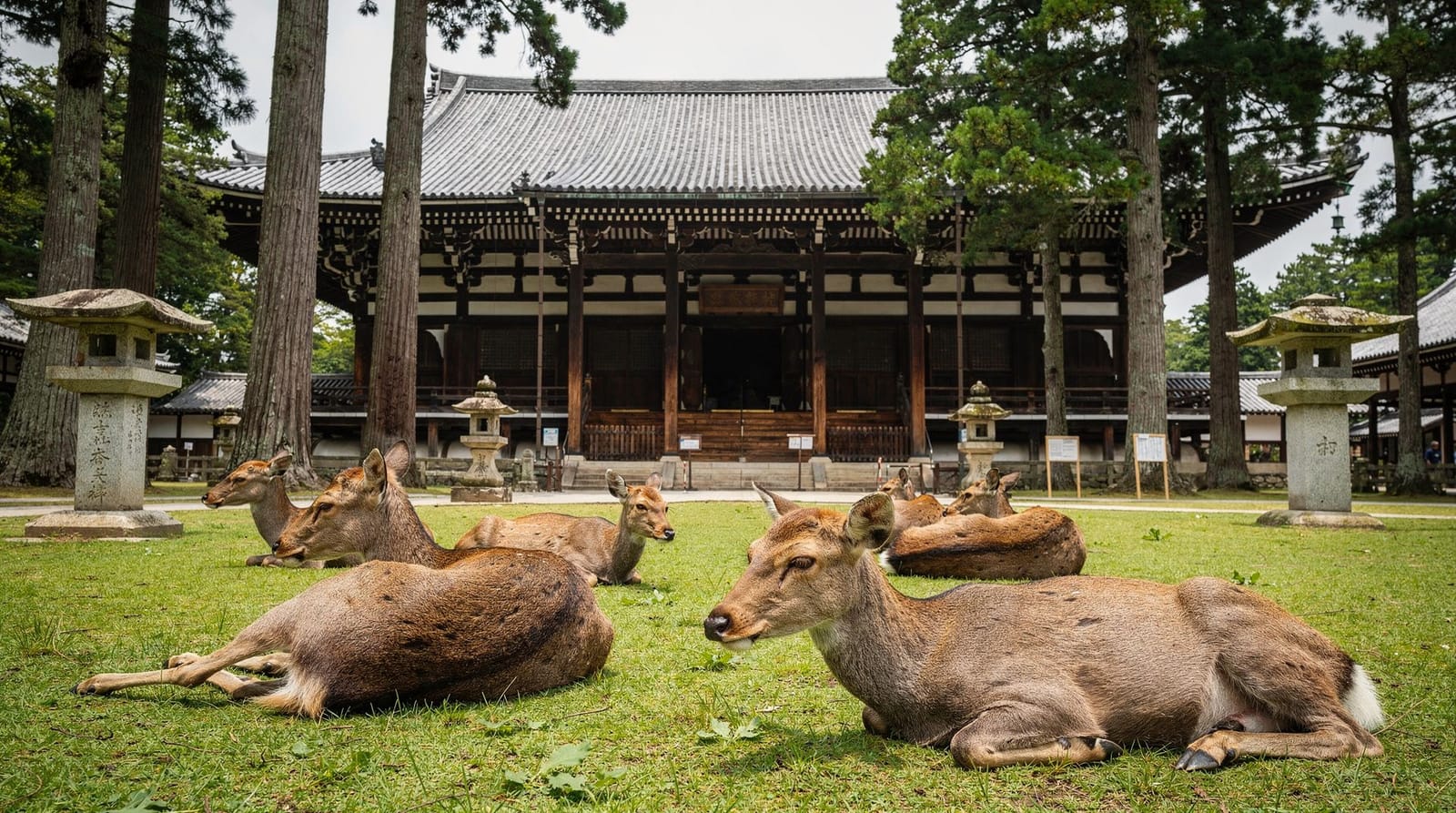
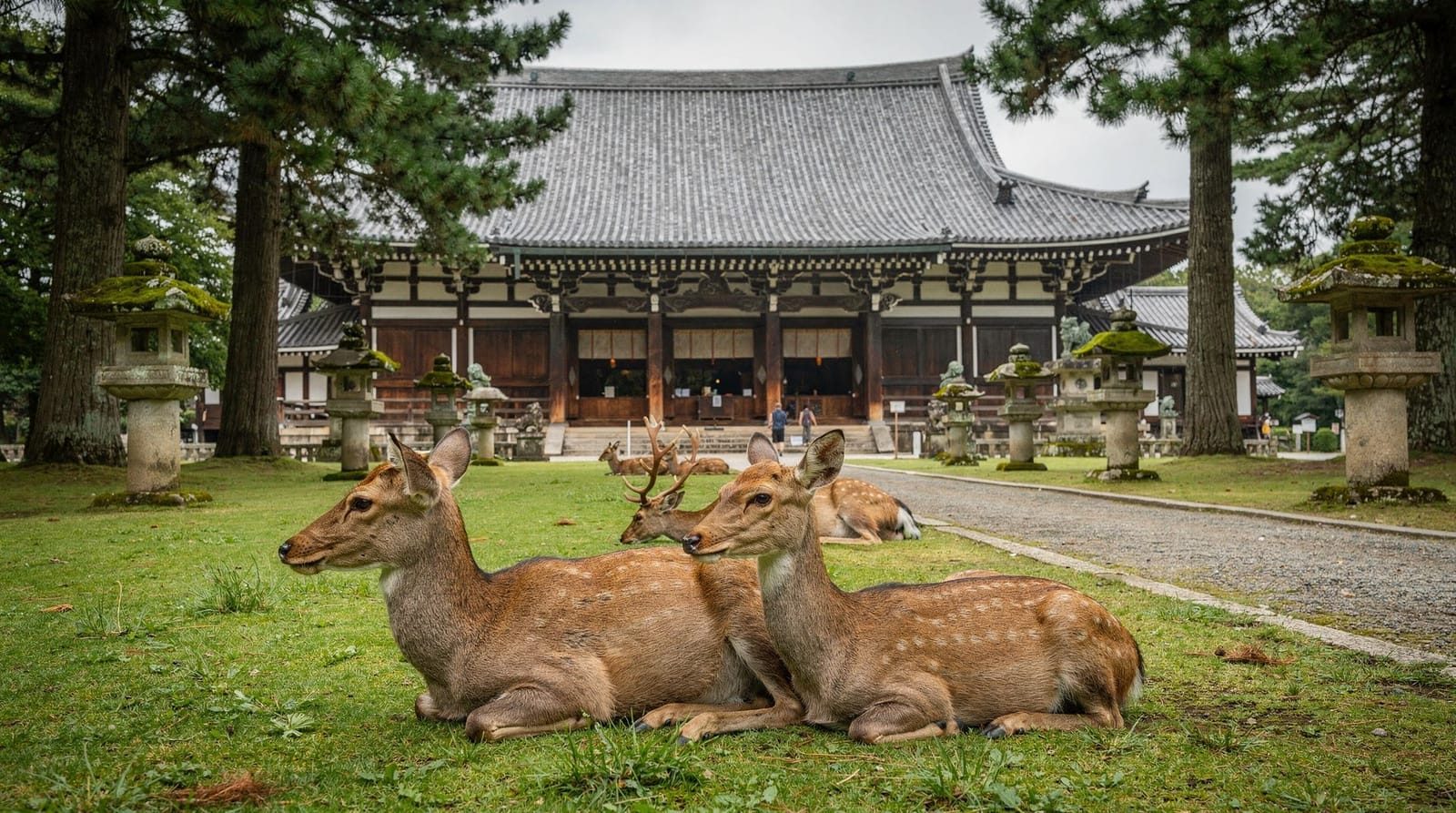
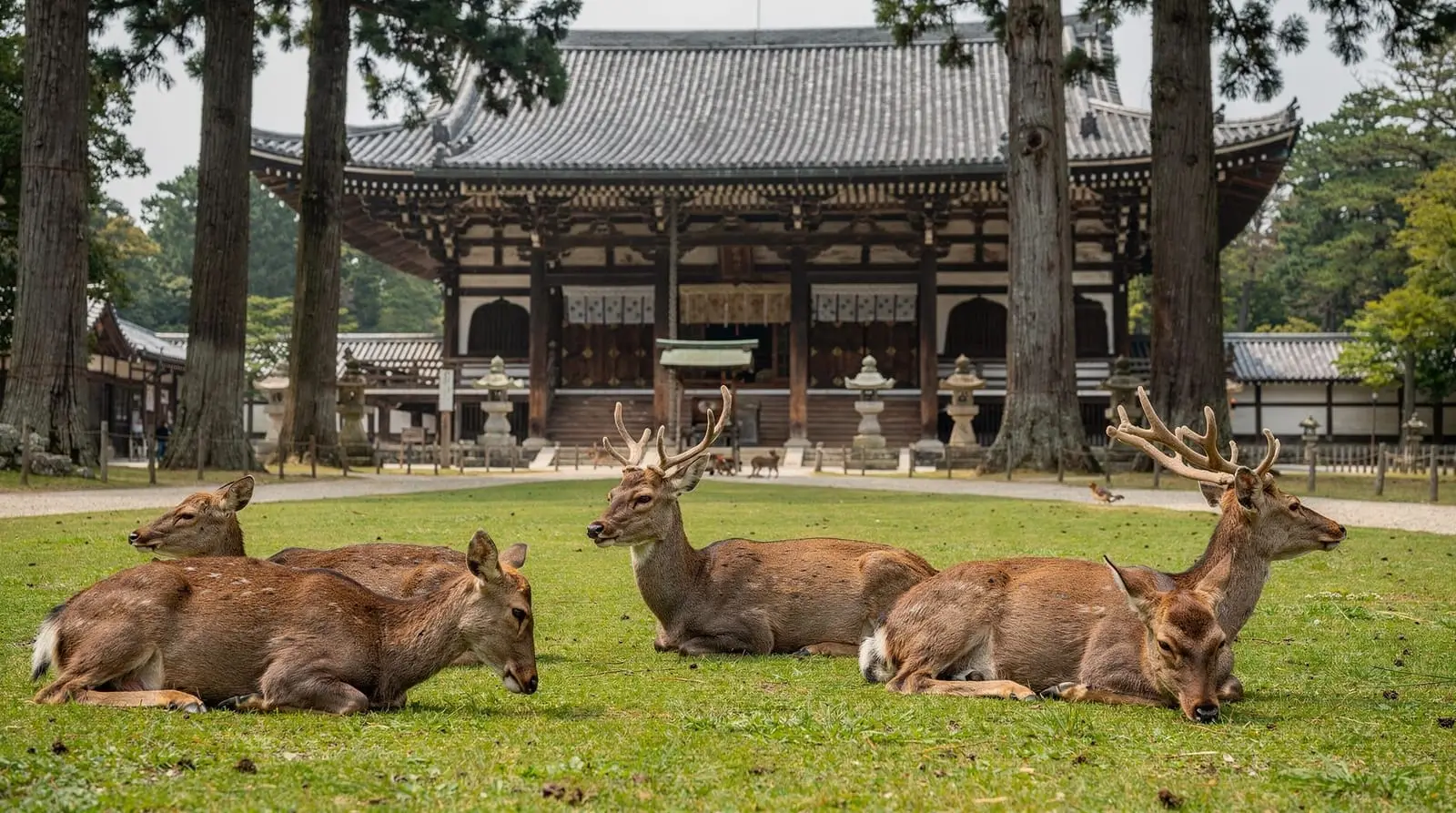
Nara Park is home to over 1,000 sika deer (nara-no-shika) that roam freely across the park grounds, in and out of temple approaches, and along the main paths. They are not fenced, not owned, and not tame in the pet sense — they’re protected as natural monuments and have been treated as sacred messengers of the gods since the Kasuga deity Takemikazuchi is said to have arrived in Nara riding a white deer. That religious status is why they’ve been left alone to breed and roam for over a thousand years, and it shows: many will approach people directly, and a good number will bow their heads before you feed them, a learned behavior specific to this population.
Shika senbei (deer crackers) are sold from stalls throughout the park for ¥200 (~$1.30) per pack of roughly 10 wafers. Feeding them is the main interaction most visitors have, and it’s genuinely charming when it goes well. It doesn’t always. These are wild animals with antlers or, in females, sharp incisors, and they’ve learned that humans mean food — which means they’ll nose at pockets, bags, and clothing, and some will nip, headbutt, or shove if they think you’re withholding a cracker or if you tease them by holding one out of reach.
The Nara municipal government publishes deer-bite injury statistics every year, and they’re not trivial: dozens to over a hundred reported minor injuries annually, mostly bites and shoves rather than anything serious, but enough that “the deer will just be adorable” is not a complete picture.
A few concrete rules make the difference. Buy the crackers, then feed them immediately and with an open flat hand rather than dangling the pack — bowing to a deer before feeding it often gets a bow in return and calms the interaction. Don’t wave a cracker to get a photo and then pull it away; that’s the single most common trigger for a nip. Don’t feed them anything other than the official senbei — regular food can make them sick and vendors do check. Be more cautious from October through December, which is rutting season: males are more aggressive and territorial during this window, and park signage specifically warns about approaching them at close range.
If a deer is persistent, walking away calmly (not running) and heading toward a busier path usually ends it. None of this should keep you away — most encounters are fine — but go in informed rather than expecting a petting zoo. It’s a good example of the wider point covered in our Kyoto-area etiquette guide: most rules here exist for practical reasons, not arbitrary tradition, and knowing them in advance makes the visit smoother.
Around the deer and temple approaches you’ll also find pushy senbei sellers and photo-op operators working the crowds, some of whom will hand you a “free” cracker or prop and then ask for payment after the fact. Buy from the marked stalls, not from someone thrusting something into your hands unsolicited.
For a more structured version of the deer-and-shrine combination, this Kasuga Taisha sacred deer shrine tour runs about 1.5 hours and covers both the animals and the shrine’s history together, which is a reasonable way to see it if you’d rather not just wing it.
Kasuga Taisha: thousands of lanterns and a forest that’s never been logged
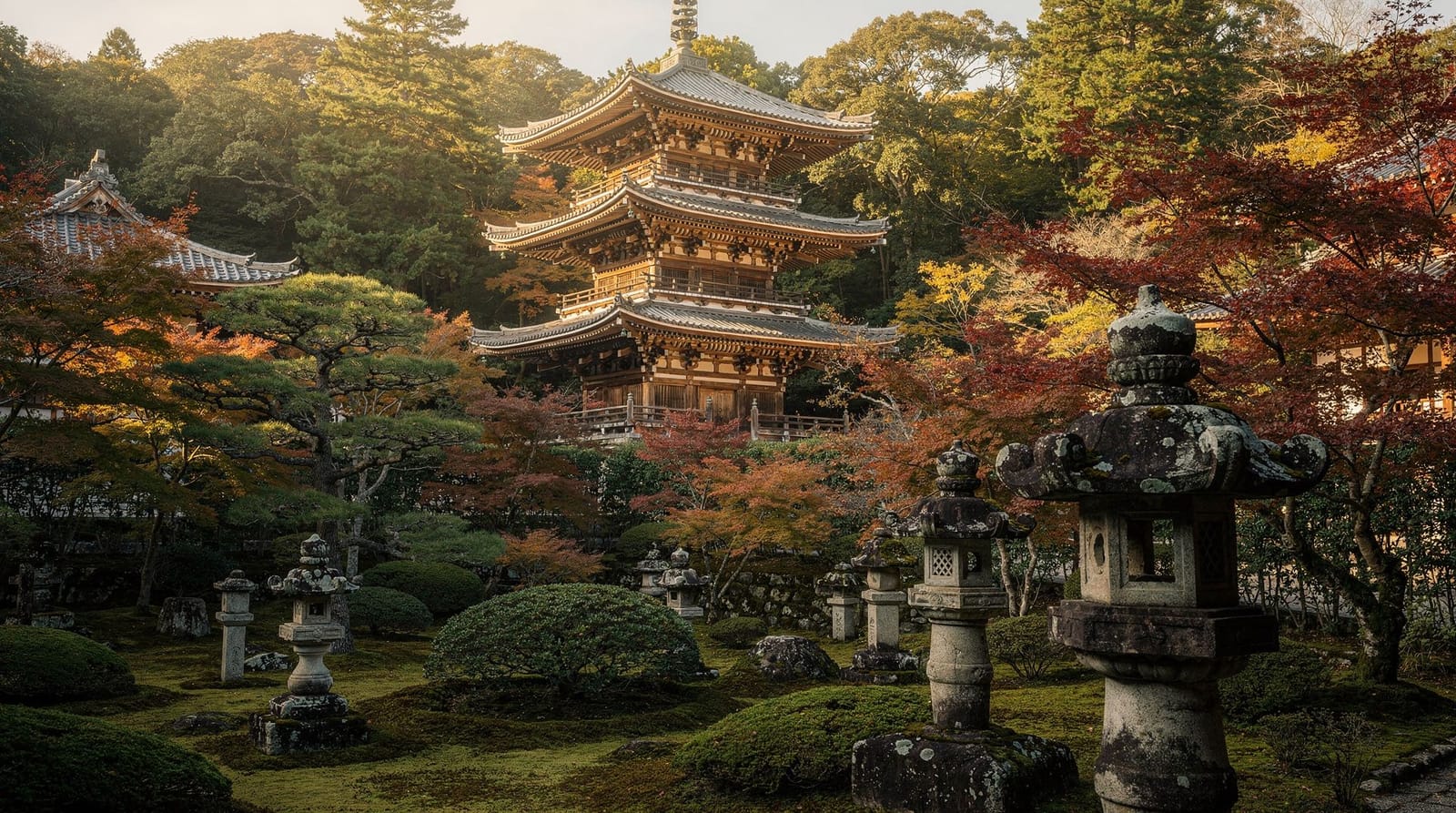
Kasuga Taisha, a short walk east from the Great Buddha through the park, is Nara’s principal Shinto shrine and one of its most photogenic. The approach paths are lined with roughly 3,000 stone lanterns donated by worshippers over the centuries, and the shrine’s inner precincts hold about 1,000 more in bronze, hung from the eaves of the vermillion-lacquered buildings. The lanterns are lit twice a year during the Setsubun Mantoro (early February) and Obon Mantoro (mid-August) festivals, when all of them are simultaneously illuminated — spectacular if your dates line up, but the site is worth visiting any time for the sheer density of lanterns and the vermillion-against-green color contrast of the buildings against the surrounding forest.
That forest matters too: the woodland behind and around Kasuga Taisha, Kasugayama Primeval Forest, has been protected from logging since the founding of the shrine in 768 CE because hunting and felling were prohibited on grounds considered sacred. It’s one of the few old-growth forests remaining this close to a major Japanese city, and it’s part of the same UNESCO World Heritage designation (“Historic Monuments of Ancient Nara”) that covers Todai-ji and Kasuga Taisha together. Basic shrine grounds access is free; the inner sanctuary area and treasure hall charge separate small admission fees if you want to go further in.
Isuien Garden: the quiet alternative when the park gets crowded
If Nara Park’s main paths feel overrun — which happens regularly on weekends and around cherry blossom and foliage season — Isuien Garden is the release valve. It’s a Meiji-era strolling garden a few minutes’ walk northwest of Todai-ji’s Nandaimon gate, split into two connected sections built in different periods, and its signature feature is “borrowed scenery” (shakkei): the garden is designed so that Todai-ji’s Nandaimon gate and the hills behind it appear framed within the garden’s own sightlines, making the temple part of the composition without you having to leave the garden grounds.
It’s small, it’s quiet relative to the park, and it rarely appears on first-time visitor itineraries, which is exactly why it’s worth the detour if you have any spare time in the day.
Kofuku-ji’s five-story pagoda
Kofuku-ji sits right at the entrance to Nara Park near the JR/Kintetsu station approach, which means most visitors walk past its five-story pagoda without stopping. It’s worth a pause: at just over 50 meters, it’s the second-tallest wooden pagoda in Japan (after Kyoto’s To-ji), originally built in 730 and rebuilt in its current form in 1426 after repeated fires.
Kofuku-ji was once one of the most powerful temples in Japan, tied to the Fujiwara clan that dominated imperial politics for centuries, and its National Treasure Museum (Kokuhokan) holds an exceptional collection of Buddhist statuary, including the famous multi-armed Ashura statue. It’s a five-minute stop on the way in or out, not a destination in itself, but skipping it entirely means missing one of Nara’s most photographed silhouettes.
Getting to Nara from Kyoto: JR vs. Kintetsu, and which one to actually take
Two railway companies connect Kyoto and Nara, and picking the right one changes both your cost and your walk at the other end.
The JR Nara Line runs rapid trains directly from Kyoto Station to JR Nara Station, taking about 45 minutes for a one-way fare of roughly ¥720 (~$4.80). If you’re holding a JR Pass or a Kansai-area JR pass, this leg is covered and effectively free, which makes it the default choice for pass holders. The catch is that JR Nara Station is a 15-20 minute walk from Nara Park and Todai-ji, so factor that into your timing.
The Kintetsu Kyoto Line runs limited express trains from Kintetsu Kyoto Station (in the same station complex as JR Kyoto Station, a short walk from the Shinkansen side) to Kintetsu Nara Station in about 35 minutes, for roughly ¥1,160 (~$7.70) including the limited express reserved-seat surcharge — regular (non-limited-express) Kintetsu trains are cheaper but slower, closer to 45 minutes. Kintetsu Nara Station drops you within a 5-minute walk of Nara Park’s entrance and considerably closer to Todai-ji and the deer, which matters if you’re doing this as a tight half day. Kintetsu is faster and more convenient at the Nara end; JR is cheaper, especially if you already have a rail pass covering it.
| JR Nara Line | Kintetsu Kyoto Line (limited express) | |
|---|---|---|
| Travel time | About 45 min | About 35 min |
| Fare | About ¥720 | About ¥1,160 (incl. surcharge) |
| Walk to Nara Park | 15-20 min | About 5 min |
| Covered by JR Pass | Yes | No |
| Best for | Rail pass holders, budget travelers | Tight half-day schedules |
Nara National Museum: skip it or not, depending on your interest
Just south of Todai-ji, the Nara National Museum houses one of Japan’s foremost collections of Buddhist art and statuary, split between an older main building and a newer wing connected by an underground passage. Most visitors bypass it entirely in favor of the temples themselves, and for a first, time-limited visit that’s a defensible call — but if Buddhist sculpture and ritual objects genuinely interest you, this is one of the better collections in the country outside Kyoto and Tokyo’s national museums, with rotating special exhibitions.
The single most notable of these is the annual Shosoin Exhibition, held for about two weeks each autumn (typically late October into early November), displaying a rotating selection from the Shosoin Repository’s 8th-century imperial treasures — items normally kept sealed away and shown nowhere else. If your visit happens to land during that window, it’s worth checking the exhibition dates before you finalize an itinerary, since it draws crowds specifically for that reason and tickets can sell out for peak days.
Mount Wakakusa: a green hill with a fire festival
Rising directly behind Todai-ji, Mount Wakakusa (Wakakusayama) is a smooth, grassy hill rather than a forested peak, and it’s open to visitors for a separate small admission fee (roughly ¥200, seasonal opening typically March through mid-December, weather dependent). Climbing to the top takes about 30-40 minutes at an easy pace and rewards you with a panoramic view back over Nara Park, Todai-ji’s roofline, and the city beyond — one of the better vantage points in the area and one most day-trippers never bother with, since it requires knowing it’s there and budgeting the extra hour.
The hill is also the site of Yamayaki, an annual controlled grass-burning festival held on the fourth Saturday of January, when the entire hillside is deliberately set alight after dark in a dramatic, centuries-old ritual with disputed origins — some accounts tie it to a historical boundary dispute between Todai-ji and Kofuku-ji, others to a purification rite. It’s a striking, very local event rather than a designed tourist spectacle, and it draws a mix of Nara residents and photographers rather than the typical day-trip crowd.
For a walkable overview of how far this fits into a broader Kyoto stay, see how many days in Kyoto — Nara is one of the day trips worth reserving a full slot for rather than squeezing into a half-day alongside other stops. If you’re weighing Nara against other rail-based day trips from the city, best day trips from Kyoto puts it in context against Uji, Himeji, and Hiroshima — and if you’re deciding between Nara and Osaka for a single free day, both are covered on their own pages.
A dedicated Kansai Thru Pass can also make sense if Nara is one of several private-rail day trips you’re planning, since it isn’t covered by the JR-only pass, or see the JR Pass guide if you’re arriving from Tokyo and deciding whether a national rail pass is worth it.
Half day or full day: what you can realistically cover
A half day (roughly 4-5 hours in Nara, door to door) is workable if you stick to the core loop: Kintetsu Nara Station, Kofuku-ji’s pagoda, into Nara Park to feed and photograph the deer, Todai-ji and the Great Buddha, then Kasuga Taisha’s lantern paths, and back. That’s a full, satisfying visit and it’s realistic to do it between roughly 9am and 2pm including a quick lunch, which leaves you back in Kyoto by mid-afternoon.
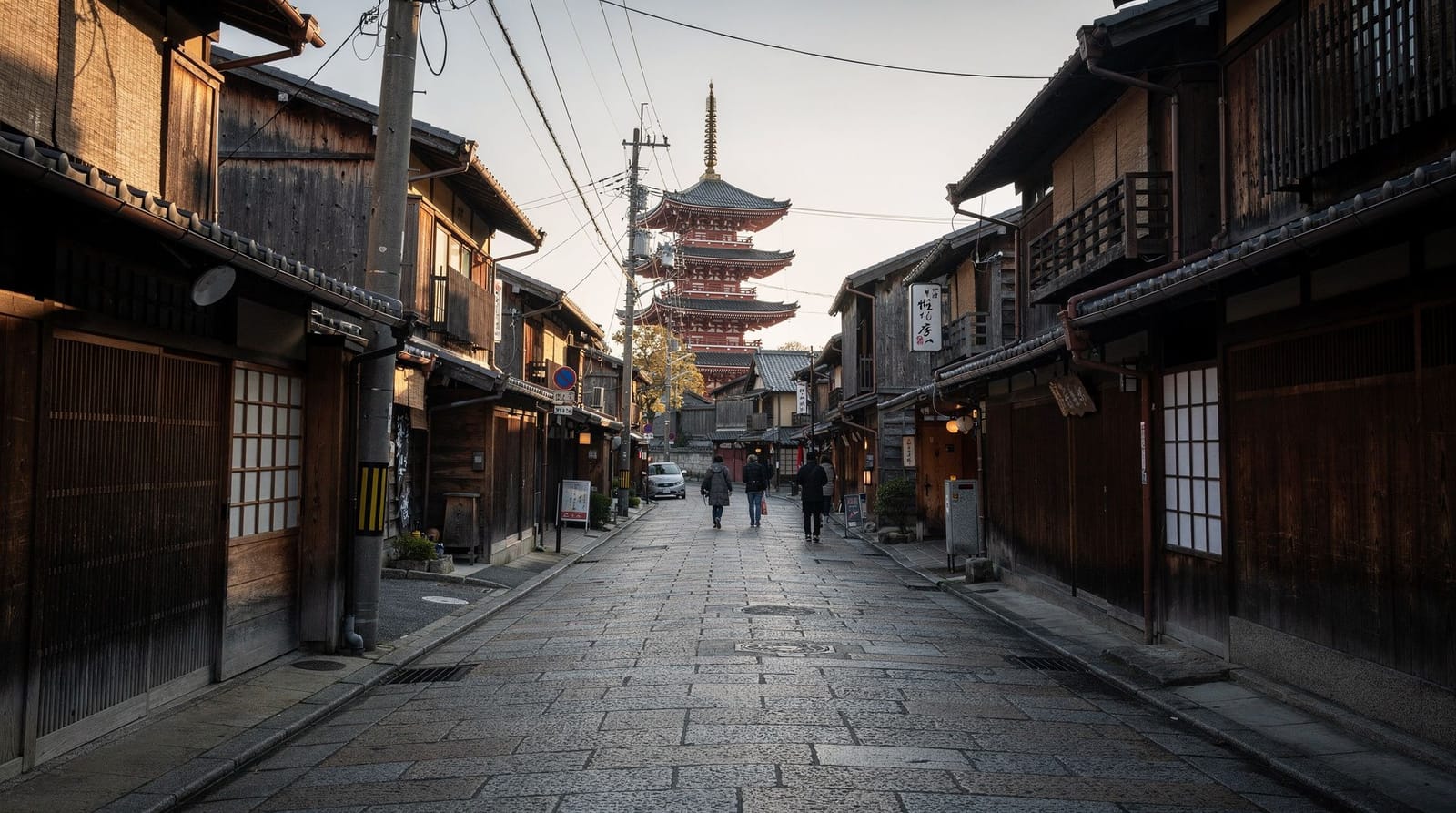
A full day adds Isuien Garden and a wander through Naramachi, the old merchant quarter south of Nara Park, a grid of Edo-period wooden townhouses (machiya) now home to small cafés, craft shops, and a few small museums in converted merchant houses. Naramachi is a good counterpart to the temple-heavy morning — quieter, more residential in feel, and a reasonable place to have lunch away from the tourist-priced options right around the park entrance.
If you want the day organized as a fixed structure rather than assembling it yourself, the Kyoto-Nara 2-day itinerary lays out a version of this alongside a Kyoto-based overnight, and this Nara heritage half-day tour is a guided option that covers the temple core if you’d rather not navigate the transit legs yourself. For families specifically, this private family bike tour with lunch included covers more ground than walking and builds in a meal stop, which helps with kids who tire of temple-hopping on foot.
If cycling appeals more broadly — Nara Park and the surrounding flat terrain suit it well — a guided bike route covering the ancient capital’s UNESCO sites is also available and tends to move faster between Todai-ji, Kasuga Taisha, and the wider park than walking does, especially useful if you’re on the half-day timeline and want to see more without rushing each stop on foot.
For travelers weighing Nara against a full second overnight versus a straightforward day trip: staying overnight in Nara itself is realistic and lets you see the park early, before the day-trip crowds from Kyoto and Osaka arrive around mid-morning, plus catch the park’s atmosphere after most visitors have left in the late afternoon. It’s a reasonable choice if Nara is a priority rather than a single stop on a broader Kansai itinerary, though most travelers based in Kyoto find a well-timed day trip sufficient given how short the journey is.
Naramachi: what’s actually there beyond “old streets”
Naramachi sits just south of Nara Park, a former merchant and townhouse district that grew up around Gango-ji temple starting in the medieval period. What survives today is a grid of narrow lanes lined with kyo-machiya-style wooden buildings — narrow street frontages opening into deeper interiors, a layout originally designed around property taxes calculated by street-facing width, the same logic behind Kyoto’s own machiya districts. Most of the buildings are 19th and early 20th century rather than truly medieval, but the district as a whole reads as genuinely old rather than reconstructed for tourism, and it’s noticeably less commercialized than equivalent districts in Kyoto like Sannenzaka.
What you’ll actually find inside: small craft shops selling Nara-specific goods like Nara-zarashi linen and Akahada-yaki pottery, several kakigori (shaved ice) specialists that draw lines in summer, cafés converted from old merchant houses with interior courtyards intact, and a scattering of small museums — the Naramachi Koshi-no-Ie is a free, restored merchant house open to walk through and gives a reasonably good sense of how a working merchant family’s home was laid out, worth the ten minutes if you’re already in the neighborhood.
Gango-ji itself, a UNESCO-listed temple within Naramachi that predates even Todai-ji in its original founding, tends to get overlooked entirely by visitors focused on the park, and its roof tiles include sections genuinely dating to the 6th and 7th centuries, some of the oldest architectural material still in situ in Japan.
Naramachi is also simply a better place to eat lunch than the streets immediately around the park entrance, where prices skew toward tour-bus turnover rather than quality. A 10-15 minute walk south from Todai-ji gets you into the district and away from that pricing.
Nara’s food identity is easy to overlook next to Kyoto’s, but a few local specialties are worth seeking out while you’re in Naramachi: kakinoha-zushi (persimmon-leaf-wrapped pressed sushi, traditionally a preservation method rather than a garnish), narazuke (vegetables pickled in sake lees, an acquired but distinctive taste), and Nara’s own sake breweries, several of which trace their history back centuries and offer small tastings. None of these require advance planning — they’re the kind of thing you stumble into walking Naramachi’s lanes rather than a destination to build a schedule around, which fits the district’s generally unhurried character.
Practical timing: crowds, weather, and when to actually go
Nara Park gets busiest on weekends and national holidays, and particularly during cherry blossom season (late March into April) and autumn foliage (mid-to-late November), when the park’s maple trees turn and domestic tourism spikes alongside the international crowds. On a weekday morning, arriving by 9:30-10am, you can walk Todai-ji’s approach and see the Great Buddha without the crowding that builds by early afternoon; the same site at 1pm on a Saturday in November is a genuinely different, much more congested experience.
General crowd-avoidance tactics that work in Kyoto proper — see avoiding crowds in Kyoto — apply just as well here: go early, go on a weekday, and treat the most photographed spot (the Great Buddha Hall) as the first stop of the day rather than the last.
Summers are hot and humid, which matters more in Nara than in Kyoto because so much of the visit happens outdoors walking between the park’s sites — bring water, and know that shaded rest areas are limited once you’re away from the main temple grounds. Winter (December-February) is quiet, cold, and arguably the best time to see Todai-ji without crowds, though some of the smaller gardens, including Isuien, are less visually rewarding without foliage or blossom.
If you’re trying to time Nara against Kyoto’s own seasonal peaks, cherry blossom season in Kyoto and autumn foliage in Kyoto cover the citywide picture; Nara Park’s blossom and foliage windows track closely with Kyoto’s, generally landing within a few days of each other given the short distance between the two cities.
Frequently asked questions about visiting Nara from Kyoto
How long does it take to get from Kyoto to Nara?
Kintetsu limited express takes about 35 minutes and costs roughly ¥1,160 ($7.70) including the surcharge; JR rapid trains take about 45 minutes and cost roughly ¥720 ($4.80). Kintetsu drops you closer to Nara Park; JR is cheaper and covered by JR passes.
Do the Nara deer actually bite people?
Yes, occasionally. They’re wild animals, not tame pets, and while most will bow politely for a cracker, some will nip, shove, or headbutt if teased with food or approached too aggressively, especially during the autumn rutting season (October-December). Nara’s city government logs dozens to over a hundred minor bite/injury reports most years. Feed them promptly with an open hand and don’t dangle crackers to provoke a reaction for photos.
How much does it cost to see the Great Buddha at Todai-ji?
Adult entry to the Daibutsuden (Great Buddha Hall) is ¥600 (~$4). The hall is open 7:30am-5:30pm April through October and 8am-5pm November through March, with last entry 30 minutes before closing.
Is Nara doable as a half-day trip, or do I need a full day?
A half day (around 4-5 hours) covers the essential loop of Kofuku-ji, the deer park, Todai-ji, and Kasuga Taisha comfortably. A full day lets you add Isuien Garden and Naramachi’s old merchant streets without rushing the temples.
Is Nara worth visiting if I’m also going to Kyoto’s temples?
Yes — Nara’s major sites predate Kyoto’s by several centuries (Nara was Japan’s capital from 710 to 794, before Kyoto took over the role), and the scale of the Daibutsuden and the atmosphere of Kasuga Taisha’s lantern paths are distinct enough from anything in Kyoto proper to justify the half-day trip.
Are the deer crackers the only food you should give the deer?
Yes. Shika senbei, sold at marked stalls for about ¥200 (~$1.30) a pack, are made specifically for the deer. Other food can make them sick, and park staff and signage ask visitors not to feed anything else.
What’s the difference between JR Nara Station and Kintetsu Nara Station?
They’re different stations run by different companies, roughly a 15-minute walk apart. Kintetsu Nara Station is much closer to Nara Park and Todai-ji (about 5 minutes on foot); JR Nara Station requires a longer 15-20 minute walk to the park entrance.
Are there tourist traps to watch for in Nara?
Some vendors near the deer park and temple entrances sell overpriced photo props or hand you “free” items before asking for payment. Buy senbei only from the clearly marked stalls, and be wary of anyone offering unsolicited photos or souvenirs near the park entrance.
Is the Nara National Museum worth visiting?
It depends on your interest in Buddhist art — the collection is one of the best in Japan outside Tokyo and Kyoto’s national museums. Most first-time, time-limited visitors skip it in favor of the temples themselves, but if your trip lines up with the annual Shosoin Exhibition each autumn, it’s worth the detour for treasures shown nowhere else.
Is Mount Wakakusa worth climbing?
Yes, if you have an extra hour — it’s a 30-40 minute climb up a grassy hill directly behind Todai-ji, and the panoramic view over Nara Park is one of the better vantage points in the area, one most day-trippers skip simply because they don’t know it’s there.
What local food should I try in Nara?
Kakinoha-zushi (persimmon-leaf-wrapped pressed sushi) and narazuke (sake-lees pickled vegetables) are both Nara specialties worth seeking out in Naramachi, along with tastings at one of the district’s historic sake breweries. None require reservations — they’re best found by wandering rather than planning ahead.
Top experiences
Bookable activities with verified prices and instant confirmation on GetYourGuide.