Arashiyama
A practical guide to Arashiyama's Bamboo Grove, Tenryu-ji temple, Iwatayama Monkey Park, and Togetsukyo Bridge, with crowd timing and real prices.
Kyoto: Arashiyama Bamboo Grove, Monkey Mountain Walking Tour
Quick facts
- Bamboo Grove
- Free, ~500m path, open-air
- Tenryu-ji garden admission
- ¥500 (+¥300 for buildings)
- Monkey Park admission
- ¥550 adults, steep 20-min climb
- Nearest stations
- JR Saga-Arashiyama, Randen Arashiyama, Hankyu Arashiyama
A riverside district built around one photograph
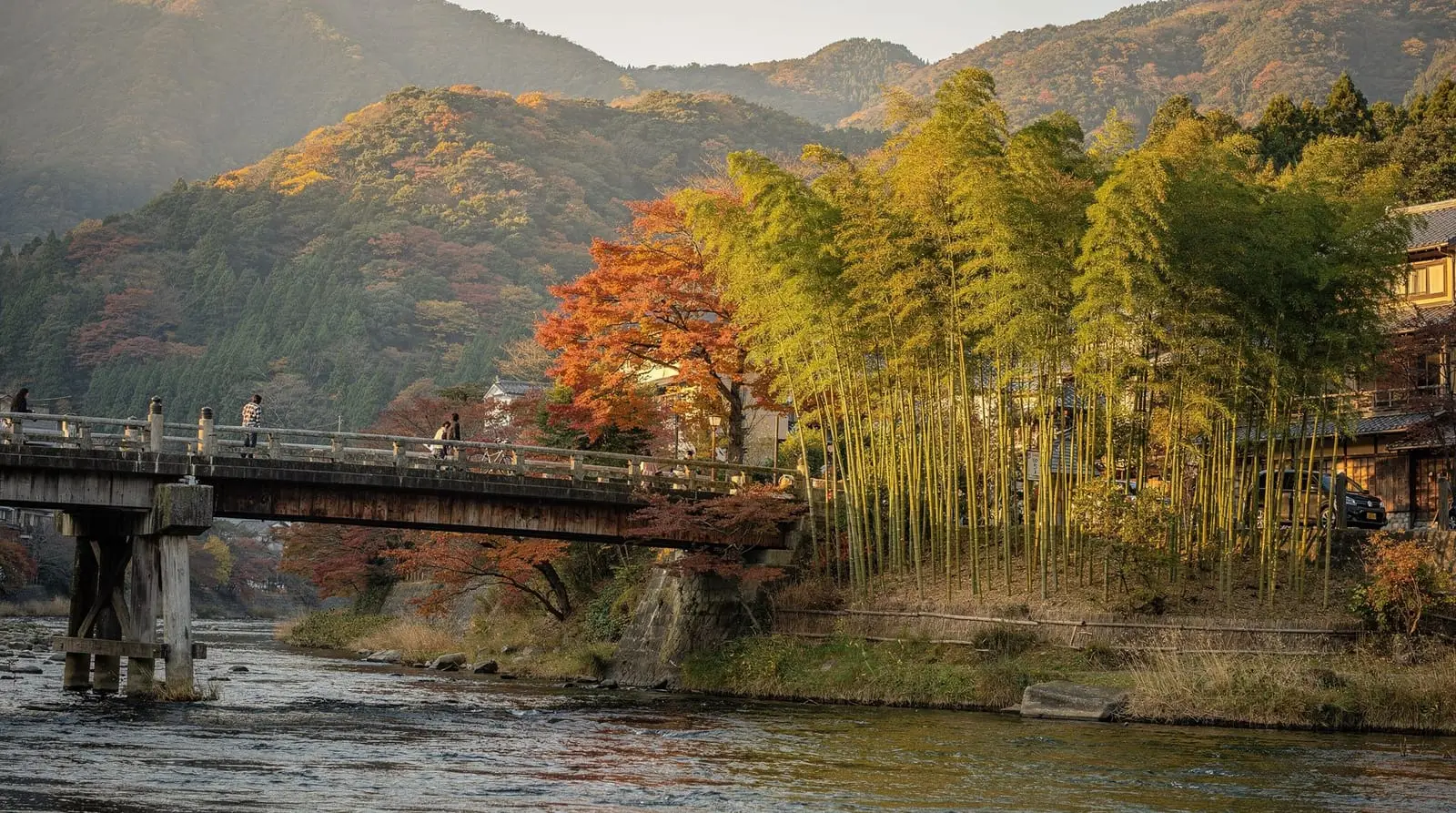
Arashiyama sits on the western edge of Kyoto, where the Katsura River (locally called the Hozu River at this stretch) cuts between wooded hills. It’s one of the most photographed districts in the city, largely because of a single image repeated across travel media: a narrow path lined with towering bamboo, sunlight cutting through in vertical bars. That image is real and it’s here, but it represents only a few hundred meters of a district that also holds a UNESCO Zen temple, a colony of wild monkeys, and a river crossing point that’s been in use for centuries. The gap between the postcard and the actual experience — particularly around crowding — is worth understanding before you plan a visit.
Arashiyama is compact enough to cover on foot. The main cluster — Bamboo Grove, Tenryu-ji, Togetsukyo Bridge, and the shopping street connecting them — fits within about a 15-minute walk end to end. Iwatayama Monkey Park adds a genuine uphill climb. If you want the quieter, more rural sights further out, they’re covered separately in our guide to Sagano, the district immediately north and west of here.
The Bamboo Grove: free, crowded, and best before 8am
The Arashiyama Bamboo Grove (Chikurin-no-Michi, “bamboo grove path”) is a roughly 500-meter walking path through dense bamboo stands, running between the Tenryu-ji north gate and the Okochi Sanso villa grounds. There’s no admission fee to walk it, and no gate — you can enter from either end at any hour.
The honest problem is crowding. By 9am on any day with decent weather, the path is a slow shuffle of people stopping every few meters for photos, and by midday in cherry blossom or autumn foliage season it can be close to a standstill in the narrowest sections. The bamboo itself doesn’t change, but the experience of walking through it does: before 8am, especially on a weekday, it’s close to empty. You can hear the stalks creak and knock against each other in the wind, which is inaudible once a crowd fills the path. If you only take one piece of practical advice from this guide, it’s to walk the Bamboo Grove at opening light rather than mid-morning.
A guided Arashiyama Bamboo Grove and Monkey Mountain walking tour times the bamboo grove visit for the early morning window and pairs it with the monkey park climb, which solves the crowd-timing problem without you needing to plan the schedule yourself. For a different pace, a Arashiyama Bamboo Forest morning bike tour covers more ground before the crowds arrive, useful if you also want to reach quieter spots toward Sagano within the same morning.
Okochi Sanso: a quieter garden villa at the grove’s far end
At the northern end of the Bamboo Grove, past where most casual visitors turn back, sits Okochi Sanso, the former private villa and garden of the silent-film-era actor Denjiro Okochi, built up gradually over roughly 30 years starting in the 1910s. Admission is ¥1,000, which includes a cup of matcha and a small seasonal sweet served at a rest house partway through the grounds — a detail that surprises visitors expecting a standard temple-style ticket. The garden itself climbs a hillside with framed views over the Arashiyama and Kitayama mountains, and because the entry fee is noticeably higher than nearby sights, it filters out much of the day-tripper foot traffic that packs the Bamboo Grove itself.
It’s not for everyone — if you’re on a tight schedule or budget, Tenryu-ji’s garden covers similar aesthetic ground for half the price. But for visitors who found the Bamboo Grove’s crowding frustrating and want a comparable garden experience without it, Okochi Sanso is the closest thing in the immediate area, and it typically takes 45 minutes to an hour to walk fully.
Tenryu-ji: a 14th-century garden still in its original form
Tenryu-ji is a UNESCO World Heritage Site and the head temple of the Rinzai Zen Tenryu-ji school, founded in 1339 by the shogun Ashikaga Takauji as a memorial to Emperor Go-Daigo. Its main draw is the Sogenchi Pond garden, designed by the priest and garden designer Muso Soseki — one of the few Japanese garden designs still standing in essentially its original layout after nearly 700 years, having survived while the temple buildings around it burned and were rebuilt multiple times.
Garden-only admission is ¥500 (about US$3.30 at ¥150 per dollar, though rates fluctuate); entering the temple’s main hall buildings costs an additional ¥300. The garden alone is enough for most visitors — it’s designed to be viewed from the veranda of the Daihojo hall as a borrowed-scenery composition, with the wooded hillside behind incorporated into the view. Tenryu-ji’s north gate opens directly onto the Bamboo Grove, so most visitors combine the two in either order. A guided Tenryu-ji temple tour covers the garden’s design history and the temple’s role in Kyoto’s Zen lineage in more depth than the posted signage does.
Budget 45 minutes to an hour for Tenryu-ji if you want to walk the full garden circuit rather than just view it from the veranda.
Iwatayama Monkey Park: a steep climb and strict rules
Iwatayama Monkey Park sits on a hillside just south of Togetsukyo Bridge and is home to roughly 120 wild Japanese macaques that roam freely across the park grounds and forested slope. Getting there is not a casual stroll: the entrance is near the bridge, but reaching the summit viewing area requires a genuinely steep 20-minute uphill walk on a dirt path, which surprises visitors who expect a short walk-in enclosure. Wear shoes you can walk uphill in, and expect to be out of breath partway up if you’re not used to hiking.
Admission is ¥550 for adults. At the top, feeding is allowed but only from inside a small enclosed hut, where visitors buy fruit or nuts and hand them to monkeys reaching through wire mesh — this arrangement exists specifically so feeding happens in a controlled, safe direction rather than monkeys approaching people directly. Staff also post clear behavioral rules: don’t make direct prolonged eye contact, and don’t smile broadly, since bared teeth read as a threat display to macaques rather than a friendly gesture. The monkeys are wild, not tame performers, and treating the park as a petting zoo is both against the rules and a real risk of a bite or scratch.
The payoff at the summit is a clear view over Kyoto to the east, plus close-range macaque viewing that most first-time visitors find worth the climb. Plan for about 90 minutes total including the walk up, time at the summit, and the walk back down.
Togetsukyo Bridge and the river
Togetsukyo Bridge (“Moon Crossing Bridge”) is the wooden-look bridge spanning the river at the base of the Arashiyama hills, and it’s the most recognizable single landmark in the district after the Bamboo Grove. It’s free to cross and open at all times. One thing that catches visitors off guard: it’s a functioning road bridge with regular car and bus traffic, not a pedestrian-only structure, so standing in the middle for photos means dodging vehicles. The better vantage points are along the riverbank on either side, particularly the south bank, where you can photograph the bridge with the wooded hillside behind it without competing with traffic.
The river below the bridge is used for traditional boat rides. The most notable is the Hozugawa river boat trip, in which boatmen pole and paddle wooden boats down roughly 16 kilometers of river rapids from Kameoka to Arashiyama, arriving at a landing point near the bridge. The full ride takes about two hours and costs roughly ¥6,000-6,500 per adult.
Most visitors reach the Kameoka starting point by riding the Sagano Scenic Railway one-way first — a separate sightseeing train covered in detail in our Sagano guide, since the railway itself runs through Sagano rather than central Arashiyama. A combined Hozugawa river boat and Sagano Romantic Train tour books both legs together, which avoids the logistics of coordinating train and boat schedules independently.
For a slower, guided alternative to walking the district yourself, a customized Arashiyama rickshaw tour through the Bamboo Forest covers the Bamboo Grove and nearby streets at a paced, narrated pace, with the route adjusted to what you want to see rather than a fixed itinerary.
Seasonal differences worth planning around
Arashiyama changes meaningfully by season in ways that go beyond the general cherry-blossom-versus-autumn-leaves advice repeated for Kyoto as a whole. Spring (late March into April) brings cherry blossoms along the riverbank near Togetsukyo Bridge and around the base of the monkey park hill, and this is consistently the single most crowded stretch of the year in the district — arriving before 7:30am during peak bloom weeks isn’t excessive caution, it’s close to necessary if you want to photograph the bridge without a continuous line of people in frame.
Autumn (early-to-mid November) brings similarly heavy crowds, concentrated especially around Tenryu-ji’s garden, where the maple color against the temple buildings draws both domestic and international visitors in comparable numbers to spring.
Summer (July-August) is hot and humid enough that the shaded Bamboo Grove path is genuinely more comfortable than the open riverside areas, and crowd levels drop somewhat compared to the two peak seasons, though not dramatically. Winter (December-February) is the quietest and, for many repeat visitors, the most rewarding time to see the Bamboo Grove and Tenryu-ji’s garden without competing for space — the bamboo stays green year-round regardless of season, so there’s no visual loss compared to warmer months, only a gain in how much room you have to yourself.
The shopping street and food between sights
The street connecting Togetsukyo Bridge to the Bamboo Grove and Tenryu-ji is lined with small shops and food stalls selling matcha soft-serve, yatsuhashi (a local cinnamon-and-red-bean sweet), and grilled snacks, priced typically ¥300-¥600 (roughly US$2-4). It’s touristy and priced accordingly, but it’s also genuinely useful as the only concentrated food option within the main sight cluster — there isn’t much in the way of sit-down dining directly between the bridge and the Bamboo Grove, so grabbing something here rather than waiting is often the practical choice if you’re on a tight schedule.
Crowding and when to actually go
Arashiyama’s core strip — Bamboo Grove, bridge, and shopping street — is consistently one of the most crowded areas in Kyoto on weekends and during the cherry blossom (early-to-mid April) and autumn foliage (mid-November) seasons. Tour buses arrive from around 9:30am, and by midday the narrow sections of the Bamboo Grove path can be genuinely unpleasant to walk through. This isn’t exaggerated travel-blog caution; it reflects how a fairly narrow physical space handles a very large number of daily visitors.
The practical fix is timing, not avoidance. Arriving by 8am gets you the Bamboo Grove, the bridge, and often Tenryu-ji’s garden before the bulk of the crowds. If you specifically want a quieter alternative to the core Arashiyama sights rather than just an earlier version of the same ones, Sagano, immediately north and west, offers similar bamboo, temple, and river scenery with a fraction of the foot traffic, even in high season.
Arashiyama core versus Sagano: which fits your pace
Visitors who found the Bamboo Grove more crowded than expected often ask whether Sagano, the quieter district just north, is simply a better version of the same trip. The honest answer is that they solve different problems rather than one replacing the other.
| Arashiyama core | Sagano | |
|---|---|---|
| Crowd level | High, especially 9am-4pm | Low to moderate year-round |
| Main draws | Bamboo Grove, Tenryu-ji, monkey park, bridge | Adashino Nenbutsu-ji, quieter bamboo path, rural temples |
| Cost | Mostly free; Tenryu-ji ¥500, monkey park ¥550 | Mostly free; small temple admissions ¥300-500 |
| Time needed | Half a day | Half a day, best combined with Arashiyama |
| Best for | First-time visitors, iconic photos | Repeat visitors, a quieter pace |
If it’s your first time in Kyoto and you want the postcard shots, start in the Arashiyama core early. If you’ve already seen the Bamboo Grove on a previous trip, or the crowding described above sounds unappealing, Sagano is the better use of your time.
A private photoshoot instead of fighting the crowd for a photo
Given how crowded the Bamboo Grove gets by mid-morning, a growing number of visitors skip trying to get a clean shot themselves and instead book a short, guided photo session timed for the early-morning quiet window. A private photoshoot in Arashiyama’s bamboo grove handles the timing, the framing, and the walk-and-talk logistics of getting a genuinely uncrowded shot, which is difficult to do reliably on your own without knowing exactly when to arrive.
Where to stay if you want the early start to actually happen
Because the single best piece of advice in this guide — arrive before 8am — depends on not fighting a long commute at dawn, where you sleep the night before matters more here than at most Kyoto districts. A handful of ryokan and small hotels sit directly in or near Arashiyama itself, which turns the “arrive before 8am” plan into a five-minute walk rather than a 30-45 minute train ride from central Kyoto.
It’s a genuinely different experience: guests staying locally can be standing in an empty Bamboo Grove at dawn while the first trains from downtown are still arriving at Saga-Arashiyama Station. The trade-off is that Arashiyama itself has fewer dining and nightlife options after dark than downtown Kyoto or Kyoto Station, so most visitors who prioritize evening options over a dawn start still choose a more central base and accept the earlier commute.
Getting to Arashiyama
Three train lines serve the district, each landing at a slightly different point: JR Saga-Arashiyama Station (JR San-in Main Line, roughly 25 minutes from Kyoto Station), Randen Arashiyama Station (the Keifuku tram line, a slower but scenic approach from central Kyoto), and Hankyu Arashiyama Station (a short walk from Togetsukyo Bridge, reached via a transfer at Katsura Station on the Hankyu Kyoto Line). Total travel time from central Kyoto runs roughly 25-45 minutes depending on the route and where you start. There’s no need to drive; parking near the core sights is limited and expensive, and the district is designed around train and foot traffic.
Planning a visit around Arashiyama
Most visitors treat Arashiyama as a half-day trip, but it pairs naturally into a full day if combined with Sagano’s quieter sights to the north, or with a stop in the Kinkaku-ji and northern Kyoto temple area if you’re comfortable with a bus or taxi transfer between the two districts.
If you’re building a broader trip, our suggested itineraries show where a half-day or full-day Arashiyama visit fits alongside downtown Kyoto and other districts, and the travel essentials tool covers IC card transit, luggage storage near the stations, and other logistics. For a wider sense of tour options across the district, our tours overview and full destination list lay out what else is nearby.
If you’re staying near Kyoto Station, a morning departure by 7am gets you to the Bamboo Grove close to opening light, which is consistently the single best-reviewed decision visitors report making about this district. Broader background on Kyoto’s temples, gardens, and seasonal timing is available in our guides section.
Frequently asked questions about visiting Arashiyama
What time should I arrive to avoid crowds at the Bamboo Grove?
Before 8am, ideally by 7:30am on weekends or during cherry blossom and autumn foliage season. The path has no gate or opening hours, so early arrival is simply a matter of getting there before tour groups and day-trippers, who typically arrive from around 9:30am onward.
Can I go inside Tenryu-ji’s Golden Pavilion-style building?
Tenryu-ji doesn’t have a gold-leafed building — that’s Kinkaku-ji, a different temple in northern Kyoto covered in our Kinkaku-ji and Kitayama guide. Tenryu-ji’s main draw is its Sogenchi Pond garden, viewable for ¥500, with an additional ¥300 to enter the temple’s main hall buildings.
Is it safe to walk close to the monkeys at Iwatayama Monkey Park?
The monkeys are wild and roam freely around the summit area, and close viewing is part of the park’s design. Feeding is restricted to inside a designated hut for safety. Staff ask visitors not to make direct prolonged eye contact or smile broadly at the monkeys, since these read as aggressive signals to macaques, and not to attempt to touch or corner them.
How long does the walk up to Iwatayama Monkey Park take?
About 20 minutes on a steep, unpaved uphill path from the entrance near Togetsukyo Bridge. It’s manageable for most fitness levels but is a real climb, not a flat walk-in, so wear appropriate shoes.
Do I need to book the Hozugawa river boat in advance?
Advance booking is strongly recommended in cherry blossom and autumn foliage seasons, when both the boat and the connecting Sagano Scenic Railway sell out. Outside peak season, same-day tickets are often available, but booking ahead removes the risk of arriving to a sold-out departure.
Is Arashiyama walkable without a guide, or is a tour worth it?
The core sights are easy to navigate independently — signage is clear and the district is compact. A guided tour adds value mainly through timing (getting you to the Bamboo Grove early) and historical context at Tenryu-ji, which isn’t well explained by on-site signage alone.
What’s the difference between Arashiyama and Sagano?
Arashiyama refers to the busier core cluster around the Bamboo Grove, Tenryu-ji, Togetsukyo Bridge, and the monkey park. Sagano is the quieter district immediately north and west, with the Sagano Scenic Railway, Adashino Nenbutsu-ji, and smaller temples that see far less foot traffic. See our Sagano guide for details.
Are there fees to simply walk around Arashiyama?
No. The Bamboo Grove, Togetsukyo Bridge, and the main shopping street are all free to walk. Fees apply only to specific sights: Tenryu-ji (¥500-800), Iwatayama Monkey Park (¥550), and paid activities like the Hozugawa river boat (roughly ¥6,000-6,500).
Is it worth staying overnight in Arashiyama itself?
Only if an empty, sunrise Bamboo Grove matters enough to trade away central Kyoto’s evening dining and nightlife options. A handful of ryokan and small hotels sit directly in the district, turning the “before 8am” advice into a short walk instead of a commute, but most visitors still prefer a more central base and accept the earlier train ride.
Can I get a good photo of the Bamboo Grove without a huge crowd behind me?
Yes, but it takes real effort: arrive before 8am, or book a guided photo session timed specifically for the quiet window, since working out the exact timing yourself is harder than it sounds once tour buses start arriving around 9:30am.
Top experiences
Bookable activities with verified prices and instant confirmation on GetYourGuide.


