Kyoto Station
What to do around Kyoto Station: Toji Temple's pagoda, Higashi Honganji, Kyoto Tower, the Railway Museum, and transit connections.
Kyoto: Nidec Kyoto Tower Observation Deck Admission Ticket
Quick facts
- Station building opened
- 1997, designed by Hiroshi Hara
- Toji Temple pagoda height
- About 55m, tallest wooden tower in Japan
- Kobo-san flea market
- 21st of every month at Toji Temple
- Fushimi Inari from here
- 2 stops on JR Nara Line, about 5 min, ¥150
More than a transfer point
Kyoto Station is where nearly every visitor to the city starts and ends their trip, whether arriving by Shinkansen, regional JR line, Kintetsu, or the Karasuma subway. It’s tempting to treat it purely as a place to pass through, but the station building itself and a handful of sights within a 15-minute walk are worth a deliberate stop rather than a rushed transfer, particularly if you have a layover of a few hours or an early/late travel day with time to fill.
The building opened in 1997, designed by architect Hiroshi Hara, and is one of the largest station complexes in Japan at 15 storeys. It houses an Isetan department store, extensive underground and ground-level shopping and dining (the Porta underground mall and The Cube retail zone), hotels, and a theater, in addition to the rail platforms themselves. Whatever you think of large modern architecture next to a historic city, it is a genuine landmark in its own right, not just a functional box.
A common first-time visitor mistake
A recurring source of confusion for first-time visitors is treating “Kyoto Station” as a single simple building the way a smaller regional station might be. In practice it functions closer to a small vertical city: platforms are spread across multiple levels connected by a mix of escalators, stairs, and a long central concourse, and the walk between, say, a Shinkansen platform and a JR Nara Line platform for Fushimi Inari can take 10 minutes on its own, longer if you’re navigating with luggage during a crowded period.
Build in more transfer time than the platform numbers alone suggest, particularly if you’re connecting from an inbound Shinkansen to an onward local or regional train with a tight gap. Signage is bilingual (Japanese and English) throughout and generally reliable, but the sheer scale of the building means it’s easy to underestimate walking time between connections.
The Great Stairs and station architecture
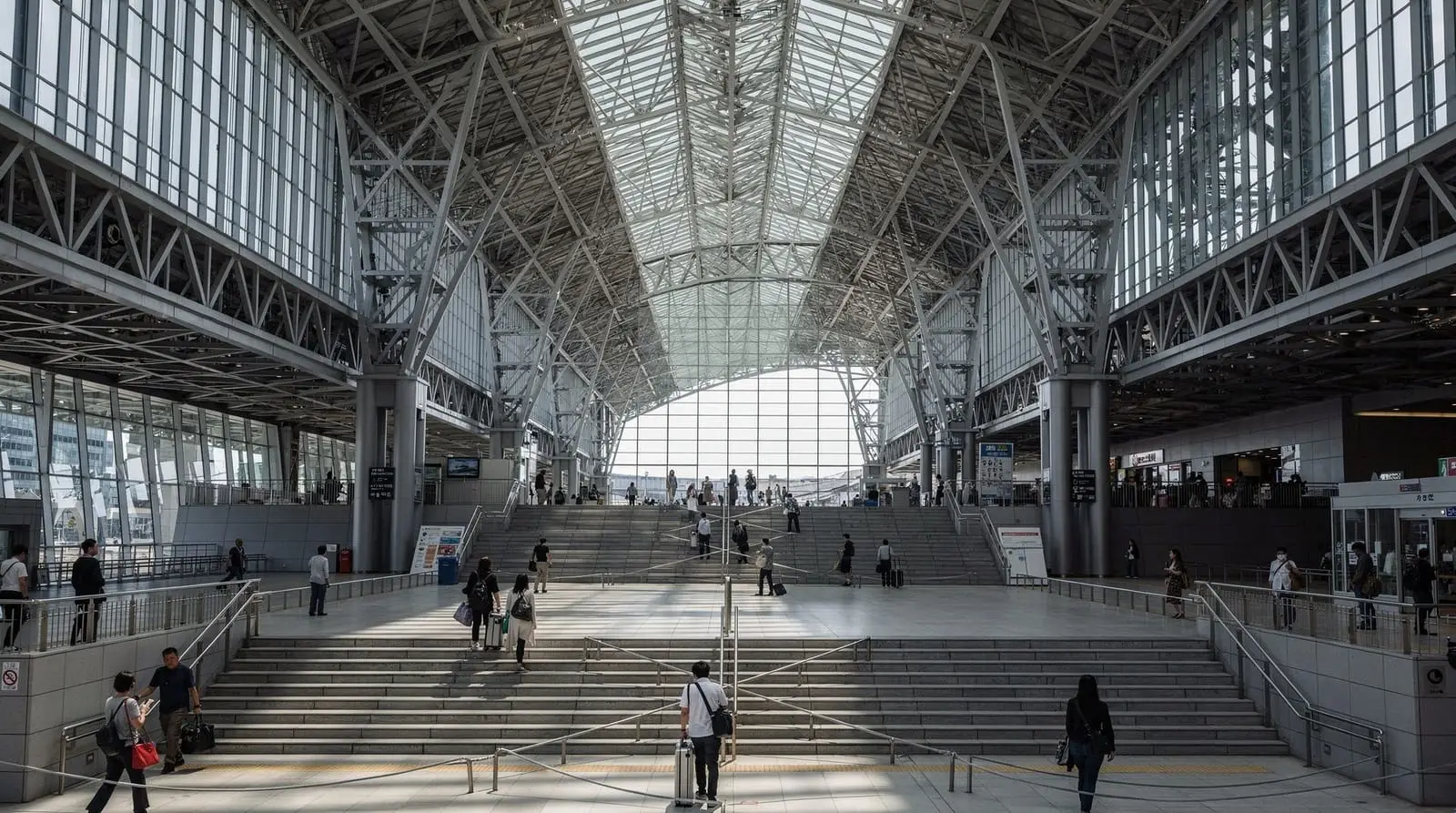
The station’s signature feature for visitors is The Great Stairs, a 171-step staircase inside the building’s atrium that climbs to a rooftop platform with a view over the city and, on clear days, the surrounding hills. It’s free, open to the public, and takes about five minutes to climb at a normal pace. In December, the stairs are illuminated as part of a light display; check current dates on arrival since the exact schedule shifts year to year.
This is one of the few genuinely free, no-reservation activities directly inside the station, and it’s worth doing even with only 20 minutes to spare between trains. The atrium itself, with its exposed steel and glass roof, is also worth a glance even if you skip the climb — it’s a deliberately dramatic space, at odds with the wood-and-tile aesthetic of most of the city’s older architecture.
Each winter, the atrium also hosts a large illuminated tree display, typically running from mid-November through the end of the year, visible from multiple floors as you climb The Great Stairs. It’s not a scheduled ticketed event and requires no planning beyond being in the station after dark, which makes it one of the easier seasonal sights to catch incidentally rather than by design.
Toji Temple: the tallest wooden tower in Japan
About a 15-minute walk south of the station, Toji Temple is a UNESCO World Heritage Site and home to Japan’s tallest wooden pagoda, at roughly 55 meters. The five-story pagoda is visible from parts of the station area and is one of the more recognizable skyline features in this part of the city. General grounds admission runs around ¥500 (about US$3.30); the pagoda’s interior is open to visitors only on limited days and seasons (typically spring and autumn special viewing periods), for an extra fee on top of the grounds ticket — don’t assume interior access is guaranteed without checking current dates.
The more distinctive reason to time a visit here, though, is Kobo-san, a flea and antiques market held on the 21st of every month on the temple grounds, marking the death day of the temple’s founding figure, Kobo Daishi (Kukai). Stalls sell antiques, pottery, kimono and textiles, plants, and food, and the crowd is a genuine mix of collectors, locals, and tourists rather than a tourist-oriented event dressed up as local color. If your dates happen to include the 21st, it’s worth rearranging a morning to be here rather than doing standard sightseeing instead.
Higashi Honganji: free, and often overlooked
A roughly 10-minute walk north of the station, Higashi Honganji is one of the largest wooden temple structures in Japan and costs nothing to enter. It doesn’t get the visitor numbers of Kyoto’s more photogenic temples, partly because it lacks a dramatic garden or hillside setting, but the scale of the main hall’s wooden construction is worth ten minutes on its own, especially if you’re waiting out time before a train and want something more substantial than the station concourse.
Eating without leaving the station
If you’d rather not walk anywhere and still want a proper meal, the station building’s 10th floor houses Kyoto Ramen Koji, a themed floor with roughly half a dozen ramen shops operating side by side, several of them outposts of well-regarded regional chains from outside Kyoto (Kyoto itself isn’t traditionally a major ramen city, so this floor deliberately imports styles from elsewhere in Japan).
It’s touristy by design, but the food is genuine rather than a food-court simulation, and it’s a reasonable option if you’re short on time between trains, typically ¥800-1,200 (about US$5.30-$8) for a bowl. Porta, the underground shopping mall beneath the station’s north side, and The Cube, on the building’s east side, both offer broader dining options including izakaya, cafes, and casual Japanese chains, generally at prices comparable to elsewhere in the city rather than an inflated station premium.
Kyoto Tower: an honest assessment
Kyoto Tower stands directly across from the station’s central exit and is the most visible non-station landmark in the immediate area. The observation deck runs roughly ¥900-1,300 (about US$6-8.70) depending on ticket type and any bundled offers. The honest take: it’s convenient, and the 360-degree view is real, but it’s not the most atmospheric vantage point in the city — the view from Toji’s grounds or from a temple on a Higashiyama hillside generally offers more context and scenery for a similar or lower cost. It’s a reasonable choice if you have limited time and want a guaranteed view without walking anywhere, or if you’re traveling with kids who’ll enjoy an elevator to the top more than a temple visit.
A Kyoto Tower observation deck admission ticket lets you skip the ticket counter, which matters more here than at most sights given the volume of station foot traffic passing by. For an evening visit specifically, a Kyoto Station and Tower night tour with light show pairs the tower with the station’s evening illumination, which is a reasonable way to use a couple of hours after dinner if you’re staying nearby.
Where the two station exits differ
Kyoto Station has two main sides, and they lead to noticeably different experiences. The Karasuma central exit, on the north side, faces Kyoto Tower and the route toward Higashi Honganji and downtown — this is the side most hotel shuttles and tour buses use, and it’s the busier, more commercial-feeling exit.
The Hachijo exit, on the south side, is quieter and more residential, closer to the Shinkansen’s western platforms and to some business hotels that are cheaper than equivalents on the north side purely because of the less central-feeling location, despite being the same walking distance from the platforms. If you’re comparing hotel listings near the station and see a meaningful price gap for similar quality, checking which exit the address is nearest to often explains it.
| Karasuma (north) exit | Hachijo (south) exit | |
|---|---|---|
| Atmosphere | Busy, commercial, tour-bus traffic | Quieter, more residential |
| Faces | Kyoto Tower, Higashi Honganji, downtown | Shinkansen western platforms |
| Hotels | Higher rates for similar quality | Often cheaper, same walking distance to platforms |
| Best for | First-time visitors, easy orientation | Early Shinkansen departures, quieter mornings |
A short walk further north from Higashi Honganji is Nishi Hongan-ji, a separate UNESCO World Heritage temple belonging to a different Buddhist sect (Jodo Shinshu, the same broad tradition, but a different head temple). It’s easy to confuse the two by name alone. Nishi Hongan-ji is also free to enter and has its own notable structures, including a Noh stage among the oldest in Japan, though it’s slightly further from the station than Higashi Honganji and less often visited on a short layover.
How much time you actually need
Not every visitor has the same window between trains, and the right plan changes a lot depending on how much time you have:
| Time available | Realistic plan |
|---|---|
| Under 30 minutes | The Great Stairs only, or a quick look at the atrium |
| 30-60 minutes | The Great Stairs plus Higashi Honganji (free, 10-min walk) |
| 1-2 hours | Add Toji Temple grounds, or the Railway Museum if traveling with kids |
| Half a day | Toji Temple plus Kobo-san market (21st only) plus a Ramen Koji lunch |
| A full day | All of the above plus a Fushimi Inari side trip via the JR Nara Line |
Kyoto Railway Museum
About a 10-minute walk west of the station, the Kyoto Railway Museum houses retired steam locomotives and Shinkansen units, a working roundhouse, and hands-on exhibits aimed squarely at families and railway enthusiasts. It’s a legitimately good option on a rainy day or with children who’ve had enough of temples, and it’s large enough to fill two to three hours. A Kyoto Railway Museum admission ticket avoids a same-day ticket queue, which can build up during school holiday periods.
Transit hub: what actually connects here
Kyoto Station is the interchange point for the JR network (Tokaido and Sanyo Shinkansen lines, plus regional JR services), the Kintetsu Kyoto Line, and the Karasuma subway line. For day-trip planning, the most useful connection for most visitors is the JR Nara Line to Inari Station, gateway to Fushimi Inari — two stops, about five minutes, ¥150 (about US$1). It’s fast enough that Fushimi Inari works as an early-morning add-on before or after a station-area visit rather than requiring its own separate day.
If you’re arriving in Japan without a local SIM already sorted, it’s worth handling connectivity before you start relying on station wifi and paper maps — a Japan and Asia eSIM roaming data plan can be set up before you land and activated the moment you’re at the station figuring out platform numbers.
The IC card system (ICOCA is the local Kansai version, though Suica and Pasmo from the Tokyo area work identically here) is worth setting up before leaving the station rather than mid-trip. Ticket machines near most gates sell and top up IC cards, and having one avoids working out exact fares for every short subway or bus hop across the rest of your stay — a genuinely large time saving over a multi-day visit, even if you’re also carrying a JR Pass for longer-distance trains.
For anyone arriving via Kansai International Airport rather than the Shinkansen, the Haruka limited express is the direct rail connection to Kyoto Station, taking roughly 75-80 minutes with an unreserved fare in the range of ¥3,000-3,600 (about US$20-24, though fares and any discount ticket schemes change periodically, so check current pricing rather than relying on an old figure). It’s generally faster and less hassle than an airport limousine bus during daytime traffic, though the bus can be more convenient if you’re traveling with a lot of luggage and want a single seat with storage directly beneath rather than navigating platform transfers.
A related mix-up worth flagging: Shin-Osaka, not Kyoto Station, is the Shinkansen stop most travelers use for Osaka itself, and the two station names get confused by first-time visitors booking tickets online. If your booking confirmation says Shin-Osaka and your hotel is in Kyoto, double-check before boarding — it’s a roughly 15-minute Shinkansen ride in the wrong direction if caught too late, though a same-day correction at the gate is usually straightforward with station staff.
Luggage and logistics
Coin lockers are available throughout the station in various sizes, but during peak travel periods — cherry blossom season in spring and foliage season in autumn especially — the larger lockers suitable for full suitcases fill up early in the day, sometimes by mid-morning. If you’re arriving with luggage and heading straight out to sightsee, it’s worth checking locker availability as soon as you arrive rather than assuming space will be available later.
An alternative used by many travelers is same-day or next-day luggage forwarding (takkyubin) via counters inside the station, which can send bags ahead to a hotel for a fee that scales with bag size and distance — useful if you’re arriving in the morning but can’t check into accommodation until the afternoon.
Getting to the rest of the city from here
Most first-time visitors use Kyoto Station as their hotel base simply because of the transit convenience, and it’s a defensible choice: downtown Kyoto is a 15-20 minute walk or short bus ride north, Gion and Higashiyama are reachable by bus routes 100 and 206 in around 15-20 minutes, and Fushimi Inari is the five-minute train ride mentioned above.
Arashiyama, on the western side of the city, and Kinkaku-ji in the Kitayama area to the north both take longer, generally 30-45 minutes by direct bus or a train-and-bus combination, so they’re better planned as their own half-day outings from the station rather than a quick add-on. The tradeoff is atmosphere — the immediate station area is modern and commercial, not the traditional streetscape many people picture when planning a Kyoto trip, so most visitors treat it as a transit and logistics base rather than the scenic centerpiece of their stay.
This tradeoff is worth weighing honestly rather than assuming “central” automatically means “best.” A hotel near the station saves time on arrival and departure days, particularly with early Shinkansen departures or late arrivals, and simplifies day trips that start from here, including Fushimi Inari and Nara.
But it means starting most sightseeing days with a 15-30 minute bus or train ride rather than stepping directly into a historic neighborhood. A common compromise is booking one or two nights near the station at the start or end of a longer trip — useful for arrival logistics or an early departure — while spending the bulk of a stay closer to Gion, Higashiyama, or downtown for easier access to evening atmosphere and shorter walks back after dinner.
For a broader sense of how a station-area stay fits into a full trip, see our suggested itineraries, which generally route day trips out from here, and the travel essentials tool for IC card setup, luggage forwarding (a genuinely useful service if you’re carrying bags between the station and later hotels), and other logistics. If you’re deciding among bookable activities before you arrive, our tours section covers options across the city, and our guides section and full destinations list cover the neighborhoods this hub connects to in more depth.
If you’re arriving on a JR Pass, our JR Pass guide explains where it does and doesn’t cover you inside the city, and the Kansai airport to Kyoto guide has the fuller Haruka-versus-bus breakdown. For first-timers deciding how to structure the arrival day, first-timer mistakes in Kyoto is worth a skim before you land.
Frequently asked questions about Kyoto Station
Is it worth stopping at Kyoto Station if I’m just changing trains?
If you have 20-30 minutes, climbing The Great Stairs is free and gives a genuine view of the city — a reasonable use of a short layover. For anything involving Toji Temple or the Railway Museum, you’ll want at least an hour beyond transit time.
What is Kobo-san and when does it happen?
Kobo-san is a monthly flea and antiques market held at Toji Temple on the 21st of every month, marking the death anniversary of the temple’s founding figure. It draws a mix of antique dealers, food stalls, and plant sellers, and is considered one of the more authentically local recurring events in the city rather than a tourist-oriented market.
Is Kyoto Tower worth the admission fee?
It’s convenient and the view is real, but it’s not considered the best vantage point in the city by most repeat visitors. If your itinerary already includes a hillside temple in Higashiyama or a visit to Toji, you’ll likely get comparable or better views there at similar or lower cost.
How do I get to Fushimi Inari from Kyoto Station?
Take the JR Nara Line two stops to Inari Station, about five minutes, ¥150 one way. This is one of the simplest and cheapest transit connections in the city and makes Fushimi Inari an easy half-day add-on.
Is Higashi Honganji worth visiting given it’s free?
Yes, particularly if you’re short on time or budget. It’s one of the largest wooden temple structures in Japan, a 10-minute walk from the station, and requires no admission fee or advance planning.
Can the pagoda at Toji Temple be entered?
Only on limited days, typically during spring and autumn special viewing periods, and for an extra fee beyond the general grounds admission. Check current dates before planning a visit around interior access, since it isn’t available year-round.
Is the Kyoto Railway Museum worth visiting without kids?
Railway enthusiasts will find it worthwhile regardless of age, given the scale of the steam locomotive and Shinkansen collection and the working roundhouse. For general visitors without a specific interest in trains, it’s a solid rainy-day option but not an essential stop.
What’s the fastest way to get downtown from the station?
Kawaramachi-dori and Nishiki Market are about a 15-20 minute walk, or a short bus or taxi ride if you’re carrying luggage. Trains via the Karasuma subway line also connect to Karasuma-Oike, a short walk from the downtown core.
Is Nishi Hongan-ji the same as Higashi Honganji?
No — they’re separate UNESCO-listed temples belonging to different branches of Jodo Shinshu Buddhism, both free to enter and both within about a 15-minute walk of the station’s north side. Higashi Honganji is closer; Nishi Hongan-ji is a little further but has one of Japan’s oldest Noh stages.
Is a hotel near Kyoto Station a good choice for a first visit?
It’s a reasonable, defensible choice for the transit convenience, especially for one or two nights bracketing a longer stay, but it trades away the atmosphere of staying inside a historic neighborhood. Many visitors compromise by basing near the station on arrival/departure days and closer to Gion or Higashiyama for the rest of the trip.
Top experiences
Bookable activities with verified prices and instant confirmation on GetYourGuide.


