Higashiyama
Kiyomizu-dera's wooden stage, the preserved lanes of Sannenzaka and Ninenzaka, and Kodai-ji's gardens — Kyoto's historic Higashiyama district in detail.
Kyoto: Kiyomizudera, Higashiyama and Yasaka Discovery Tour
Quick facts
- Kiyomizu-dera admission
- ¥500 (~US$3.30), main hall only
- Opening hours
- 6am-6pm, later during spring/autumn illuminations
- Getting there
- Bus 100/206 from Kyoto Station, ~15-20 min, ¥230 flat fare
- Quiet window
- Before 8am or after 5pm
Higashiyama is the strip of temple-covered foothills running along Kyoto’s eastern edge, anchored by Kiyomizu-dera and the sloped pedestrian lanes that lead up to it. The main hall’s wooden stage, built in 778 and rebuilt in its current form in 1633, has no nails in its structure — a fact repeated so often on tour scripts that it’s easy to miss how unusual the joinery actually is. This is also, by a wide margin, the most visited single stretch of temples in the city, which shapes almost every practical decision about when and how to go.
Kiyomizu-dera’s wooden stage and why it draws crowds
Kiyomizu-dera (清水寺) is a UNESCO World Heritage Site and one of the oldest continuously operating temple complexes in Kyoto, founded in 778 on a hillside site chosen for its spring water — the temple’s name literally means “pure water temple.” The building most people come to see is the main hall’s veranda, a wooden stage cantilevered 13 meters above the slope on a lattice of zelkova pillars assembled with traditional joinery and no metal nails, a construction method called kake-zukuri. It’s a genuinely striking piece of engineering in person, not just a postcard image, and it’s worth pausing on the stage itself rather than immediately walking past it to the next viewpoint.
Admission to the main hall and stage is ¥500 (~US$3.30) for adults, raised from ¥400 in 2023 as part of a broader round of fee increases at major Kyoto sites responding to post-pandemic visitor volumes. The temple grounds open around 6am and close around 6pm most of the year, with extended hours until roughly 9pm during the spring (early-to-mid April) and autumn (mid-November) illumination periods, when the wooded hillside and pagoda are lit and the crowd is different — thinner in the very early evening, then dense again once tour groups arrive.
Whatever time you go, budget for a genuinely crowded midday: this is consistently one of the busiest religious sites in Japan by foot traffic, and by 10am the approach street and the stage itself can be shoulder to shoulder. The 6-8am window, by contrast, is close to empty, and it’s the version of Kiyomizu-dera worth actually planning a trip around if you care about photographs or a quiet visit.
Otowa Waterfall: the three streams, one choice
At the base of the main hall, a short set of stairs leads down to Otowa-no-taki, the waterfall the temple is named for, where three separate streams fall from the hillside into a collection pool. Visitors use long-handled cups, sanitized by UV light between uses, to drink from one of the three streams — each is traditionally associated with a different benefit (commonly cited as longevity, success in studies, and a fortunate love life, though the specific pairing varies by source and era).
The relevant local custom isn’t which stream you pick; it’s that you’re only supposed to drink from one. Drinking from all three is considered greedy and is said to cancel the benefit out, which is a small but genuinely charming piece of folk etiquette worth knowing before you’re standing in line for it.
Sannenzaka and Ninenzaka: Kyoto’s best-preserved shopping lanes
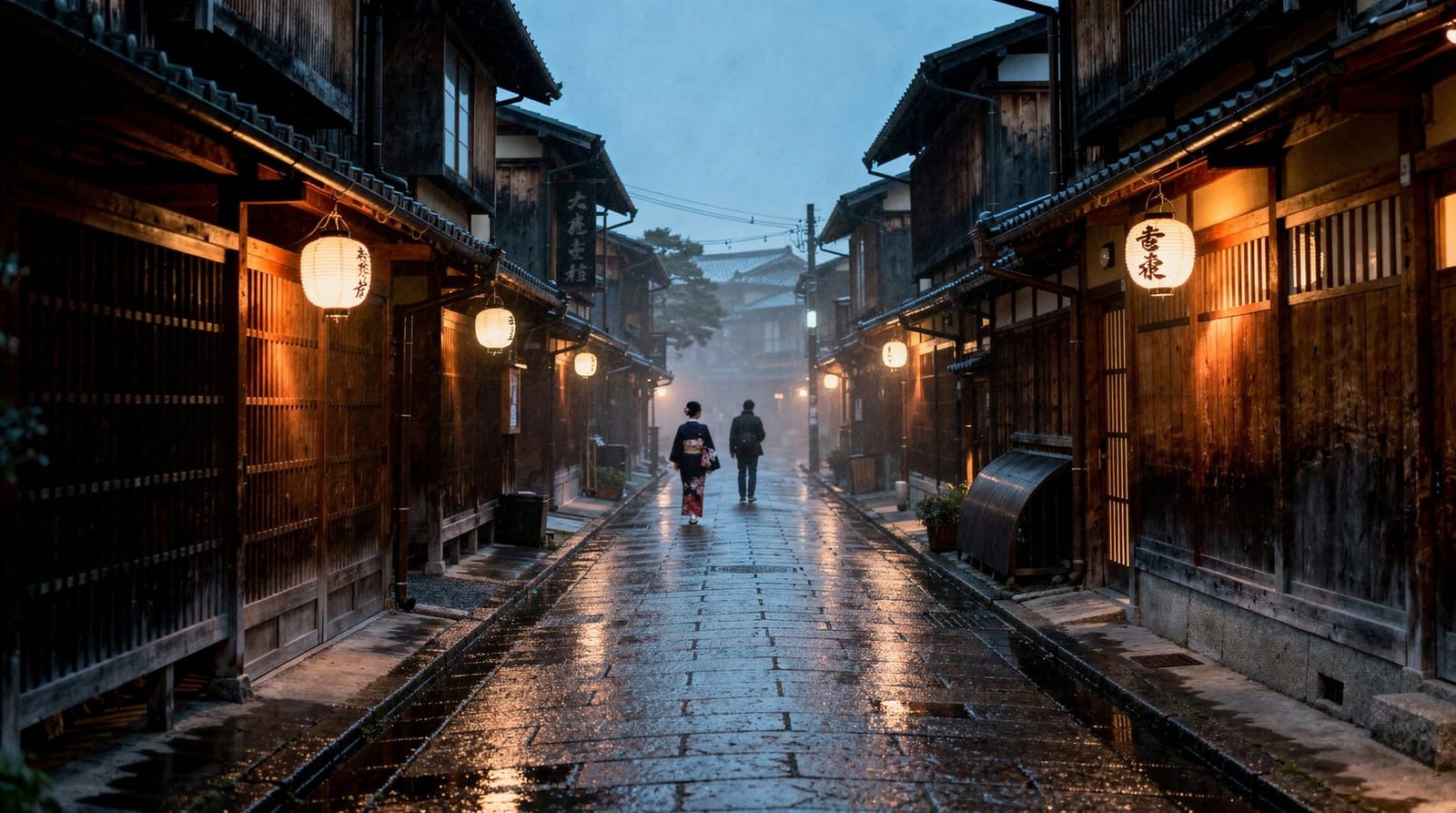
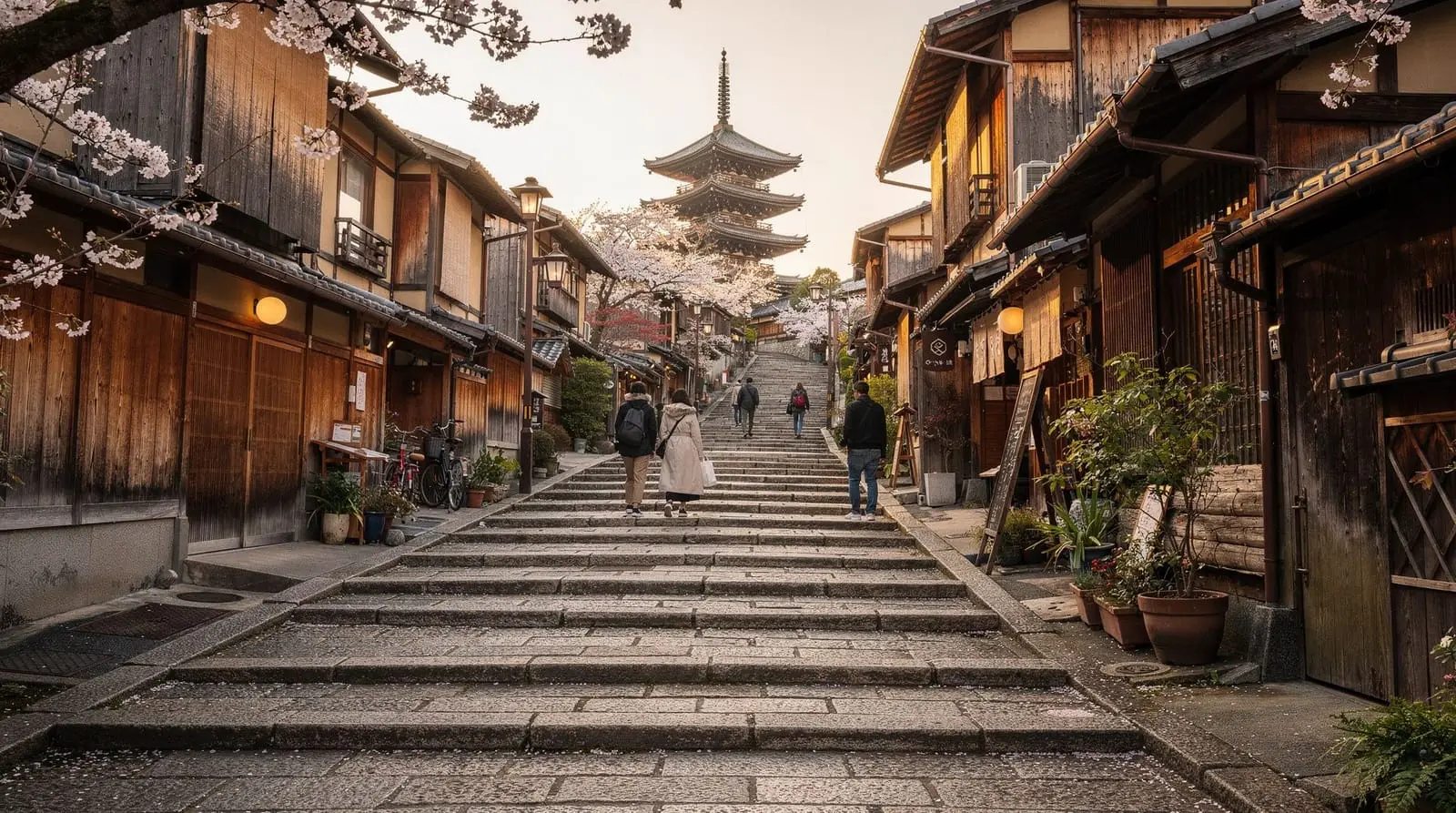
The approach to Kiyomizu-dera from the north runs through two connected, sloped, stone-paved lanes — Sannenzaka (“three-year slope”) and Ninenzaka (“two-year slope”) — lined with wooden machiya shopfronts that are largely original rather than reconstructed for tourism, which is unusual for a commercial street this central in a Japanese city. Local superstition holds that tripping on the steps of Sannenzaka brings three years of bad luck (some versions say the fall itself causes a fatal misfortune within three years), and shopkeepers along the lane still sell small gourd charms (hyotan) specifically marketed as insurance against a stumble. It’s a tourist product now, but the underlying superstition predates mass tourism by centuries.
The shops along these lanes are worth slowing down for rather than rushing past on the way to the temple. Kiyomizu-zaka, the steeper street leading directly up to the main gate, has been a center of Kiyomizu-yaki pottery production and sale for generations — look for shops selling hand-painted ceramics rather than the mass-produced souvenir versions stocked closer to the temple entrance.
Shichimiya Honpo, an Edo-period spice shop on the approach, sells custom-blended shichimi togarashi (seven-spice chili blend) and will mix a blend to your taste in front of you, which is a more interesting souvenir than most of what’s sold nearby. Partway down Ninenzaka, a Starbucks occupies a converted 100-year-old machiya townhouse with tatami-mat seating on the upper floor — it’s a genuine architectural curiosity rather than just a coffee stop, and it’s usually less crowded than the queue outside might suggest since most of the line is for takeaway.
Because this stretch feeds directly into the Yasaka Shrine and Gion area to the north, it’s easy to treat Higashiyama and Gion as one continuous walk, and for planning purposes that’s reasonable — allow at least half a day if you’re doing both properly rather than passing through.
Food along the way is worth planning for rather than grabbing whatever’s closest when you’re hungry. Kagizen Yoshifusa, a confectionery near the Gion end of the walk that has been making traditional wagashi since the Edo period, is known for kuzukiri — cold arrowroot noodles served with a small pot of brown sugar syrup for dipping — and it’s a genuinely different kind of dessert from the matcha soft serve sold every few storefronts along Ninenzaka. Yatsuhashi, Kyoto’s signature cinnamon-and-red-bean confection, is sold in dozens of variations by shops on Kiyomizu-zaka; Shogoin Yatsuhashi is one of the older, more established makers if you want a version with some history behind it rather than a generic gift-shop box.
Kodai-ji: gardens, bamboo, and quieter illuminations
Kodai-ji, a short walk north of Kiyomizu-dera toward Gion, is a Zen temple founded in 1606 by Kita-no-Mandokoro, the widow of the warlord and unifier Toyotomi Hideyoshi, as a memorial to her husband. The grounds include a rock garden attributed to the noted garden designer Kobori Enshu, a covered wooden bridge over a small pond, and a bamboo grove path that, while much smaller than Kyoto’s famous western-district bamboo grove, sees a fraction of the foot traffic.
Admission runs around ¥600 (~US$4). Kodai-ji also runs its own seasonal night illuminations in spring and autumn, timed similarly to Kiyomizu-dera’s, and while the temple itself is smaller, the crowd is consistently thinner — it’s a reasonable alternative or addition if you want the illuminated-garden experience without Kiyomizu-dera’s density.
A guided walking tour through Kiyomizu-dera, Higashiyama, and Yasaka is a practical way to cover Kiyomizu-dera, the Sannenzaka-Ninenzaka lanes, and the Yasaka Shrine approach in one structured route with a guide who can point out details — like the Otowa Waterfall etiquette or the joinery on the main hall — that are easy to miss on a self-guided walk through a crowded site.
Ishibe-koji: a two-minute detour that’s actually quiet
Tucked between Kodai-ji and Yasaka Shrine, Ishibe-koji is a short, traditionally stone-paved alley lined with a handful of ryokan and restaurants, closed to vehicle traffic and largely bypassed by the main tourist flow because it isn’t directly on the route between the big-name sites. It takes about two minutes to walk end to end and it’s worth the detour specifically because it’s quiet — there’s rarely a crowd, which after an hour on Sannenzaka is a genuine change of pace. It’s not a “sight” in the sense of having an entry fee or a plaque; it’s a reminder of what these lanes generally looked like before they became this heavily trafficked.
Getting to Higashiyama
From Kyoto Station, city buses 100 and 206 both stop near the district — get off at Gojo-zaka or Kiyomizu-michi, depending on the service, for the closest access to the Kiyomizu-dera approach. The ride takes roughly 15-20 minutes in normal traffic and costs the flat city bus fare of ¥230 regardless of distance; pay on exit, and note that buses can be standing-room only during peak sightseeing hours, especially in the 10am-2pm window. Alternatively, it’s a 20-25 minute walk from the Gion-Shijo area, which is a reasonable option if you’re already staying near downtown Kyoto and prefer to walk through the Gion streets on the way rather than deal with a crowded bus.
There’s no train station within easy walking distance of Kiyomizu-dera itself, which is the main practical constraint on this district: plan around the bus, or budget the walking time from Gion, rather than expecting a direct rail option.
When to visit, and when to actually skip the crowd
The single most useful piece of planning advice for Higashiyama is to treat “before 8am” as a real strategy, not just a suggestion. Kiyomizu-dera opens around 6am, and the temple grounds — including the main hall, the pagoda, and the view over the city — are genuinely walkable and photographable without a crowd in that early window, particularly on weekdays. By 9-10am, tour buses and group tours from hotels start arriving, and the density on the stage and along Sannenzaka builds steadily through the early afternoon before easing off after 4-5pm.
Weekends, Japanese national holidays, and the spring/autumn illumination periods are the worst combinations of crowding; a weekday morning outside those windows is the closest this district gets to calm. If your schedule only allows a midday visit, an early-morning guided route from Kiyomizu-dera into Gion is one way to guarantee the quiet version rather than hoping to beat the crowd on your own.
Etiquette, scams, and things that aren’t obvious to first-time visitors
A few practical warnings are worth stating plainly rather than assuming they’re obvious. Men dressed as Buddhist monks who approach visitors near crowded temple entrances — including outside Kiyomizu-dera — asking for cash donations in exchange for a blessing or a bead bracelet are a documented scam, not temple staff; legitimate temples do not solicit street donations this way, and the polite response is to decline and keep walking.
Separately, several kimono and yukata rental shops along the approach to Sannenzaka use aggressive street solicitation and inconsistent pricing — if you want to rent one for photos, compare a shop’s posted price list before agreeing to anything, since quoted “starting” prices sometimes exclude accessories or styling that get added at checkout.
Because Higashiyama borders Gion, tourists sometimes assume the same photography etiquette applies in both districts. It doesn’t formally apply on Higashiyama’s public streets the way it does on certain private lanes in Gion, where photographing geiko and maiko without consent on specific streets carries a ¥10,000 fine under a local ordinance — but the underlying courtesy (don’t chase, block, or photograph performers or temple staff without asking) is worth extending here too. If you’re continuing north into Gion afterward, it’s worth reading up on that district’s specific rules before you go, since the fine is real and has been enforced.
Kiyomizu-dera versus Kodai-ji, side by side
If you’re weighing whether to add Kodai-ji to a Kiyomizu-dera visit, or use it as a calmer substitute, the two sights differ enough to be worth comparing directly.
| Kiyomizu-dera | Kodai-ji | |
|---|---|---|
| Admission | ¥500 | ~¥600 |
| Crowd level | Very heavy, especially 10am-4pm | Consistently thinner, even during illuminations |
| Main draw | The wooden stage and Otowa Waterfall | Rock garden, bamboo path, pond bridge |
| Historical weight | Founded 778, major UNESCO site | Founded 1606, smaller-scale but genuine |
| Best for | First-time visitors, the signature Kyoto photo | Anyone who found Kiyomizu-dera’s crowds exhausting |
Most first-time visitors should still prioritize Kiyomizu-dera — it’s the more historically significant and more photographed of the two — but Kodai-ji is a legitimate calmer stop rather than a consolation prize, especially during the spring and autumn illumination periods when Kiyomizu-dera’s crowds peak.
Mobility and accessibility across the district
Higashiyama’s terrain is one of the more physically demanding in central Kyoto, and it’s worth planning around honestly rather than discovering it on-site. Sannenzaka and Ninenzaka are stone-stepped and slope steadily uphill, Kiyomizu-dera’s own approach and interior include further steps, and none of it is flat. Wheelchairs and strollers can manage some of the lower approach but not the full route to the main hall without assistance.
If mobility is a concern, budget extra time, consider a taxi directly to the upper approach near the temple gate rather than walking the full Sannenzaka-Ninenzaka route, and check current accessibility notes with the temple in advance — this isn’t a district where accessibility has been fully retrofitted onto centuries-old stone lanes.
Where to base yourself for an early start
Because the biggest advantage in Higashiyama is arriving before 8am, where you sleep the night before matters more here than at most Kyoto sights. Staying near Kyoto Station or in downtown Kyoto around Kawaramachi and Shijo both put you within a 15-20 minute bus or taxi ride of the Kiyomizu-dera approach, which is close enough to realistically make a 6am opening without an unreasonably early alarm. Staying directly in Gion is the other reasonable option, since it turns the walk to Kiyomizu-dera into a 20-25 minute stroll rather than a bus ride, with the added benefit of seeing Gion’s own lanes before the day’s tour groups arrive.
Where this fits in a Kyoto itinerary
Higashiyama pairs naturally with Gion as a single eastern-Kyoto walking day, and less obviously but still sensibly with a second temple district on another day — the canal-side Philosopher’s Path to the north covers a different set of temples (Ginkaku-ji, Nanzen-ji) with a noticeably different, quieter atmosphere, and makes a good contrast if Higashiyama’s crowds wear you out.
If you’re building a multi-day plan, our Kyoto itineraries lay out how to sequence eastern Kyoto against the rest of the city, and the destination guides section has more detail on individual temples and neighborhoods mentioned here. For practical logistics — IC cards, bus passes, what to pack for a day of hillside walking — the travel essentials tool is a faster reference than piecing it together from separate articles.
If you’d rather have someone else handle the route and the historical context, a walking tour led by a former history teacher covers Kiyomizu-dera and the Gion approach with more depth on the Edo-period and Meiji-period history behind what you’re looking at than a self-guided walk typically surfaces.
For something slower-paced, a tea ceremony in a traditional tea house near Kiyomizu-dera is a reasonable way to build in a rest stop between the temple and Sannenzaka, particularly if you’re visiting with kids or in hot weather. Browse the full range of options on our Kyoto tours page, or start from the destinations overview if you’re still deciding which neighborhoods to prioritize — Higashiyama is one of a handful of districts, alongside Fushimi to the south, that most first-time visitors put near the top of the list.
Frequently asked questions about Higashiyama and Kiyomizu-dera
Is Kiyomizu-dera worth the ¥500 admission?
Yes for the main hall and stage, which is the part most visitors mean when they picture the temple; the surrounding grounds, approach lanes, and Otowa Waterfall are free to walk through without paying the main hall fee at all, so you can see a substantial portion of the site for nothing if you’re budget-constrained.
How long does a visit to Higashiyama take?
Kiyomizu-dera alone takes about 60-90 minutes at an unhurried pace, including the stage and Otowa Waterfall. Add Sannenzaka, Ninenzaka, and Kodai-ji and a full loop runs 3-4 hours; most visitors treat Higashiyama as a half-day outing, often combined with Gion.
Is Higashiyama crowded year-round, or just in peak season?
It’s busy most days, but the degree varies sharply by time of day rather than just season. Cherry blossom season (late March-early April) and autumn foliage (mid-to-late November) are the worst overall, but even a random Tuesday in July gets crowded by mid-morning; the 6-8am window is reliably quieter regardless of season.
Can I wear a rented kimono to Kiyomizu-dera?
Yes, and it’s a common sight on Sannenzaka; several rental shops operate in the area. Compare posted prices before booking, since some shops advertise a low base rate that doesn’t include hair styling or accessories, and confirm the return time and location, since return-by-evening policies vary by shop.
Is there wheelchair or stroller access to Kiyomizu-dera?
Partial. The main approach streets are steep and stone-paved, which is difficult for wheelchairs and strollers, and the main hall itself has some steps. The temple has made incremental accessibility improvements, but this is not an easy site to navigate with mobility equipment; contacting the temple in advance or budgeting extra time and assistance is realistic planning rather than a formality.
What’s the difference between visiting Kiyomizu-dera and Kodai-ji?
Kiyomizu-dera is larger, older, more architecturally significant, and far more crowded. Kodai-ji is smaller, quieter, has a notable garden and bamboo path, and its night illuminations tend to be less jammed than Kiyomizu-dera’s. If you only have time for one and crowding matters to you, Kodai-ji is the calmer choice; if historical significance matters more, Kiyomizu-dera is the obvious pick.
Are the “monks” asking for donations near the temple legitimate?
No. This is a known scam in Kyoto and elsewhere in Japan — men in monk-like robes approaching tourists near busy sites to solicit cash “donations” are not temple staff. Kiyomizu-dera and other major temples do not solicit money this way on the street; it’s fine to decline and walk on.
Is Sannenzaka closed to cars?
Yes, it’s a pedestrian lane, along with Ninenzaka. Both are stone-stepped and can be slippery when wet, which matters if you’re visiting during Kyoto’s rainy season in June or after snow in winter.
Should I visit Kiyomizu-dera or Kodai-ji if I only have time for one?
Kiyomizu-dera for historical significance and the wooden stage; Kodai-ji if crowding matters more to you than seeing the district’s single most famous sight. Kodai-ji is smaller but consistently quieter, even during its own seasonal illuminations.
Is Higashiyama manageable with a stroller or wheelchair?
Only partially. The lower approach streets can be managed with assistance, but Sannenzaka, Ninenzaka, and the temple’s own steps are not stroller- or wheelchair-friendly without help. Budgeting extra time and considering a taxi to the upper approach is more realistic than expecting a flat route.
Top experiences
Bookable activities with verified prices and instant confirmation on GetYourGuide.