Kiyomizu-dera guide — the wooden stage, Otowa waterfall & illuminations
Kyoto: Kiyomizudera, Higashiyama and Yasaka Discovery Tour
How much does it cost to visit Kiyomizu-dera and what are the hours?
Main hall admission is ¥500 (about US$3.30). The temple opens at 6am and closes at 6pm most of the year, with extended hours until around 9pm during the spring (late March-early April) and autumn (mid-November) illumination periods, when a separate evening ticket is sold at the gate.
A wooden stage built without a single nail
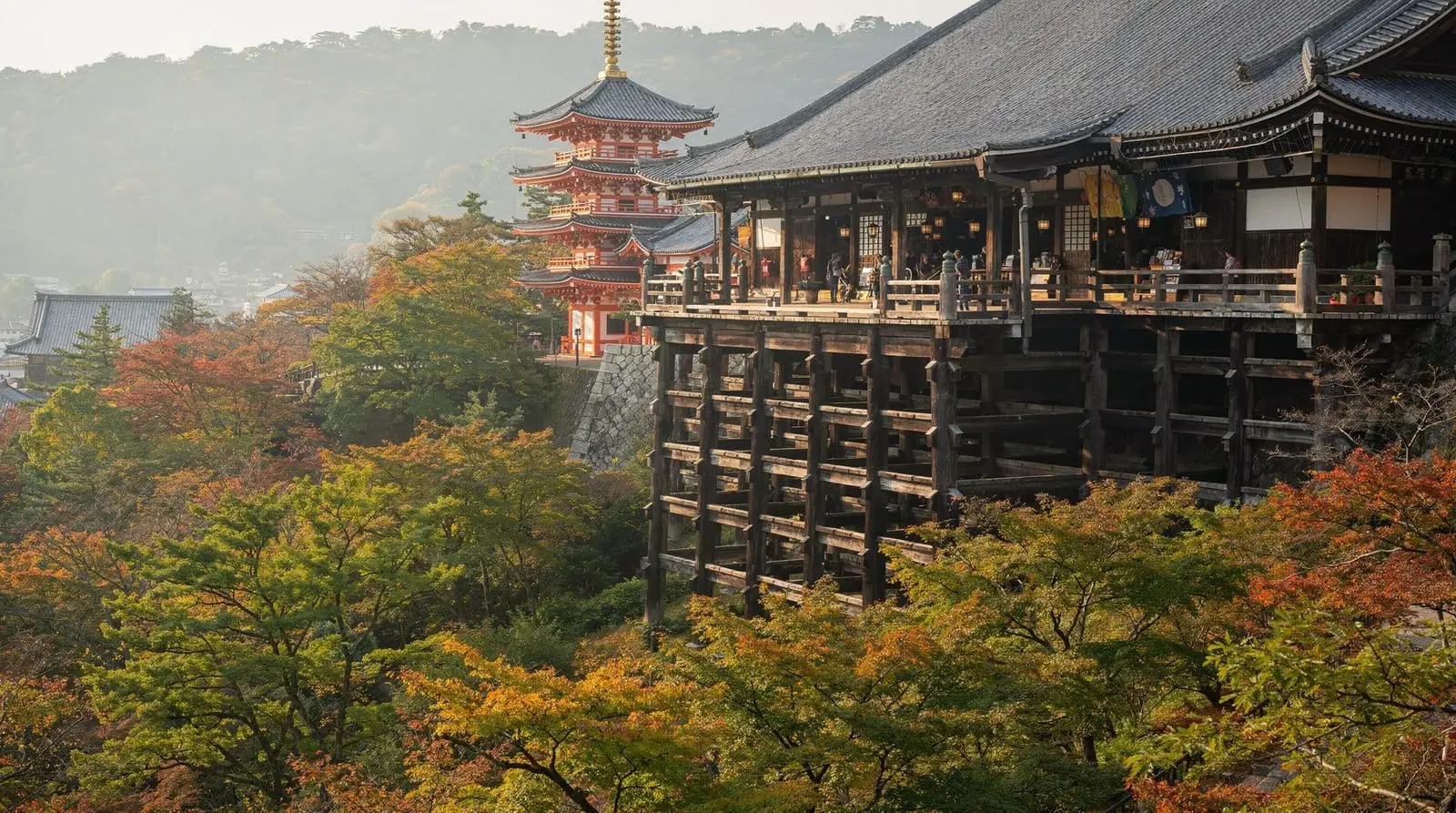
Kiyomizu-dera is the temple most people picture when they picture Kyoto: a wooden stage jutting out over a wooded hillside in Higashiyama, framed by cherry blossoms in spring and maples in autumn. It’s also, by most counts, the single most visited temple in the city, which means the practical questions — when to go, what it costs, how to skip the worst of the crowd — matter more here than almost anywhere else on this list.
The temple was founded in 778, though the buildings standing today date mostly from a 1633 reconstruction ordered by the shogun Tokugawa Iemitsu, after the earlier structures burned down (as they had several times before). The main hall’s stage is the part everyone comes for: a 13-meter-high wooden platform built using kigumi joinery, a technique that interlocks cypress beams without a single nail. UNESCO listed the temple complex as a World Heritage Site in 1994 as part of the Historic Monuments of Ancient Kyoto.
| Admission | ¥500 (main hall + stage) |
| Hours | 6am-6pm daily, later during illuminations |
| Time needed | 1-2 hours with the approach lanes |
| Getting there | Bus 100/206 from Kyoto Station, 15-20 min |
| Best time | Right at 6am opening |
Admission, hours, and the illumination exception
Main hall admission — which includes the stage — is ¥500 (about US$3.30), payable in cash or by IC card at the entrance gate. Jishu-jinja, the small matchmaking shrine tucked behind the main hall, doesn’t charge separately.
Standard hours run 6am to 6pm year-round, which is unusually early for a major Kyoto temple — most open at 8:30 or 9am. That early opening is one of the best tools for avoiding crowds here, since the grounds are still close to empty in the first hour.
During two seasonal windows — cherry blossom season in late March/early April, and peak autumn foliage in mid-November — the temple extends hours into the evening, typically until around 9pm, with a separate evening admission ticket sold at the gate (daytime tickets don’t carry over). These illumination nights light the stage and the valley below in colored floodlights, and they’re genuinely striking, but they also draw the year’s largest crowds. If you go, expect a slow shuffle up the approach lanes rather than a relaxed walk.
Early-morning Kiyomizu-dera to Gion historical tourThe Otowa waterfall: pick one stream, not three
Below the main stage, a set of stairs leads down to the Otowa-no-taki waterfall, which gives the temple its name (kiyomizu means “pure water”). Three separate streams fall from the hillside into a collection pool, and visitors use long-handled cups — sterilized with UV light between uses — to drink from one of them.
Local tradition assigns each stream a different blessing: longevity, academic success, and love. Drinking from all three is considered greedy and is discouraged by tradition (and occasionally by staff). Pick one. The queue for the waterfall moves quickly except during illumination nights, when it can back up 15-20 minutes.
Jishu-jinja: the matchmaking shrine behind the main hall
Jishu-jinja is a Shinto shrine sharing the same hillside as Kiyomizu-dera, dedicated to Okuninushi, a deity associated with love and good matches. It’s a separate religious site from the Buddhist temple around it, which is a common arrangement at older Japanese religious complexes where Shinto and Buddhist practice developed side by side for centuries.
The shrine’s best-known feature is a pair of “love stones” set about 18 meters apart. Tradition holds that if you walk from one to the other with your eyes closed, without veering off course, your romantic wish will come true — a friend calling out directions to you is allowed and doesn’t count as cheating. Entry to Jishu-jinja is free and doesn’t require a separate ticket from the main temple.
Getting there: bus, on foot, or taxi
Kiyomizu-dera sits on a hillside with no train station directly beneath it, so most visitors arrive by bus or on foot from a nearby stop. From Kyoto Station’s bus terminal, take city bus 100 or 206 to the Gojo-zaka or Kiyomizu-michi stop — 15-20 minutes, flat fare ¥230 with an IC card or exact cash. From either stop, it’s a 10-15 minute uphill walk through the Sannenzaka and Ninenzaka pedestrian lanes, lined with shops selling matcha sweets, pickles, and ceramics.
A taxi from Kyoto Station costs roughly ¥1,500-2,000 and takes about the same time once you account for the walk up from where cars are allowed to stop — the final stretch to the temple gate is pedestrian-only. If you’re coming from Gion, it’s a 20-25 minute walk uphill along Higashiyama’s connected temple lanes; see the Higashiyama destination guide for the full route.
Avoiding the crowds: timing matters more than the season
Kiyomizu-dera’s stage gets genuinely crowded from around 9:30am through late afternoon, every day of the week, in every season except the depths of winter. Tour buses from Osaka and Nara typically arrive mid-morning, which is also when the Sannenzaka and Ninenzaka lanes below the temple fill in.
The 6am opening is the single best lever available. Arriving at or shortly after opening gets you the stage with a fraction of the daytime crowd, better light for photos, and a genuinely different experience of the same building. The trade-off is obvious — an early start and no breakfast at your hotel — but it’s the one change most likely to make the visit feel worthwhile rather than crowded.
Kiyomizu-dera and Gion walking tour with a history teacherThe illumination evenings are the opposite trade: beautiful lighting, maximum crowd. If you want the night version, go on a weekday rather than a weekend, and expect the approach lanes to be genuinely packed rather than merely busy.
Combining Kiyomizu-dera with the rest of Higashiyama
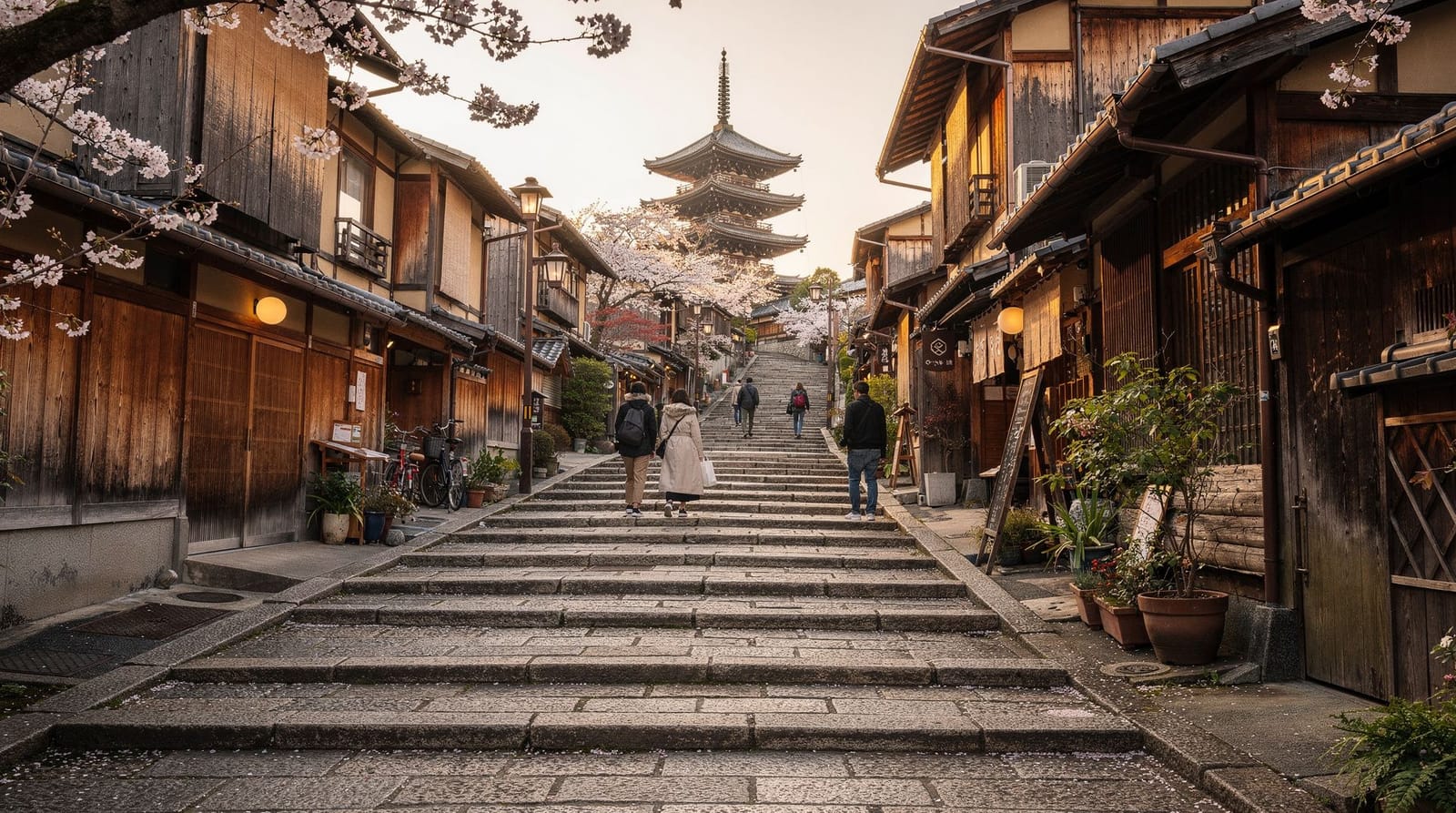
Almost nobody visits Kiyomizu-dera in isolation, since it sits at the top of a single connected slope that also holds Sannenzaka, Ninenzaka, Kodai-ji, and Yasaka Shrine before ending in Gion. The standard route works downhill: start at Kiyomizu-dera early, then walk down through the preserved lanes, stopping for tea or shopping, before continuing into Gion by late morning or early afternoon.
Budget a half day for the full walk if you plan to browse the shops and stop for food; a rushed version can be done in under two hours if you go straight through. For a broader sense of what else sits in this district, the Higashiyama destination guide covers Sannenzaka, Kodai-ji, and Yasaka Shrine in more detail.
Kiyomizu-dera, Fushimi Inari and Gion half-day tourWhat to skip if you’re short on time
If you only have an hour, the stage itself and Jishu-jinja are the priorities — both take under 30 minutes combined if you don’t linger. The Otowa waterfall adds another 10-15 minutes with a queue. The temple’s other halls (Okunoin, the three-story pagoda) are worth a look if you have more time, but they’re secondary to the stage and the waterfall for most first-time visitors.
Skip the souvenir shops directly at the temple exit if you’re planning to shop at all in Sannenzaka — prices there are noticeably lower than the stalls immediately outside the gate, which cater to tour groups on a tight schedule.
Seasonal notes: cherry blossoms, autumn maples, and snow
Spring (late March to early April) brings cherry blossoms around the temple grounds and along the approach lanes, timed with the extended evening hours. Autumn, particularly mid-November, brings maple foliage that turns the valley below the stage into a wash of red and orange — arguably the single best season to see Kiyomizu-dera, and also the most crowded.
Winter is the quiet season here. Snow on the temple’s wooden roof is rare but not unheard of, and when it happens the crowds thin out considerably compared to spring and autumn. Summer is hot and humid with the same daytime crowd pattern as the rest of the year — early morning is still the best strategy.
For planning a fuller day around the temple, see the Philosopher’s Path guide for a quieter walking alternative nearby, or the Fushimi Inari guide if you’re combining a temple morning with a shrine hike in the same day.
What to wear and what to bring
The approach through Sannenzaka and Ninenzaka is cobbled and uneven, and the temple grounds themselves involve stairs in both directions — flat, closed-toe shoes matter more here than at flatter sights like Nijo Castle or the Imperial Palace grounds. Summer visits (June through August) mean heat and humidity that build quickly on the uphill walk; carrying water is worth it, since the shops along the approach sell drinks at a markup compared to a convenience store near the bus stop.
There’s no dress code enforcement at the gate the way there is at some religious sites elsewhere in Japan, but modest clothing is still the norm inside the temple buildings themselves, and shoes come off if you enter any of the interior halls beyond the stage. A small towel or handkerchief is useful in summer — Japanese public buildings don’t reliably stock paper towels in restrooms.
Common mistakes first-time visitors make
The most common misstep is treating Kiyomizu-dera as a quick 20-minute photo stop rather than budgeting time for the approach lanes, which is where a meaningful share of the experience actually happens — the shops, the architecture of Sannenzaka itself, and the views back toward the temple from lower on the hill. Rushing straight to the stage and leaving skips most of what makes the district worth visiting in the first place.
The second common mistake is underestimating how early “early” needs to be. Arriving at 8am rather than 6am still means a temple that’s meaningfully busier than opening hour — the gap between “early” and “actually quiet” is narrower than most visitors expect, especially in peak cherry blossom or autumn foliage weeks.
A third mistake, specific to the illumination evenings: assuming a daytime ticket carries over. It doesn’t. If you’re staying for the evening light-up, you’ll need a separate evening ticket purchased after the daytime session ends, and the temple typically closes briefly between the two sessions to reset.
Photography tips and etiquette
The classic shot of the stage from the side, showing the full wooden substructure against the Higashiyama hillside, is taken from a viewing platform partway around the main hall loop — it’s clearly marked and usually has a short queue during the day, virtually none at 6am. Tripods are not permitted inside the temple grounds due to the volume of foot traffic; a monopod or simply steadying against a railing works for most shots.
Inside Jishu-jinja, photographing other visitors attempting the love-stone walk is common and generally accepted, but be mindful of blocking the narrow path between the stones — it’s a small space that gets congested quickly when a queue forms.
Nearby food and where prices make sense
Sannenzaka and Ninenzaka are lined with food stalls selling matcha soft-serve, yatsuhashi (a cinnamon-and-red-bean pastry unique to Kyoto), and skewered dango, mostly in the ¥300-600 range. Prices climb the closer a stall sits to the temple gate itself; a short walk down toward Kodai-ji or into Gion generally gets better value for similar snacks. Sit-down restaurants along the lanes lean toward tourist-oriented pricing — for a more locally priced meal, the area around Kiyomizu-Gojo Station or downtown Kyoto, a bus or taxi ride away, is a better bet.
How Kiyomizu-dera compares to Kyoto’s other major temples
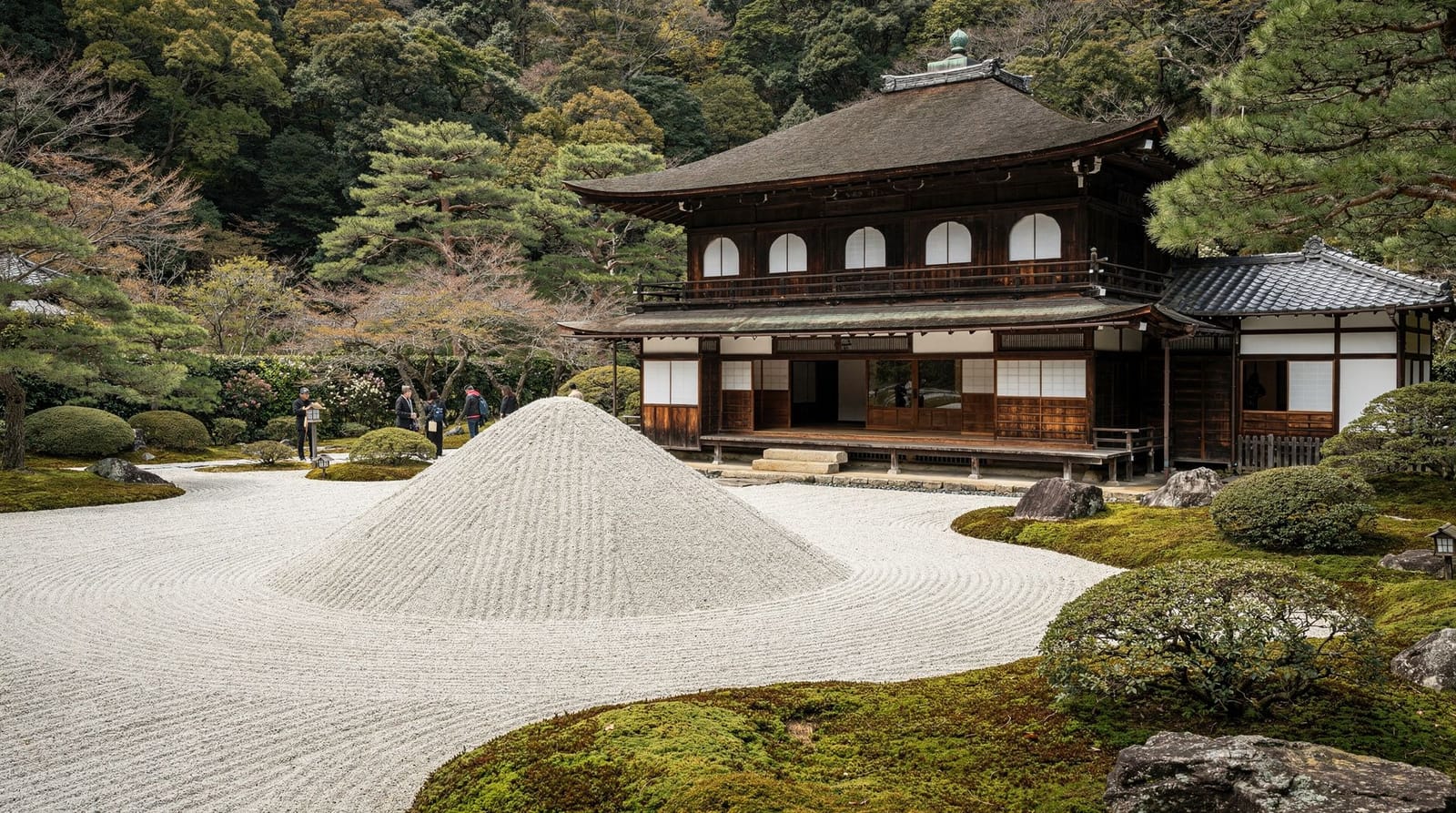
Kiyomizu-dera’s draw is architectural and geographic — the wooden stage and its hillside setting — rather than a garden or a philosophical puzzle, which sets it apart from sights like Ryoan-ji’s rock garden or Ginkaku-ji’s sand garden. If you’re choosing between temples on a tight schedule and want the single most photographed structure in the city, Kiyomizu-dera is the priority; if garden design interests you more than architecture, the northern Kitayama temples or the Philosopher’s Path cluster are a better use of limited time.
Compared to Kinkaku-ji, Kiyomizu-dera rewards a longer visit — the surrounding lanes, Jishu-jinja, and the waterfall add real content beyond the main structure, whereas Kinkaku-ji is a single fixed viewpoint with a much shorter visit time. Budget accordingly if you’re splitting a day between the two districts.
Accessibility and getting around with limited mobility
The approach through Sannenzaka and Ninenzaka involves sustained uphill walking on cobbled, sometimes uneven stone paths, with no elevator or accessible alternative route to the temple’s main entrance — this is one of the more physically demanding major sights in Kyoto. Wheelchair users and visitors with mobility limitations should expect the approach itself, rather than the temple grounds, to be the main obstacle; the temple’s own precinct has some paved sections but also stairs at several points, including around the main hall and toward Jishu-jinja.
A taxi can get closer to the temple than the bus, dropping passengers nearer the upper approach, which shortens the uphill walk somewhat, though it doesn’t eliminate it. If mobility is a significant concern, the Philosopher’s Path is a flatter alternative eastern Kyoto walk with fewer stairs overall.
A brief history worth knowing before you go
Kiyomizu-dera’s founding legend credits a monk named Enchin, who is said to have followed a vision of clear water to the site in 778 and built a hall beside the spring that still feeds the Otowa waterfall today. The temple was originally affiliated with the Hosso school of Buddhism, one of Japan’s oldest Buddhist sects, imported from China in the 7th century — a detail that surprises visitors who assume every major Kyoto temple belongs to a Zen lineage, since Kiyomizu-dera’s Buddhist tradition predates Zen’s arrival in Japan by several centuries.
Fire has shaped the temple’s history more than almost any other single factor: contemporary records describe at least nine major fires between the temple’s founding and the 1633 reconstruction that produced the buildings seen today, funded by shogun Tokugawa Iemitsu. That reconstruction is itself now approaching four centuries old, making the “modern” Kiyomizu-dera older than most people assume when they learn the temple’s founding date is 778.
Budgeting your time: a sample two-hour visit
For visitors who want a structured plan rather than wandering, a reasonable two-hour route starts at the Gojo-zaka bus stop, walks up through Sannenzaka and Ninenzaka (20-30 minutes with a browsing pace), enters the temple grounds and heads straight for the stage and main hall (20 minutes), continues to Jishu-jinja for the love-stone walk (10-15 minutes), descends to the Otowa waterfall for a drink from one stream (10-15 minutes including any queue), and finishes with a slow walk back down through the lanes with time for a tea or snack stop (30 minutes). This leaves a buffer for photos and the inevitable slower pace of a hillside crowd.
Visitors with less time can compress this to roughly 45 minutes by skipping the waterfall queue and moving directly between the stage, Jishu-jinja, and the exit — still enough to see the temple’s two signature features without the full lane-to-lane walk.
A note on the surrounding shrines and side halls
Beyond the main stage and Jishu-jinja, Kiyomizu-dera’s grounds include a three-story pagoda near the entrance gate, and Okunoin, a secondary hall behind the main structure that offers a different angle on the stage itself, often with a noticeably shorter line than the main viewing platform. Visitors focused entirely on the main stage frequently miss Okunoin’s vantage point, which some repeat visitors consider the better photo angle of the two since it captures the stage and the valley in a single frame.
Frequently asked questions about Kiyomizu-dera guide — the wooden stage, Otowa waterfall & illuminations
What time does Kiyomizu-dera open?
How much is admission to Kiyomizu-dera?
Is Kiyomizu-dera worth visiting early in the morning?
Can you drink from all three streams of the Otowa waterfall?
Why does Kiyomizu-dera's stage have no nails?
What is Jishu-jinja and is it separate from Kiyomizu-dera?
How do you get to Kiyomizu-dera from Kyoto Station?
Should you combine Kiyomizu-dera with other Higashiyama sights?
Top experiences
Bookable activities with verified prices and instant confirmation on GetYourGuide.