Ryoan-ji guide — the fifteen-stone dry garden and its meaning
Kyoto: Ryōan-ji, Greatest Zen Garden Guided Tour in 80 Min.
Duration: 80 minutes
What makes Ryoan-ji's rock garden famous and how much does it cost to see?
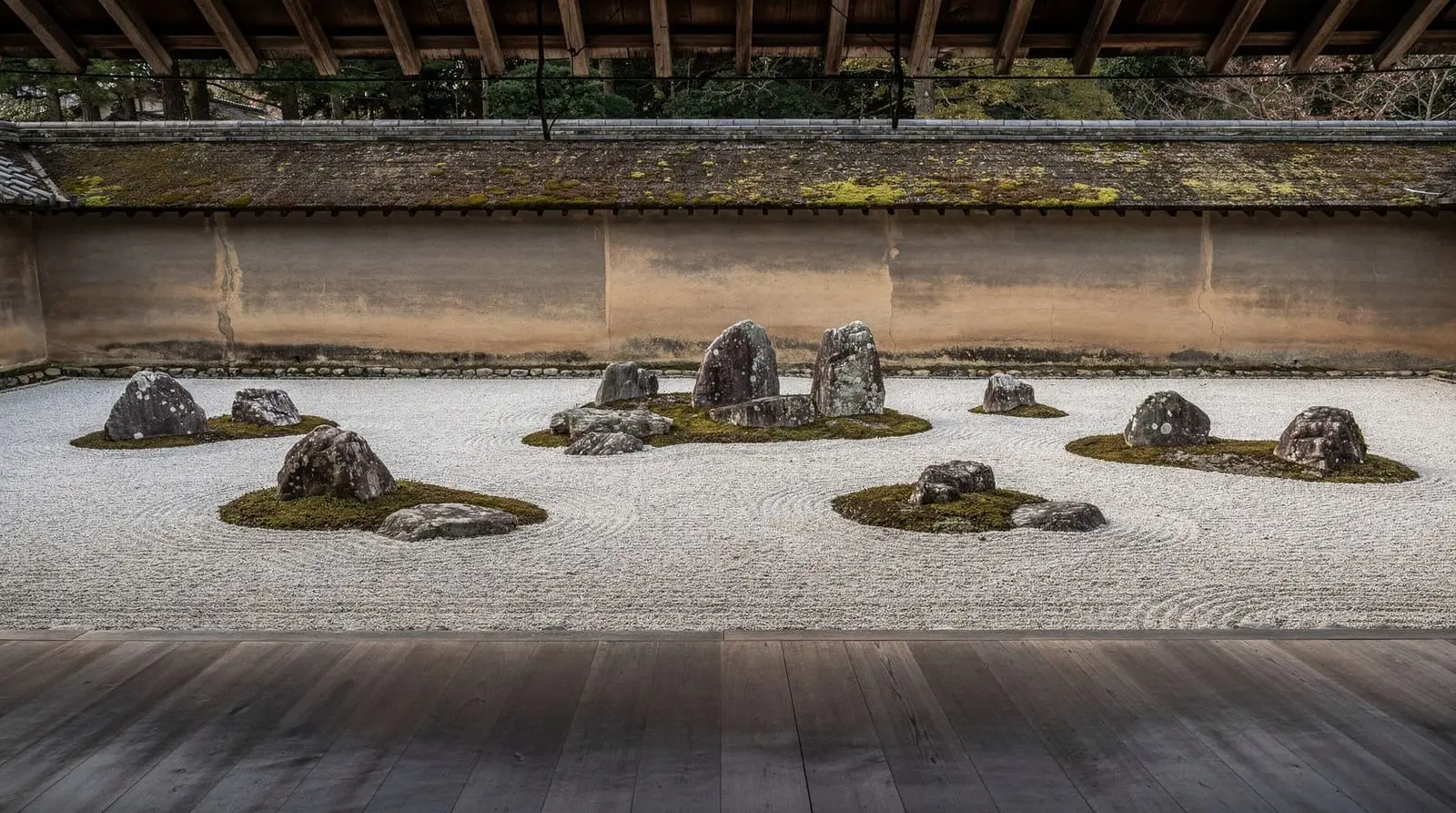
Ryoan-ji's karesansui (dry landscape) garden arranges 15 stones in raked white gravel, positioned so that at least one stone is always hidden from view no matter where you sit along the veranda. Admission is ¥600, hours are 8am-5pm (8:30am-4:30pm in winter), and the garden itself takes only 15-20 minutes to sit with, though most visitors stay longer.
Fifteen stones, and you can never see them all
Ryoan-ji’s rock garden is one of the most written-about small spaces in Japan: a rectangle of raked white gravel roughly the size of a tennis court, containing 15 stones arranged in five groups of varying size, enclosed by a low earthen wall. The rule that makes it famous is simple to state and genuinely holds up under testing — from any single seat along the wooden veranda, at least one stone is always hidden behind another, no matter where you sit.
| Where | Kitayama district, near Kinkaku-ji |
| Cost | ¥600 admission |
| Hours | 8am-5pm (Mar-Nov); 8:30am-4:30pm (Dec-Feb) |
| Time needed | 15-20 min garden; 40-50 min with Kyoyochi pond |
| Getting there | Bus 50 or JR/subway to Ryoanji-michi, 35-45 min |
| Best time | Right at 8am opening for a quiet veranda |
No one knows for certain who designed it or exactly when. The temple itself was founded in 1450 on the site of a former aristocratic villa, but no contemporary record documents the garden’s creation, and the most common scholarly estimate — late 15th to early 16th century — remains an informed guess rather than a documented fact. That absence of a clear origin story hasn’t hurt the garden’s reputation; if anything, it’s added to the mystique.
What the missing stone actually means
Interpretations of the fifteen-stones puzzle vary widely, and Ryoan-ji itself doesn’t endorse a single official reading. One common explanation ties it to Zen ideas about incomplete perception — that no vantage point offers total understanding, a fitting metaphor for a Zen training temple. Another, more literal reading simply admires the technical achievement: arranging stones so precisely that the “always one hidden” rule holds from every seat along a 25-meter veranda is a nontrivial feat of spatial design regardless of any symbolic meaning attached to it.
Ryoan-ji greatest Zen garden guided tour, 80 minutesTraditional temple lore adds one more layer: that only someone who has attained spiritual enlightenment can see all 15 stones simultaneously from the veranda. A small number of viewing positions inside the temple building itself, rather than the public veranda, do allow all 15 to be seen at once — a detail worth knowing if the puzzle interests you more than the general atmosphere.
The tsukubai: a message hidden in a water basin
Behind the main hall, away from the rock garden itself, sits a low stone water basin called a tsukubai, used traditionally for ritual hand-washing before a tea ceremony. Carved into the basin’s surface are four characters arranged around a square opening that also functions as a fifth character — the water-filled center reads as the character for “mouth” when combined with each surrounding stroke, forming four different phrases depending on which two characters you read together. Combined, the accepted reading translates roughly to “I learn only to be contented,” a Zen teaching about sufficiency and restraint.
The basin currently on site is a copy; the original, said to have been donated by a 17th-century feudal lord and Confucian scholar, is preserved separately on the temple grounds rather than left exposed to weather.
Kyoyochi pond: the part most visitors skip
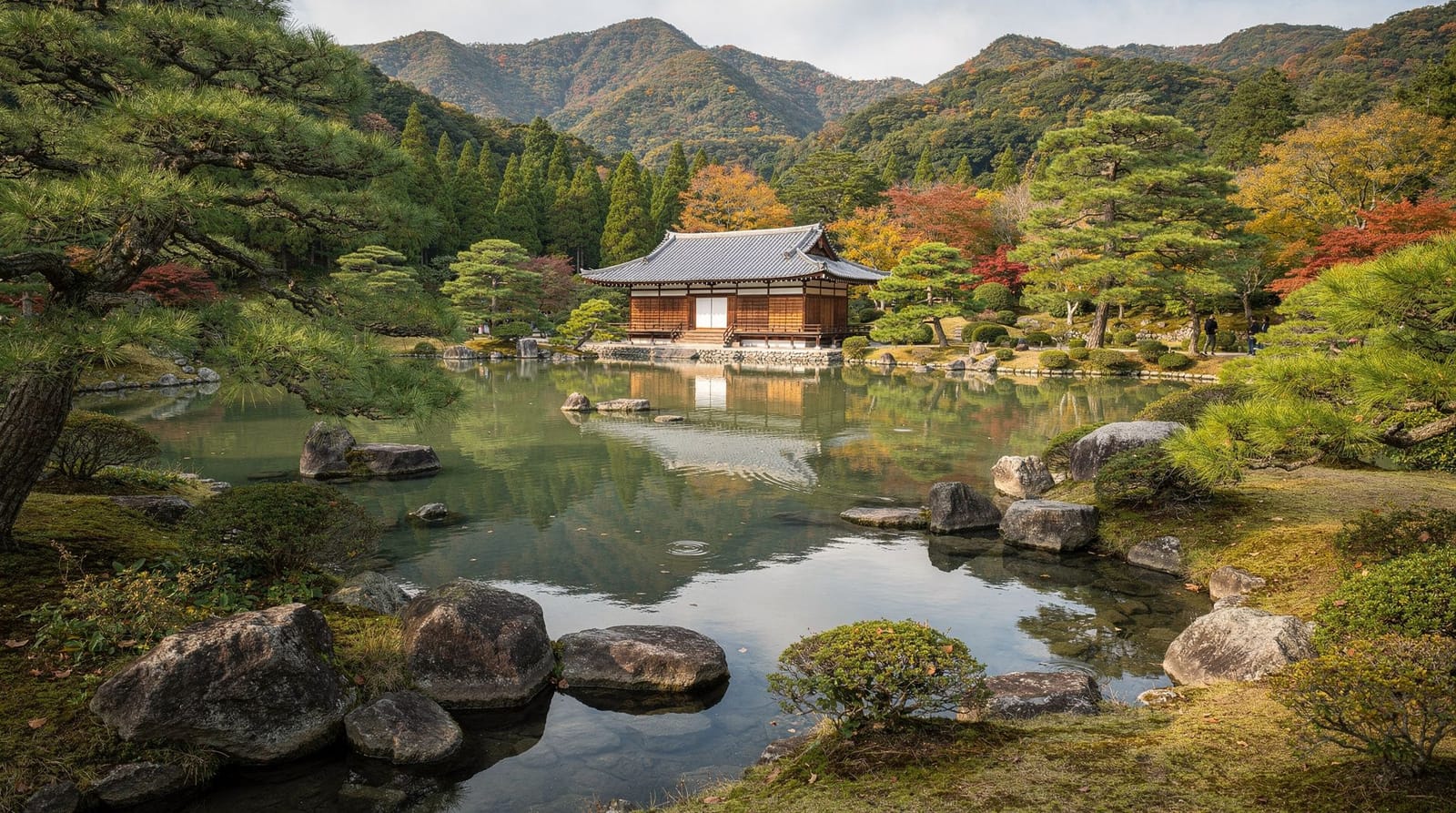
Below and behind the rock garden, Kyoyochi is a landscaped pond dating to the 12th century — older than the current temple itself, since it was part of the original aristocratic villa on the site before Ryoan-ji was founded around it. A walking path circles the pond through a wooded section of the grounds, and it’s consistently quieter than the rock garden veranda, since a meaningful share of visitors come specifically for the stones and leave without continuing further into the grounds.
If you’ve already spent your allotted time sitting with the dry garden, the pond adds a genuinely different, calmer 15-20 minutes to the visit, particularly appealing in autumn when maples around the water turn color.
Admission, hours, and how long to allow
Admission is ¥600. Hours run 8am to 5pm from March through November, shifting to 8:30am-4:30pm from December through February. The rock garden itself can be seen in 15-20 minutes if you’re moving through efficiently, though the veranda invites lingering, and many visitors sit for considerably longer, especially outside peak hours. Add another 20-30 minutes for the Kyoyochi pond walk if you have the time.
Crowds: better than Kinkaku-ji, still not empty
Ryoan-ji draws fewer large tour groups than Kinkaku-ji, since it appeals more specifically to visitors interested in garden design and Zen history rather than every general Kyoto sightseeing itinerary — but it’s still a well-known, frequently visited site, not a hidden one. The veranda facing the rock garden can fill up shoulder-to-shoulder at peak midday hours, particularly when a tour bus arrives mid-visit.
Right at 8am opening offers the best chance of sitting with the garden in relative quiet. Midday through mid-afternoon is reliably the busiest stretch, especially since many visitors combine Ryoan-ji with Kinkaku-ji on the same half-day, arriving at whichever temple is second on their route around lunchtime.
Kinkaku-ji and Ryoan-ji walking tourGetting there and combining with Kinkaku-ji
Ryoan-ji sits in the same general Kitayama district as Kinkaku-ji but isn’t within comfortable walking distance of it — city bus (roughly 15-20 minutes between the two) or taxi is the practical connection. See the Kinkaku-ji guide for exact bus numbers and stop names from Kyoto Station.
Most visitors treat Kinkaku-ji and Ryoan-ji as a paired half-day outing, since both sit in an otherwise scattered northern district with limited walkable connections between sights. For the broader area, including Ninna-ji’s later-blooming cherries and Daitoku-ji’s quieter Zen sub-temples, see the Kinkaku-ji and Kitayama destination guide. For a different dry-garden tradition using raked sand rather than stone, the Ginkaku-ji guide covers the Sea of Silver Sand on the opposite side of the city.
Karesansui: the broader dry-garden tradition
Ryoan-ji’s rock garden belongs to a broader design tradition called karesansui, or dry landscape gardening, which uses raked gravel, stone, and carefully placed rocks to suggest water, mountains, and islands without using any actual water — a style closely associated with Zen Buddhist temples from the Muromachi period (1336-1573) onward. Ryoan-ji’s version is considered the most refined and abstract example of the style still surviving, since it strips the format down to essentially two elements: gravel and stone, with no trees, moss, or water features inside the garden’s rectangle itself.
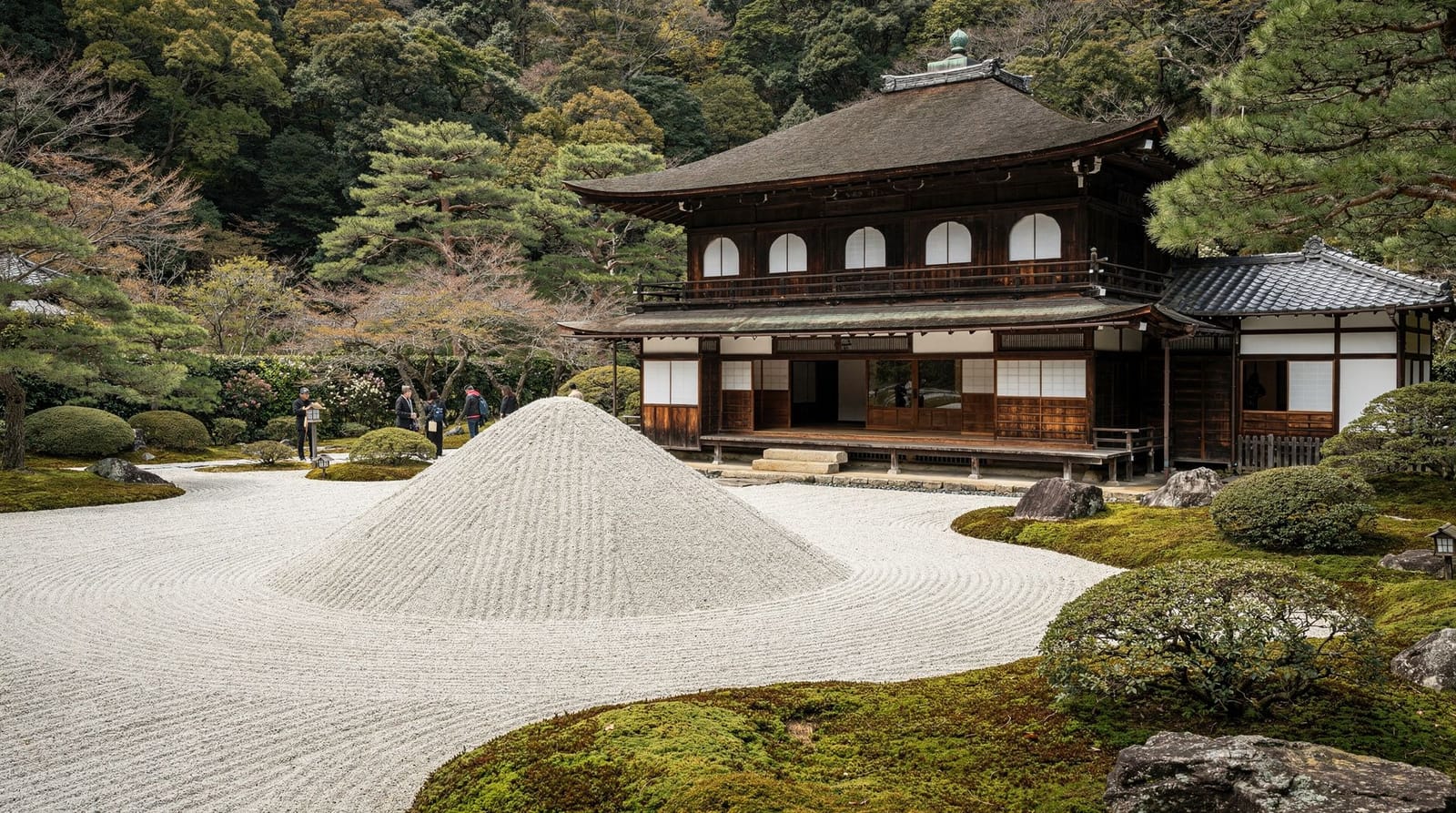
Other Kyoto temples use the same broader tradition with different results — Ginkaku-ji’s Sea of Silver Sand uses raked sand in a more sculptural, less abstract way, while some sub-temples at Daitoku-ji use karesansui gardens that incorporate moss and carefully pruned trees alongside the stone arrangements. Ryoan-ji’s comparative austerity — a plain rectangle with no ornamentation beyond the stones and their moss-edged bases — is part of why it’s held up as the defining example of the form.
What to wear and practical tips
Visitors sit on a wooden veranda to view the garden, so shoes come off before stepping onto it — a standard practice at Japanese temples with interior wooden floors, and one worth planning for with easily removable footwear and presentable socks. The veranda itself can be crowded during peak hours, with limited seating space, so be prepared to view standing if the wooden platform is full.
The temple grounds beyond the rock garden, including the walk around Kyoyochi pond, involve some uneven natural paths through wooded sections — comfortable walking shoes are worth it if you’re doing the full grounds rather than just the rock garden viewing.
Common mistakes first-time visitors make
The most common mistake is treating the rock garden as a quick five-minute photo stop rather than sitting with it — the design rewards a slower look, since the “always one hidden” effect isn’t always immediately obvious from a single glance, and testing it from a few different seats along the veranda is part of the point. A five-minute visit misses most of what makes the garden interesting beyond its surface appearance in photographs.
A second common mistake is skipping Kyoyochi pond entirely, assuming the rock garden is the only thing worth seeing at Ryoan-ji. The pond area offers a genuinely different, quieter experience and is worth the extra 15-20 minutes for anyone not on a tight schedule.
A third mistake, more about expectations than experience, is arriving hoping for a definitive explanation of the garden’s meaning. Ryoan-ji itself doesn’t provide one, and the honest answer is that no one — including art historians who’ve studied the site for decades — has settled on a single agreed interpretation. Enjoying the ambiguity is, for many visitors, part of what makes the site memorable rather than a shortcoming to be resolved.
Nearby food and shops
The area immediately around Ryoan-ji has limited dining directly at the temple gate — a few small shops sell tea, snacks, and temple charms near the entrance, priced similarly to other major temple gift shops in the city. For a proper meal, the Kitaoji or Kinkaku-ji area a short bus ride away offers more variety, or downtown Kyoto if you’re willing to travel 20-30 minutes for a wider range of options.
Seasonal notes
The rock garden itself changes little with the seasons, since its central elements are stone and raked gravel rather than plants — one of the reasons it’s considered a year-round sight rather than a seasonal one, unlike many Kyoto gardens built around cherry blossoms or maple foliage. That said, the moss edging the stones and the surrounding grounds do shift with the seasons, and Kyoyochi pond’s surrounding trees bring genuine autumn color in November, adding a seasonal layer to a visit that would otherwise look nearly identical in July and January.
Winter visits offer the quietest version of the rock garden, with fewer visitors competing for veranda seating, and a stark, spare quality to the raked gravel against bare winter trees that some visitors find suits the garden’s aesthetic particularly well.
A brief history: from villa to temple, with an uncertain garden date
Ryoan-ji’s grounds began as an aristocratic villa belonging to the Tokudaiji family before passing to the Hosokawa clan, one of the most powerful warrior families of the Muromachi period. Hosokawa Katsumoto converted the property into a Zen temple in 1450, establishing Ryoan-ji as part of the Myoshin-ji school of Rinzai Zen Buddhism, a lineage it remains affiliated with today.
The temple, like much of Kyoto, suffered serious damage during the Onin War (1467-1477), a decade-long civil conflict that destroyed large sections of the city, and was substantially rebuilt afterward. This destruction and rebuilding is part of why the rock garden’s exact creation date is so difficult to pin down — whether it dates from before or after the war’s damage remains a subject of scholarly debate, with most estimates favoring a late 15th or early 16th century date, sometime during the temple’s postwar reconstruction period.
The wider temple grounds beyond the rock garden
Beyond the famous dry garden, Ryoan-ji’s grounds include the Kuri, the temple’s kitchen and administrative building, and a network of paths through wooded sections surrounding Kyoyochi pond that see considerably less foot traffic than the rock garden veranda. Several smaller sub-structures and a graveyard containing the tombs of historical figures associated with the temple sit within the grounds as well, though they’re not typically a focus for visitors on a first trip.
The full grounds, including the pond loop, cover a meaningfully larger area than most visitors realize when they picture Ryoan-ji as just the rock garden — worth knowing if the temple’s stillness and space are as much a draw for you as the specific fifteen-stone puzzle at its center.
Getting there from central Kyoto
From Kyoto Station, the most direct route is city bus 50 or a JR/subway combination to Ryoanji-michi, followed by a short walk — total journey time runs 35-45 minutes depending on the route and traffic. A taxi from Kyoto Station takes roughly 25-30 minutes. If you’re coming directly from Kinkaku-ji, bus connections between the two temples run every 15-20 minutes, making the pairing straightforward without requiring a return to Kyoto Station in between.
Photography tips
The rock garden is best photographed from a seated position on the veranda rather than standing, since the low angle better captures the relationship between the raked gravel patterns and the stone groupings — standing shots tend to flatten the careful spacing that makes the “hidden stone” effect work. Morning light, particularly around opening, casts long shadows from the stones across the raked gravel that add depth to photos in a way flat midday light doesn’t.
Tripods are discouraged on the veranda given limited space and the volume of visitors moving through, especially during busier midday hours. A wide-angle lens or phone camera set to a wider field of view captures the garden’s full width better than a standard zoom, since the space is wider than it is deep.
Accessibility
The main rock garden veranda is accessible via a relatively flat approach from the temple’s entrance, with shoes removed before stepping onto the wooden platform — a minor obstacle for visitors with certain mobility limitations, though staff can generally accommodate specific needs if asked. The wider grounds, including the Kyoyochi pond loop, involve some uneven natural paths and are less consistently accessible than the rock garden itself, which sits closer to the entrance.
Budgeting your time
For a focused visit, the rock garden veranda alone takes 15-20 minutes, enough to sit, observe the layout from a couple of different seats, and read the small amount of signage explaining the garden’s background. Adding the Kyoyochi pond loop brings a visit to 40-50 minutes, and allows time to see the tsukubai basin behind the main hall on the way. Combined with travel time and the pairing with Kinkaku-ji, most visitors allocate a full morning or afternoon to this stretch of Kitayama rather than treating Ryoan-ji as a brief standalone stop.
How Ryoan-ji fits into a wider Kyoto trip
For visitors weighing which of Kyoto’s garden sights to prioritize on a limited schedule, Ryoan-ji offers the most distilled version of Zen dry-garden design in the city — a useful contrast if you’re also visiting Tenryu-ji’s Sogenchi garden in Arashiyama, which uses a living pond and borrowed mountain scenery rather than abstract stone and gravel. Seeing both on the same trip offers a genuinely useful comparison of two very different approaches within the same broad tradition of Japanese Zen landscape design.
Comparing Ryoan-ji’s three karesansui gardens in Kyoto
| Temple | Style | Distinctive feature |
|---|---|---|
| Ryoan-ji | Pure stone and gravel | 15 stones, one always hidden |
| Ginkaku-ji | Sculptural raked sand | Sea of Silver Sand, Kogetsudai cone |
| Daitoku-ji sub-temples | Stone with moss/trees | Varies by sub-temple, generally quieter |
Ryoan-ji’s version is the most austere of the three, stripping the format to essentially two elements; the Ginkaku-ji guide covers the sculptural alternative in full, useful for anyone comparing the two dry-garden traditions on the same trip.
Silence and how visitors are expected to behave on the veranda
Unlike many Kyoto temples where quiet conversation is normal throughout the grounds, the rock garden veranda has an unspoken expectation of relative quiet, particularly at the calmer opening hours — it’s a space designed for contemplation, and loud conversation or phone calls draw noticeable, if polite, attention from other visitors and temple staff. This isn’t an enforced rule with posted signage the way photography restrictions sometimes are elsewhere, but it’s a norm worth knowing before sitting down, especially if visiting specifically for the reflective quality the garden is known for rather than treating it as a quick photo stop.
Frequently asked questions about Ryoan-ji guide — the fifteen-stone dry garden and its meaning
Why can you never see all 15 stones at once?
How old is Ryoan-ji's garden and who designed it?
What is the tsukubai basin at Ryoan-ji?
Is Kyoyochi pond worth visiting alongside the rock garden?
How much does Ryoan-ji cost and what are the hours?
Is Ryoan-ji crowded, and when is the best time to visit?
Can you walk from Kinkaku-ji to Ryoan-ji?
Top experiences
Bookable activities with verified prices and instant confirmation on GetYourGuide.