Lake Biwa and Otsu
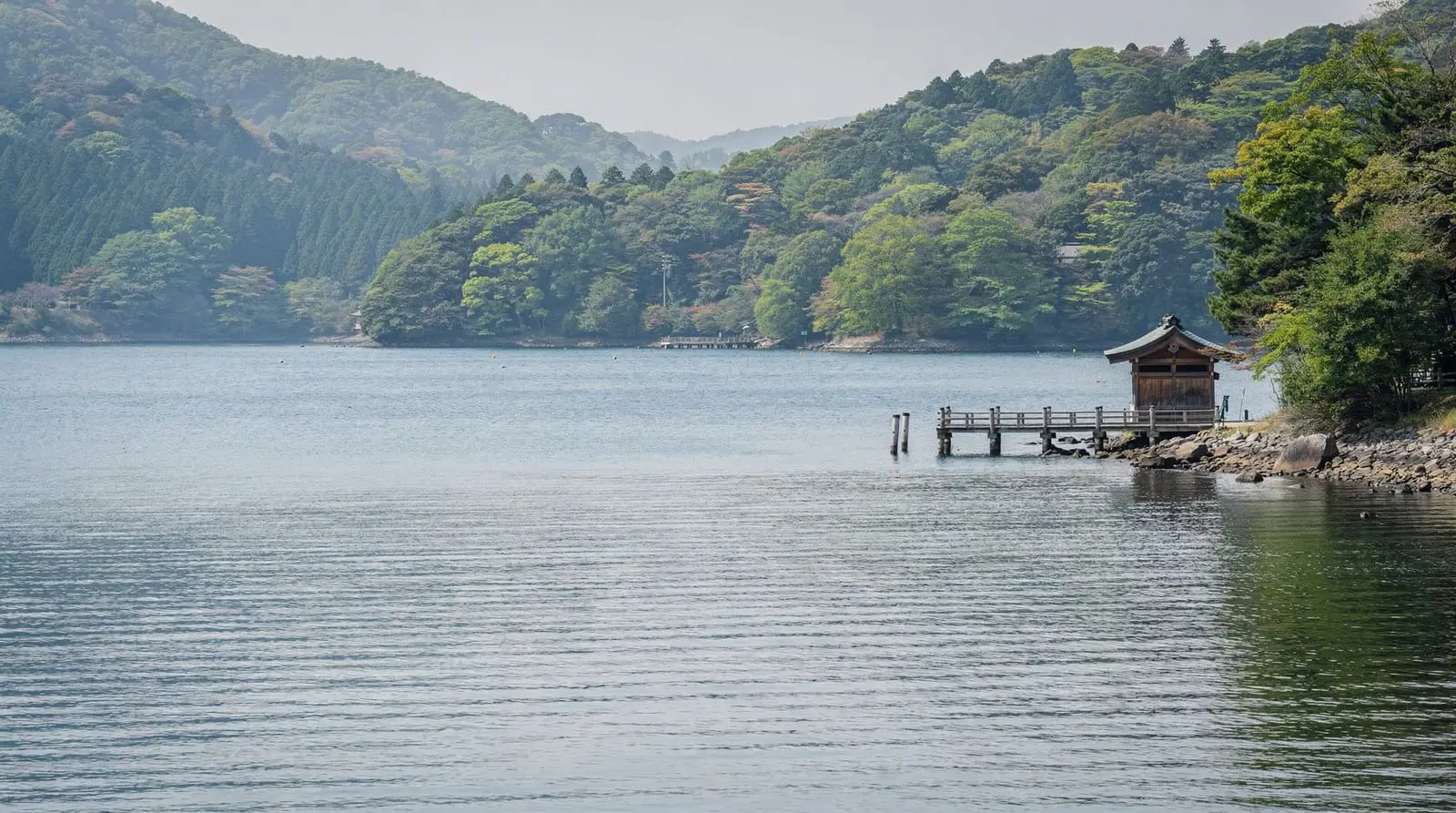
Lake Biwa and Otsu are 10 minutes from Kyoto Station by train — Ishiyama-dera, Mii-dera, and a paddle-wheel cruise on Japan's largest lake.
Lake Biwa: three-hour private guided tour from Kyoto
Duration: 3 hours
Quick facts
- Distance from Kyoto Station
- About 10 min by JR Biwako Line
- One-way fare
- About ¥240
- Time needed
- Half day
- Best known for
- Japan's largest lake and Ishiyama-dera Temple
- Best time to visit
- Spring cherry blossoms or autumn foliage
Is Lake Biwa worth visiting on a short Kyoto trip? Yes, if you want water and open space without committing a full day — Otsu, on the lake’s southwestern shore, is about 10 minutes from Kyoto Station on the JR Biwako Line (roughly ¥240/$1.60 one way), making it one of the easiest and shortest excursions in this entire guide. Japan’s largest lake, a temple linked to the traditional origin story of The Tale of Genji, and a paddle-wheel cruise boat are all within a short walk of the station.
Why Lake Biwa is the easiest “escape” from central Kyoto
Every other day trip in this guide involves at least 20-30 minutes of dedicated travel time, often with a transfer. Lake Biwa doesn’t. Otsu sits directly over the prefectural border in Shiga, immediately east of Kyoto, and the JR Biwako Line connects the two city centers in about the time it takes to ride a few subway stops within Kyoto itself. That makes this destination less about “a day trip” in the conventional sense and more about a genuinely easy half-day add-on — useful specifically for travelers on their third or fourth day in Kyoto who’ve worked through the major temple circuit and want water, open sky, and a change of scale without a long commitment.
It also matters that Lake Biwa isn’t just scenically adjacent to Kyoto — it’s functionally connected to it. More on that below, but the short version: some of the water flowing past Nanzenji and along the Philosopher’s Path in central Kyoto originated in this lake.
Getting to Otsu and Lake Biwa from Kyoto Station
The simplest route is the JR Biwako Line (part of the JR Kyoto Line/Tokaido Line network), which runs directly from Kyoto Station to Otsu Station in about 10 minutes for roughly ¥240 (~$1.60) one way — covered by the Japan Rail Pass and standard JR regional passes. Trains run frequently, typically every 5-10 minutes during the day, since this is a commuter line, not a tourist service.
An alternative route, useful if you’re starting from downtown Kyoto rather than the station, is the Keihan Keishin Line, a small tram-like line running from Sanjo or Misasagi in eastern Kyoto directly into Otsu, terminating near Otsu’s lakefront rather than the JR station — a nicer arrival if the lake itself, not the temples, is your main goal. This route takes about 20 minutes and isn’t covered by the JR Pass, so factor in a separate fare, generally in the ¥300-400 (~$2-2.70) range depending on your exact starting point.
Once in Otsu, most of the sites described below are walkable from either station, though Ishiyama-dera requires a short additional train ride (see below) further along the same JR line or the separate Keihan Ishiyama-Sakamoto Line.
Ishiyama-dera: where The Tale of Genji is said to have begun
Ishiyama-dera sits a few minutes further along the rail line from central Otsu, reached via the Keihan Ishiyama-Sakamoto Line to Ishiyamadera Station (or JR to Ishiyama Station, followed by a short walk or local transfer) — roughly 15-20 minutes total from Kyoto Station door to door. The temple, founded in 749 CE, is built directly into and around striking outcrops of wollastonite, a pale, crystalline rock formation unusual enough in appearance that the temple takes its name from it (ishiyama literally means “stone mountain”); the rock is visible right at the base of the temple’s main approach, a genuinely distinctive geological feature you won’t see at any other major Kyoto-area temple.
Ishiyama-dera’s literary claim to fame is its traditional association with Murasaki Shikibu, the Heian-period court lady credited with writing The Tale of Genji. According to temple tradition, Murasaki Shikibu retreated to Ishiyama-dera in 1004 and began composing the novel here while gazing at the moon over Lake Biwa from a room on the temple grounds, a room still preserved and marked today (Genji-no-Ma).
Whether the story is literally accurate or a later embellishment attached to a temple that Murasaki Shikibu is known to have visited is debated among historians, but the association is centuries old and taken seriously enough that Ishiyama-dera functions as a genuine literary pilgrimage site, complementary to Uji’s Tale of Genji museum and sites if you’re tracing the novel’s real-world connections across the wider Kyoto region.
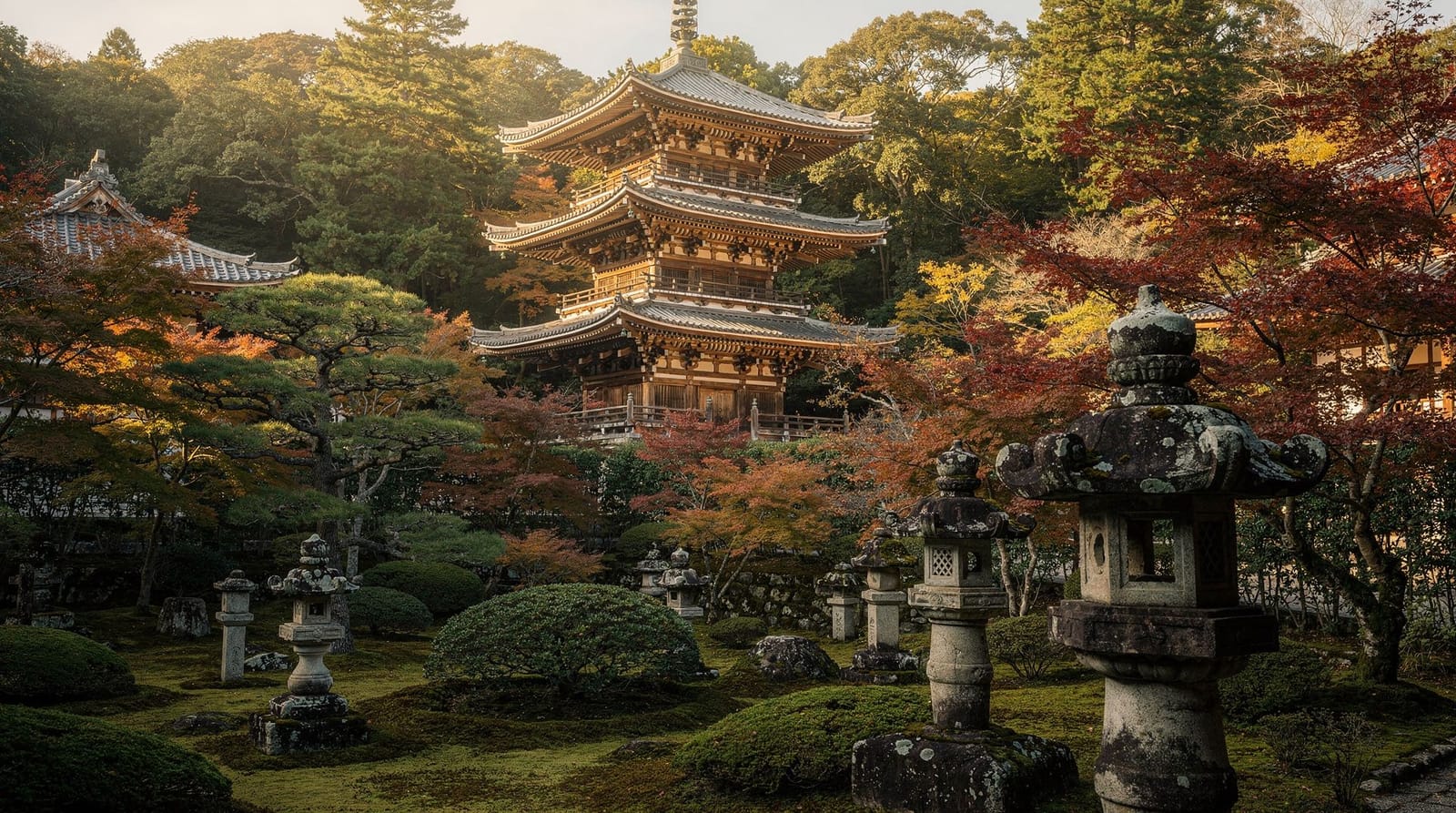
Beyond the literary angle, the temple grounds are simply good — moss, maples for autumn color, cherry blossoms in spring framed against the wollastonite outcrops, and a multi-story pagoda dating to the Kamakura period. Admission is ¥600 (~$4), with an additional fee for the treasure hall when special exhibitions are running; hours are roughly 8am-4:30pm daily.
Mii-dera (Onjo-ji): one of Japan’s three famous bells
Mii-dera, formally Onjo-ji, is a major temple complex of the Tendai Buddhist sect’s Jimon branch, founded in the 7th century and rebuilt multiple times after destruction during sectarian conflicts in the medieval period — its history is, in places, genuinely violent, tied up in centuries of rivalry with Mount Hiei’s Enryaku-ji. The temple’s bell, cast in 1602 and known as the Mii bell (or “evening bell of Mii-dera”), is traditionally counted among Japan’s three most famous bells, prized historically for its tone; it’s rung as part of a public New Year’s Eve bell-ringing event, and visitors can pay a small fee to ring it at other times of year, a genuinely satisfying, low-key activity most tourists skip entirely.
Mii-dera’s grounds are also one of the better cherry blossom spots in the wider Otsu area, with several hundred trees spread across a hillside site large enough to absorb crowds better than Kyoto’s most famous, more concentrated blossom spots. Admission is ¥600 (~$4), hours roughly 8am-5pm daily, and the temple is a short walk or one stop by tram/bus from central Otsu.
Ishiyama-dera versus Mii-dera: which one fits your afternoon
Both temples are good, but they reward different interests, and most half-day visitors realistically only have time for one plus the lakefront.
| Ishiyama-dera | Mii-dera (Onjo-ji) | |
|---|---|---|
| Known for | Tale of Genji association, wollastonite rock | 1602 bell, one of Japan’s three famous bells |
| Founded | 749 CE | 7th century, rebuilt several times |
| Admission | About ¥600 | About ¥600 |
| Best season | Spring blossoms and autumn maples against the rock | Spring, for hillside cherry blossoms |
| Travel time from Kyoto Station | About 15-20 minutes | About 10-15 minutes |
| Best for | Literary interest, distinctive scenery | Bell-ringing, quieter crowds, history buffs |
Omi Jingu: a shrine tied to Emperor Tenji and, unexpectedly, competitive karuta
Not far from central Otsu, on the lake’s edge, Omi Jingu is a Shinto shrine established in 1940 specifically to honor Emperor Tenji, the ruler who briefly moved the capital here in 667 CE (see the history section below). Architecturally it’s a 20th-century shrine rather than an ancient structure, built in a clean vermilion-and-white style typical of mid-century State Shinto shrines, set against wooded hills above the lake. It draws relatively few foreign visitors, which makes it a genuinely quiet stop if you want a shrine visit without a crowd.
Its more unusual claim to fame: Omi Jingu hosts Japan’s official New Year’s championship for competitive karuta, the fast-paced card game built around classical waka poetry, because Emperor Tenji is credited with the very first poem in the Hyakunin Isshu anthology that karuta competitions use. The connection has made the shrine a minor pilgrimage site for karuta fans, some drawn by the sport’s popularization in manga and anime. It’s a short bus or taxi ride from Otsu Station and pairs naturally with a Mii-dera visit given the short distance between them.
The Michigan: a paddle-wheel cruise on Japan’s largest lake
Lake Biwa’s surface area, roughly 670 square kilometers, makes it by far the largest lake in Japan — more than ten times the size of Kyoto’s entire built-up urban area — and the easiest way to actually experience that scale, rather than just see it from shore, is a cruise on the Michigan, a Mississippi-style paddle-wheel sightseeing boat that departs from Otsu port.
The Michigan runs multiple cruise types throughout the day: shorter scenic cruises of roughly an hour, and longer lunch or sunset cruises with onboard dining and, on some sailings, live music, running closer to 90 minutes. Prices vary by cruise type and whether a meal is included, generally in the ¥2,000-4,000+ (~$13-27+) range for a standard sightseeing cruise, more for dining cruises.
It’s a legitimately different way to see the region — from the water, Otsu’s shoreline, the distant mountains, and the sheer flat expanse of the lake read very differently than they do from any of the temple hillsides. If cycling rather than cruising appeals more, the lake also has an extensive dedicated cycling path circling much of its shoreline, and a guided or self-guided option like cycling along the shores of Lake Biwa is a genuinely good active alternative to a boat cruise, particularly on a clear day.
Lake Biwa’s quiet role as Kyoto’s water source
Here’s a detail most visitors never connect: a meaningful share of the water running through central Kyoto’s most scenic canals actually originates in Lake Biwa. The Lake Biwa Canal (Biwako Sosui), completed in 1890 as a major Meiji-era engineering project, channels water from the lake through a tunnel under the mountains into Kyoto, originally built to power the city’s early hydroelectric plants and support transportation and irrigation.
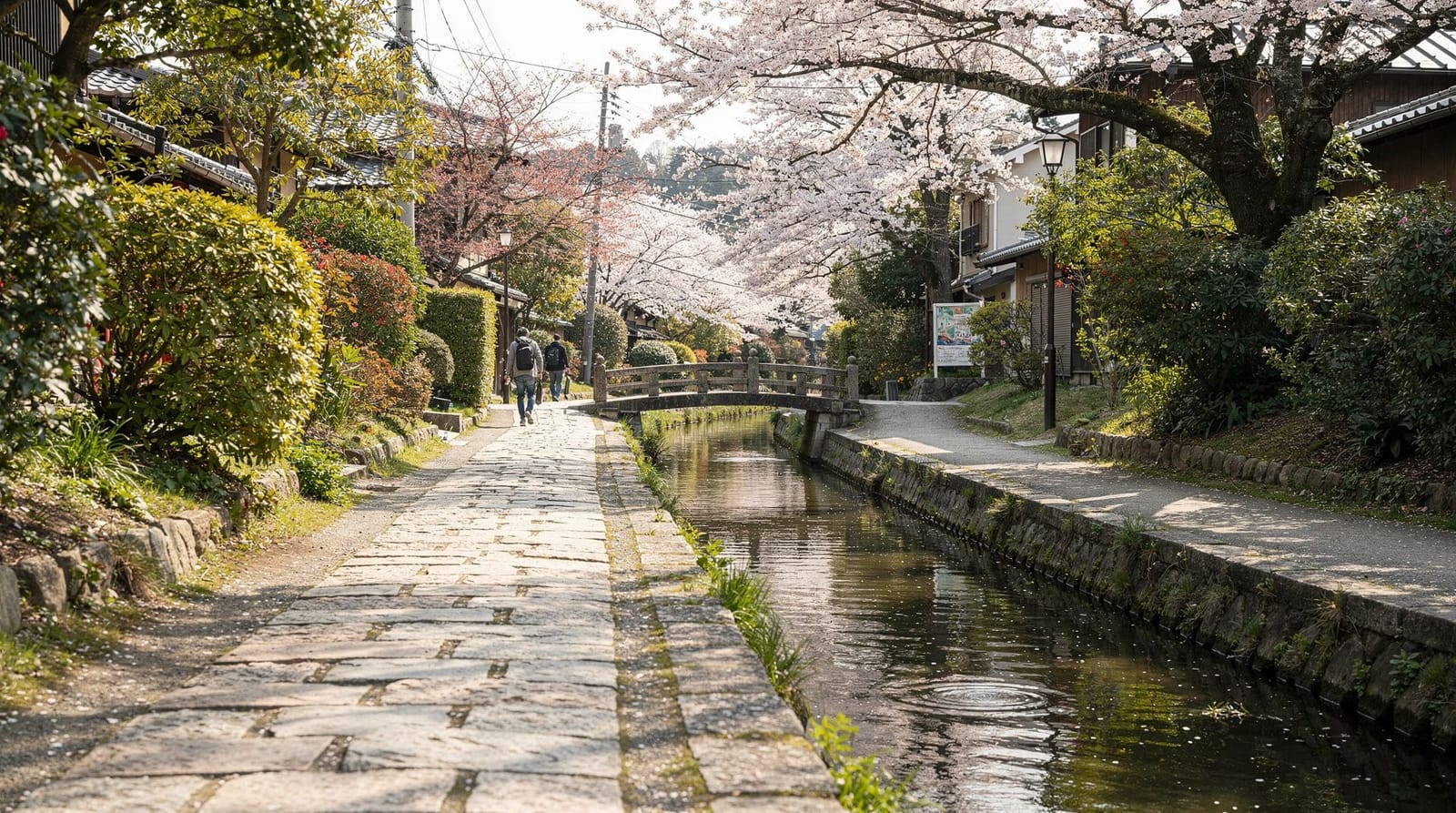
Part of that same canal system feeds the small aqueduct near Nanzen-ji — the brick Roman-style aqueduct arch that’s become one of Higashiyama’s more photographed structures — and a branch of the canal runs along part of the route now known as the Philosopher’s Path, where the canal water is what actually fills the canal-side walkway’s iconic waterway.
It’s a small detail, but a genuinely honest one to know before you visit either place: the picturesque canal walk in central Kyoto and the giant lake you’re standing next to in Otsu are literally the same water system, connected by 19th-century engineering rather than natural coincidence. For general background on Kyoto’s canal-adjacent walking routes, see our Nanzen-ji guide and Philosopher’s Path guide, both of which touch the far end of the same water Lake Biwa supplies.
Eating Omi beef while you’re in the area
Shiga Prefecture, of which Otsu is the capital, produces Omi beef — one of Japan’s three most historically prestigious wagyu brands alongside Kobe and Matsusaka beef, and arguably the oldest of the three, with a documented history going back centuries longer than Kobe’s modern branding. Restaurants around Otsu serving Omi beef, whether as steak, sukiyaki, or shabu-shabu, are generally less expensive and less tourist-oriented than the well-known Kobe beef restaurants back in Kansai’s bigger cities, simply because Otsu sees far fewer visitors specifically chasing wagyu.
If you’re already committed to a wagyu meal somewhere on your trip, doing it here rather than in a heavily marked-up Kyoto or Osaka restaurant is a genuinely reasonable way to get comparable quality for less, though it does mean planning a specific restaurant stop rather than relying on the convenience of a station-adjacent option.
A brief, genuinely capital history
One detail that surprises most visitors: Otsu was, briefly, the capital of Japan. In 667 CE, Emperor Tenji moved the imperial court here from Asuka, establishing the short-lived Otsu-kyo capital on the lake’s shore, before the court relocated again just five years later following Tenji’s death and the Jinshin War of 672.
Almost nothing physically remains of that original capital today — its exact site is still debated by archaeologists, and centuries of subsequent building on the same shoreline have erased most direct traces — but the episode is a genuine, if minor, footnote in the same broader story that eventually led to Kyoto (Heian-kyo) becoming the long-term imperial capital in 794. If you like the layered-history angle that runs through a lot of this region, it’s worth knowing that Otsu’s relationship to “the capital” predates Kyoto’s own by well over a century, even if the physical evidence is thin on the ground today.
Otsu’s more lasting historical role has been as a post town on the Tokaido, the great Edo-period highway connecting Kyoto and Tokyo (then Edo) — the last major stop before travelers reached Kyoto itself, and a logistics and trade hub for goods moving between the Kyoto region and the rest of Japan via the lake. That commercial role is part of why Otsu grew into a real city in its own right rather than staying a satellite village, and it’s part of why the area has enough temple density (Mii-dera, Ishiyama-dera, and several smaller sites) to support more than a single afternoon if you’re inclined to dig deeper.
Planning a Lake Biwa and Otsu half day
A realistic half day (roughly four hours including transit) covers one temple — Ishiyama-dera if the Genji connection interests you, Mii-dera if you’d rather prioritize the bell and cherry blossoms — plus either a short cruise or a walk along the lakefront promenade near Otsu port.
Trying to fit both temples and a full cruise into a half day is tight; if you want all three, budget closer to a full day, or consider a structured option like the three-hour private guided tour from Kyoto, which handles the logistics and typically covers the lakefront and a temple stop in one guided block, or the Otsu history, culture and faith walking tour if you’d rather explore on foot with a guide who can explain the Mii-dera and Ishiyama-dera history in context.
Because this is genuinely one of the shortest, easiest trips out of Kyoto, it also pairs unusually well with other plans the same day — a morning in Otsu followed by an afternoon back in Higashiyama or Gion, for instance, is realistic in a way that’s simply not true of most other destinations in this guide, which tend to consume the better part of a full day once transit is factored in.
For a broader sense of where Lake Biwa fits among Kyoto’s outlying options, see our best day trips from Kyoto guide and our getting around Kyoto guide for how JR and Keihan lines connect the wider region; if you’re relying on a rail pass for the rest of your trip, our JR Pass guide covers whether the Biwako Line trip is worth factoring into your pass math (usually a rounding error, given the short distance and low fare).
Lake Biwa and Otsu by season
Spring, roughly late March into early April, brings cherry blossoms along Otsu’s lakefront and around Mii-dera’s hillside grounds — a genuinely good, less crowded alternative to central Kyoto’s most famous blossom viewing spots, timed to almost exactly the same window; see our cherry blossom in Kyoto guide for how the two compare and how to time a visit to both in the same week if you’re around for it. Summer brings warm-weather cruising and, for the more adventurous, some limited swimming access along parts of the lakeshore further from Otsu’s built-up center, plus the cycling path at its most usable, before the weather gets uncomfortably humid by midday.
Autumn, especially November, turns Ishiyama-dera’s maples and the hillside around Mii-dera into a genuine foliage destination, calmer than the marquee spots back in the city. Winter is quiet and cold, with clear days offering the best long-distance visibility across the lake toward the mountains on the far shore — worth considering if photography is a priority and you don’t mind the cold, since haze is far more common in the warmer months.
This kind of easy, low-crowd, season-flexible profile is part of why Lake Biwa shows up as a recommendation in our off-the-beaten-path Kyoto itinerary — not because it’s obscure or hard to reach, but because so few visitors bother with it despite the short trip, leaving it consistently calmer than destinations that require far more effort to reach.
Honest planning notes
Don’t oversell this to yourself as a major excursion — Lake Biwa and Otsu are worthwhile specifically because they’re low-commitment, not because they compete with Kyoto’s headline sights or with a full day trip to somewhere like Nara. If you only have a few days in Kyoto and haven’t yet seen the central temples, prioritize those first; Lake Biwa is a strong choice for a spare afternoon or a slower final day, not a must-do that should displace Fushimi Inari or Kinkaku-ji.
Cruise schedules on the Michigan vary seasonally and some sailings require advance reservations, particularly dinner or special-event cruises — check current departure times before building your afternoon around a specific sailing, since showing up at the pier with no reservation can mean a multi-hour wait for the next available slot on a popular sunset cruise. Weather also affects the experience meaningfully more here than at an indoor temple hall: a hazy or overcast day genuinely diminishes the “largest lake in Japan” payoff, since much of the appeal is the open horizon view across the water. If you have flexibility, save this trip for a clear day.
Frequently asked questions about visiting Lake Biwa and Otsu from Kyoto
How far is Lake Biwa from Kyoto Station?
About 10 minutes by JR Biwako Line to Otsu Station, for roughly ¥240 (~$1.60) one way. It’s one of the shortest and easiest excursions from central Kyoto covered anywhere in this guide.
Is Lake Biwa really connected to The Tale of Genji?
Ishiyama-dera, near Otsu, has a centuries-old tradition holding that Murasaki Shikibu began writing the novel there in 1004 while looking out over the lake. The room associated with this story, Genji-no-Ma, is preserved on the temple grounds today.
What is the Michigan cruise boat?
The Michigan is a Mississippi-style paddle-wheel sightseeing boat operating from Otsu port on Lake Biwa, offering scenic, lunch, and sunset cruises generally running one to 1.5 hours, priced roughly ¥2,000-4,000+ (~$13-27+) depending on the cruise type.
Is Lake Biwa actually connected to Kyoto’s water system?
Yes. The Lake Biwa Canal, completed in 1890, channels lake water into Kyoto, including a branch that feeds the aqueduct near Nanzen-ji and runs alongside part of the Philosopher’s Path — the same water you see in both places.
How much time should I budget for a Lake Biwa day trip?
A half day (about four hours including transit) comfortably covers one temple and a short lakefront walk or cruise. A full day allows both Ishiyama-dera and Mii-dera plus a proper cruise, without rushing.
Is Mii-dera worth visiting if I’ve already seen Kyoto’s major temples?
Yes, particularly for its 1602 bell, one of Japan’s three most famous, and its relatively uncrowded cherry blossom grounds. It’s a different flavor of temple visit — Tendai Jimon-sect history and a sizable hillside complex — rather than a repeat of central Kyoto’s typical stops.
Can I combine Lake Biwa with other Kyoto sightseeing the same day?
Yes, more easily than most day trips in this guide, given the roughly 10-minute train ride each way. A morning in Otsu followed by an afternoon in central Kyoto neighborhoods like Higashiyama is realistic in a single day.
Do I need a reservation for the Michigan cruise?
Standard scenic cruises generally allow walk-up tickets, but dinner, sunset, and special-event sailings often require advance booking, especially on weekends. Check current departure times and availability before planning your afternoon around a specific sailing.
What is Omi Jingu and is it worth a stop?
Omi Jingu is a 20th-century Shinto shrine near Otsu honoring Emperor Tenji, who briefly moved Japan’s capital here in 667 CE. It’s also the venue for Japan’s official New Year’s karuta championship, since Tenji is credited with the opening poem in the classical anthology the game draws from. It’s a quiet, uncrowded stop worth combining with a Mii-dera visit given the short distance.
Should I choose Ishiyama-dera or Mii-dera if I only have time for one?
Choose Ishiyama-dera for the Tale of Genji literary connection and its distinctive wollastonite rock outcrops; choose Mii-dera for its famous 1602 bell and quieter cherry blossom grounds. Both cost around ¥600 and are reachable within 15-20 minutes of Kyoto Station.
Top experiences
Bookable activities with verified prices and instant confirmation on GetYourGuide.