Cherry blossoms in Kyoto — bloom forecast, best spots, and hanami rules
Kyoto: Guided Walking Tour around Philosopher’s Path
When and where should I see cherry blossoms in Kyoto?
Full bloom (mankai) typically lands in the first week of April, within a broader late-March-to-mid-April window that shifts 5-10 days year to year. The Philosopher's Path and Maruyama Park are the classic, most crowded spots; Daigo-ji and the Kamo River banks north of downtown offer a similar experience with noticeably fewer people.
| Full bloom window | Late March-mid April, most often first week of April |
| Bloom duration | 4-7 days at peak, ~2 weeks first flower to fall |
| Least crowded spot | Kamo River banks / Daigo-ji |
| Most crowded spot | Philosopher’s Path, Maruyama Park |
| Hotel premium | +60-100% above baseline |
Kyoto’s cherry blossom season lasts barely two weeks from first flower to falling petals, and most of that window is spent building toward or fading from a handful of truly spectacular days. This guide focuses narrowly on the sakura season itself — forecasting the bloom, ranking the viewing spots by what they’re actually like on the ground, and covering the hanami customs and illumination events that make the season more than just pink trees in photos. For a broader look at Kyoto’s whole calendar, see the best time to visit Kyoto guide; for the spring season as a whole, see Kyoto in spring.
How the bloom forecast actually works
The Japan Meteorological Corporation and several independent forecasters publish sakura bloom predictions starting in late January, refining them roughly weekly as spring approaches. Two dates matter: kaika (first bloom, when a reference tree — usually a specific tree monitored at a shrine or park — opens a set number of buds) and mankai (full bloom, typically 4-10 days after kaika, when the tree is at its visual peak).
Kyoto’s mankai has landed anywhere from late March to mid-April in the last several years, with the first week of April the most common window, but no forecast published more than 3-4 weeks out should be treated as precise. If sakura timing is the single priority for a trip, checking forecasts 3-4 weeks before departure and again a week out gives a realistic read, rather than booking flights around a fixed calendar date a year in advance.
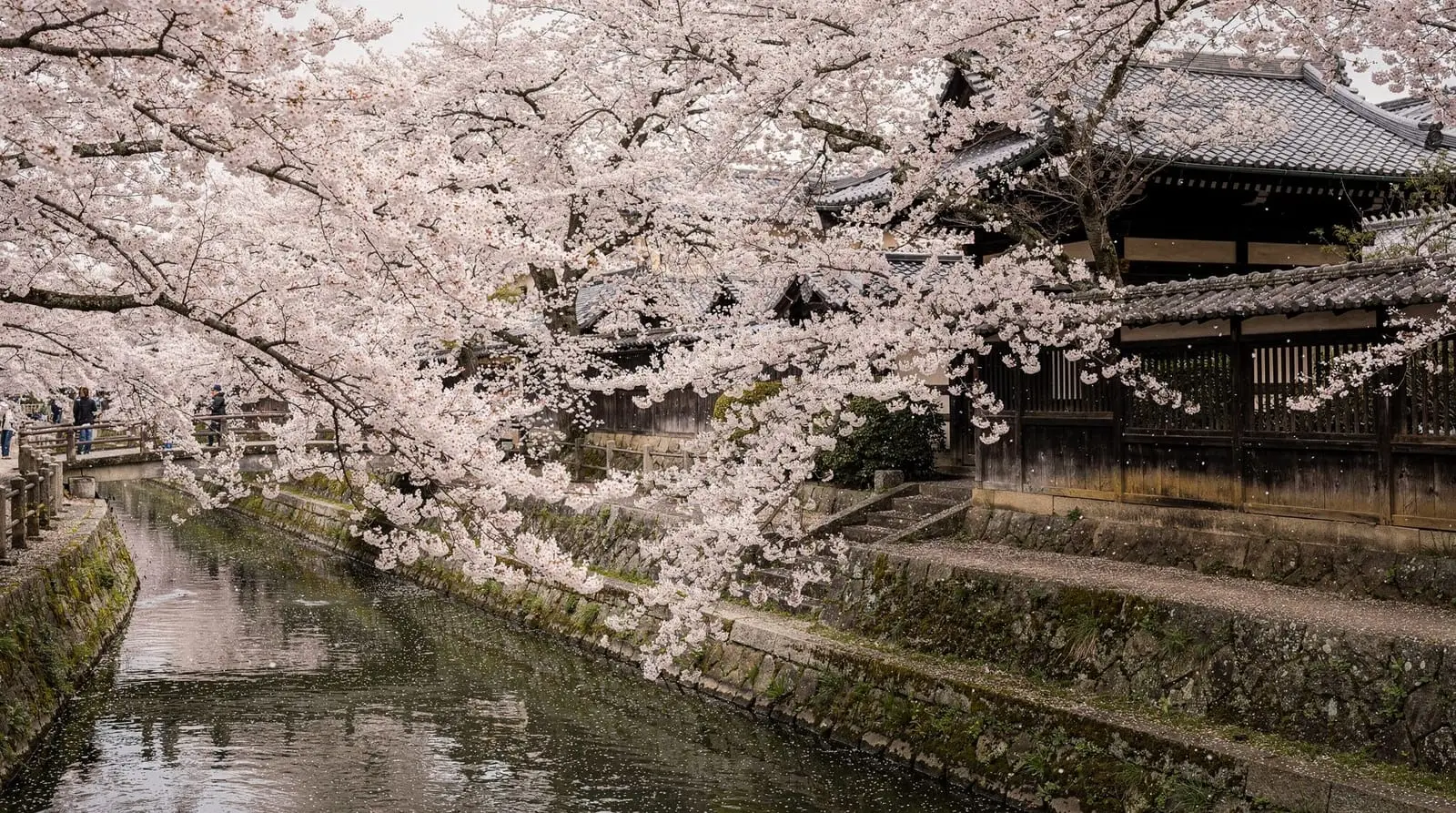
Once flowers open, the bloom period itself is short — full bloom typically holds for 4-7 days before petals start falling, and a period called hanafubuki (literally “flower snowstorm,” when petals drift and scatter in the wind) marks the tail end, which some visitors find as beautiful as the peak itself. A rainy or windy day during peak bloom can shorten the window considerably, which is part of why sakura trips carry more inherent scheduling risk than most seasonal travel.
The Philosopher’s Path: the classic choice, and its trade-offs
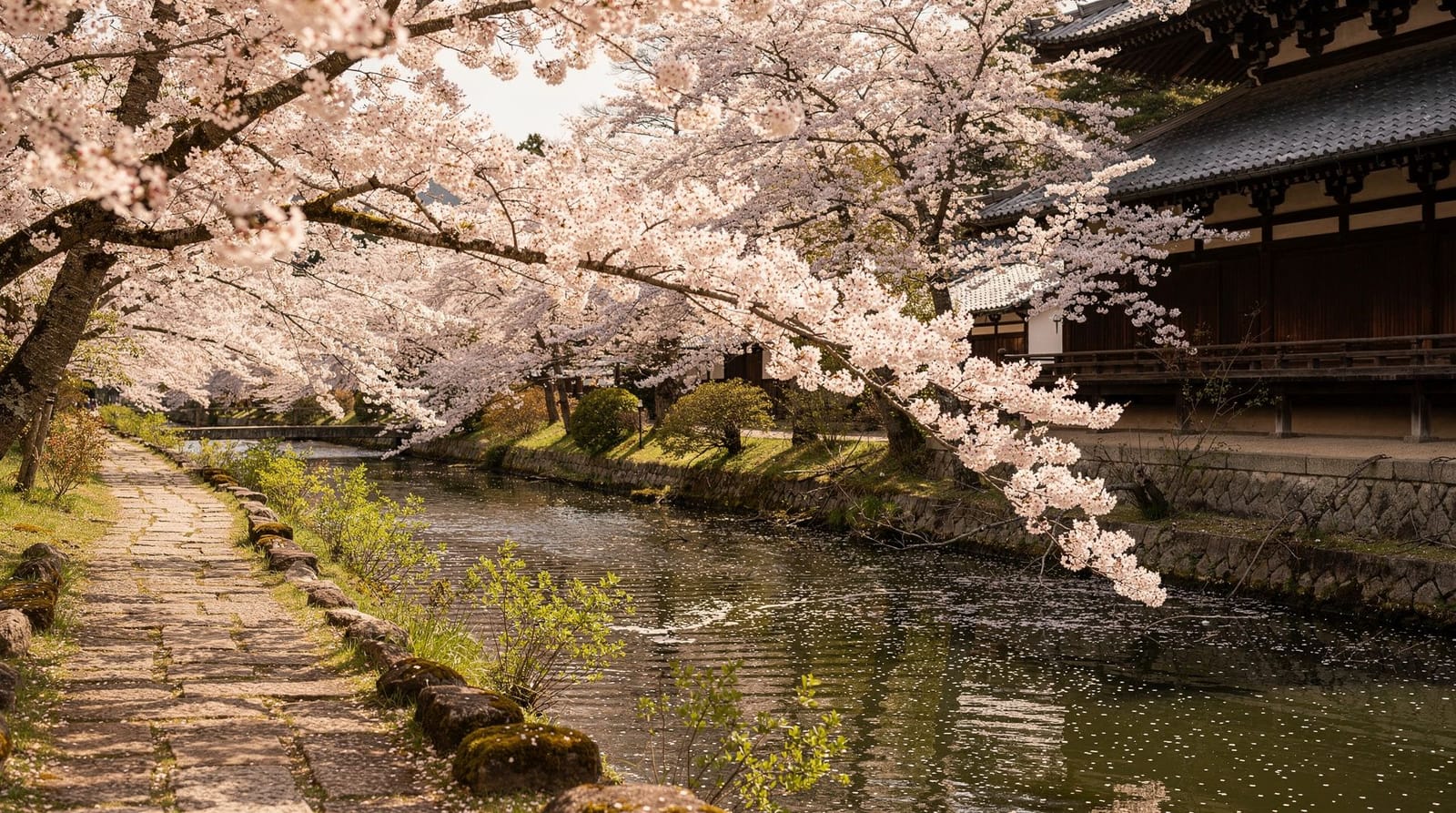
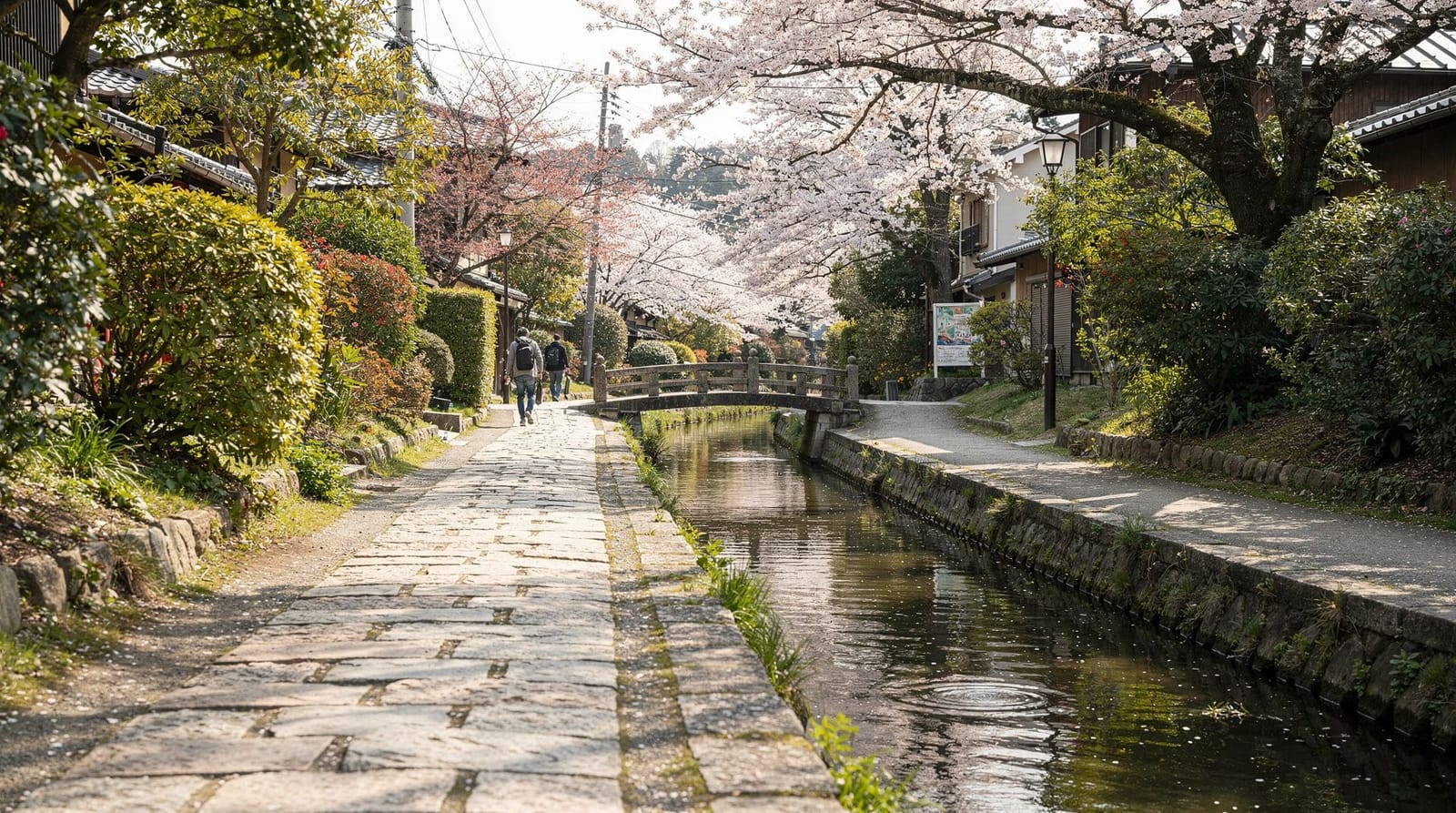
The Philosopher’s Path (Tetsugaku no Michi), a roughly 2km canal-side walking route in eastern Kyoto lined with several hundred cherry trees, is the single most photographed sakura spot in the city and the reason most sakura-season itineraries include a morning in the Higashiyama area. The path runs between Ginkaku-ji at the northern end and Nanzen-ji near the southern end, both worth combining with the walk itself.
Guided walking tour along the Philosopher’s Path timed for peak sakuraThe trade-off is crowd density: by mid-morning during peak bloom, the path’s narrow canal-side walkway can feel more like a moving queue than a quiet stroll, particularly on weekends. Arriving before 8am is the single most effective way to experience the path close to how it looks in photographs — after 9-10am, the crowd builds steadily through the afternoon and doesn’t meaningfully thin until early evening. See the Philosopher’s Path destination guide for a fuller neighborhood breakdown.
Maruyama Park: Kyoto’s hanami headquarters
Maruyama Park, adjoining Yasaka Shrine at the edge of the Gion and Higashiyama districts, is Kyoto’s oldest public park and its unofficial hanami capital — the large weeping cherry tree (shidare-zakura) at its center, illuminated at night during peak bloom, is one of the most recognizable single trees in the city. Unlike the Philosopher’s Path, Maruyama Park is built for picnicking: food stalls set up along the paths during peak season, and locals and visitors alike lay out blue tarps to claim ground space from midday onward on weekends.
This is the spot to experience actual hanami culture — groups picnicking, drinking, and socializing under the blossoms — rather than just viewing trees. It gets correspondingly crowded, especially in the evening once the illumination switches on, but the atmosphere (rather than a quiet photo) is the point here. Pair it with a walk through neighboring Gion or up into Higashiyama for temples and narrow lanes with their own scattered cherry trees.
Arashiyama: cherry blossoms with a different backdrop
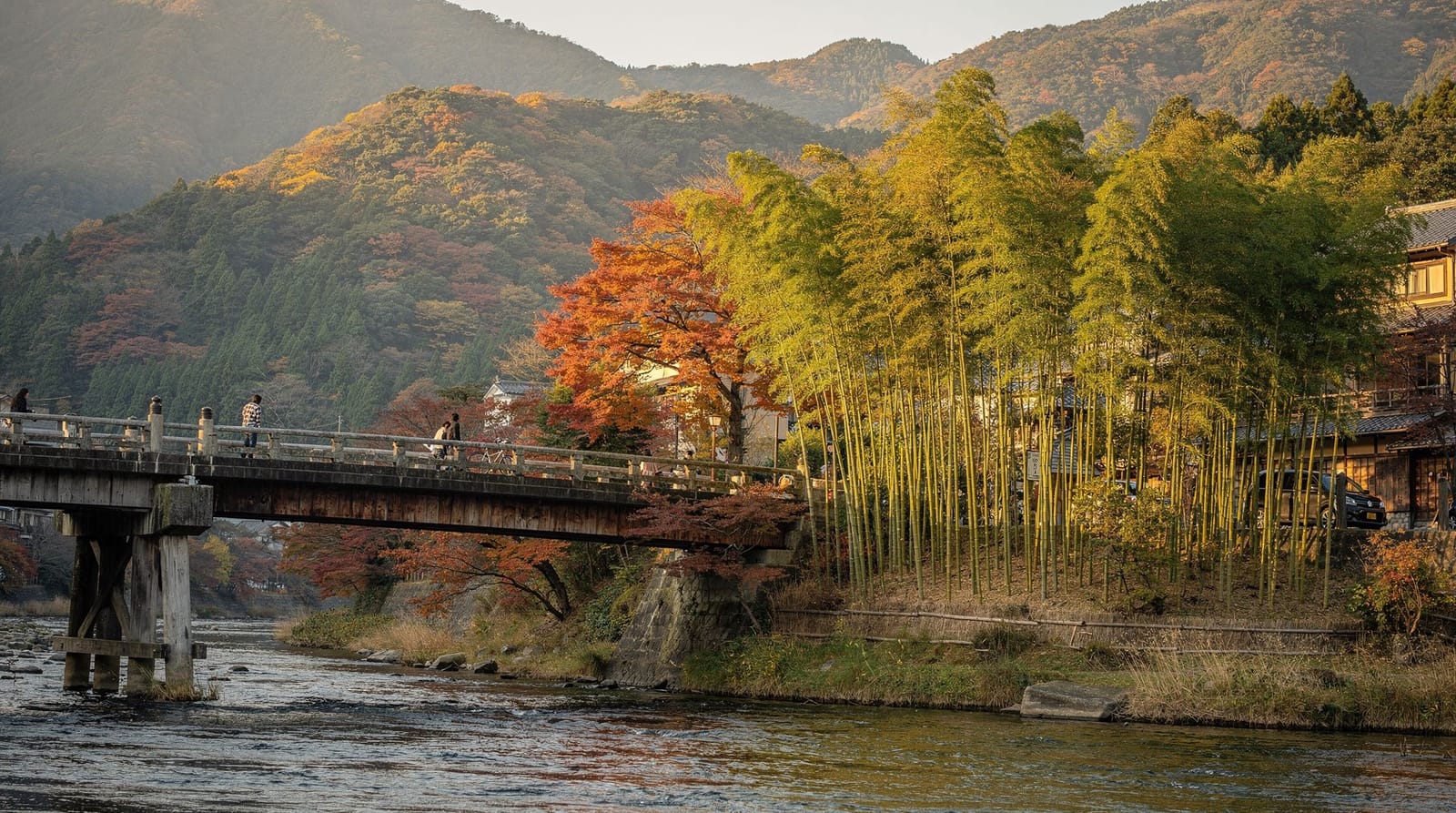
Arashiyama, on Kyoto’s western edge, combines sakura with its bamboo grove, the Togetsukyo Bridge over the Katsura River, and Tenryu-ji’s landscape garden — a genuinely different visual register from the Higashiyama temple-and-canal aesthetic. The riverside path near Togetsukyo Bridge, lined with cherry trees against the backdrop of the Arashiyama hills, is a distinct and less imitated composition than the Philosopher’s Path.
Arashiyama bamboo forest morning bike tour — built around the cooler, quieter early windowArashiyama draws heavy crowds regardless of season, and sakura season compounds that further, particularly around the bridge and main street. The same early-arrival logic applies here as elsewhere: a 7:30-8am start beats a mid-morning one by a wide margin. See the Arashiyama destination guide for the full neighborhood layout, including which streets get worst for crowds and when.
Daigo-ji: the quiet, historically weighty alternative
Daigo-ji, a UNESCO World Heritage temple complex in southeastern Kyoto with over 1,000 cherry trees spread across its lower and upper (Kami-Daigo) precincts, is comparatively overlooked given its size and history — it was the site of a famous 1598 hanami party hosted by the warlord Toyotomi Hideyoshi, an event still referenced in Japanese cultural memory. Because it sits further from the central Higashiyama cluster that dominates most sakura itineraries, it sees meaningfully fewer visitors relative to how much there actually is to see, making it one of the better trade-offs in the city for travelers who’ve already done the headline spots on a previous trip or who prioritize a calmer experience over a widely recognized backdrop.
The Kamo River: free, unstructured, and genuinely quiet
The Kamo River banks running north from downtown Kyoto, particularly between Demachiyanagi Station and Kitayama, line with cherry trees for a considerable stretch and see a fraction of the foot traffic of any named temple or park spot. There’s no admission, no illumination event, and no single iconic photo composition — just a long, walkable riverside with blossoms overhead, popular with locals for a jog or a quiet sit rather than as a tourist destination. It’s a reasonable choice for an unhurried morning or a break between more structured sightseeing, particularly for travelers who’ve already covered the marquee spots and want something less staged.
Night illuminations worth the ticket
A handful of temples run paid yozakura (night cherry blossom) illumination events during peak bloom weeks, lighting trees against temple architecture in ways that look genuinely different from daytime, rather than simply the same scene lit up. Kiyomizu-dera’s spring illumination, when it runs, lights the famous wooden stage and surrounding hillside cherry trees against the night sky — a striking, different composition from the daytime view.
Ninna-ji, home to a distinctive variety of low-growing, late-blooming cherry trees (Omuro-zakura) that bloom roughly a week after the rest of the city, also runs evening illumination during its own peak. Maruyama Park’s central weeping cherry is illuminated nightly during peak season at no separate cost beyond the park’s normal free access, making it the easiest illumination to catch without planning around a specific ticketed event.
Early morning Kiyomizu-dera to Gion tour — pairs well with an evening illumination visit to the same templeHanami etiquette and practical logistics
Hanami — the practice of viewing (and often picnicking under) blossoming cherry trees — has specific, mostly unwritten customs worth knowing before joining in. In designated hanami spaces like Maruyama Park, laying out a mat or tarp to claim space, eating, and drinking (including alcohol, which is legal in Japanese parks) are all normal and expected; the same behavior at a formal temple garden like Daigo-ji or Ninna-ji is generally out of place, where viewing rather than picnicking is the norm and eating is typically confined to designated rest areas.
Trash disposal is a genuine logistical issue during hanami season — public bins are scarce in Japan generally, and popular hanami spots get noticeably littered by evening if visitors don’t pack out what they bring. Carrying a bag for your own trash rather than assuming a bin will appear is a small but real courtesy. Cash matters too: food stalls that set up along the Philosopher’s Path and in Maruyama Park during peak season are frequently cash-only, so carrying yen rather than relying on cards is worth planning for specifically during this season.
Booking around sakura season
Hotel rates in central Kyoto commonly run 60-100% above baseline during the peak bloom week, and popular restaurants, ryokan, and even some paid temple experiences book out weeks to months ahead once forecast dates firm up. If sakura is the trip’s priority, booking accommodation with a flexible cancellation policy well before the forecast is confirmed, then adjusting arrival dates as the forecast narrows in the final month, is a more realistic strategy than trying to book a non-refundable trip around a single date chosen a year out.
See the Kyoto travel budget guide for how season-driven price swings factor into overall trip cost, and avoiding crowds in Kyoto for timing strategies that apply beyond just cherry blossom season.
If the bloom is early, late, or missed entirely
Because bloom timing shifts year to year, it’s worth planning a trip that still works even if the flowers haven’t opened yet or have already fallen by the fixed dates on a ticket. Building in one or two flexible half-days rather than dedicating an entire itinerary to a single park or path hedges against timing risk — if the Philosopher’s Path is past peak, Arashiyama or a higher-elevation, later-blooming spot may still be near its best, since bloom timing varies by several days even within the city depending on elevation and microclimate.
Late-blooming varieties, including the Omuro-zakura at Ninna-ji, extend the realistic sakura window by up to a week beyond the citywide average peak, which is worth knowing for trips booked slightly later than the forecast average.
Combining sakura with the rest of a Kyoto itinerary
Sakura sightseeing doesn’t need to consume an entire trip — a well-planned itinerary treats it as a layer over normal sightseeing rather than the whole plan. A morning at the Philosopher’s Path pairs naturally with Ginkaku-ji and Nanzen-ji at either end; an Arashiyama sakura visit combines easily with the bamboo grove and Tenryu-ji, already on most first-time itineraries. See how many days in Kyoto for general pacing, and Kyoto for first-time visitors for how a sakura-season trip fits into a broader first visit without over-indexing the whole itinerary on flowers alone.
Regional bloom variation within Kyoto
Bloom timing isn’t uniform across the city — lower-elevation, more urban spots (central downtown, the Kamo River banks) tend to bloom a few days earlier than higher-elevation or more sheltered locations, and this variation can be used deliberately to extend the practical viewing window on a fixed-date trip. If the Philosopher’s Path and Maruyama Park have already passed peak by the time a trip lands, higher-elevation temples in the northern hills, or Ninna-ji’s late-blooming Omuro-zakura variety, often still have flowers a week or more later than the citywide average.
Conversely, a trip arriving before the forecast peak can often still catch early bloomers in the city’s warmer, more sheltered downtown pockets even if the headline spots haven’t opened yet. Checking a bloom-progress map rather than relying on a single citywide date is worth the extra few minutes for any trip where sakura is the priority, since a five-day gap in bloom timing between neighborhoods is common in a typical year.
Sakura-season food and seasonal specialties
Cherry blossom season brings its own seasonal food traditions worth seeking out alongside the flowers themselves. Sakura mochi — a pink-tinted rice cake wrapped in a pickled cherry leaf, with a distinctive salty-sweet flavor from the leaf — appears in wagashi (traditional sweets) shops citywide during the season and makes a genuinely representative seasonal snack rather than a tourist novelty.
Hanami dango, three-colored (pink, white, green) skewered rice dumplings, is the traditional hanami-picnic sweet and is sold from stalls at Maruyama Park and along the Philosopher’s Path during peak weeks. Several cafés and restaurants also run limited-time sakura-themed menus during the season, generally available for the few weeks bloom lasts and gone once it passes, similar to how momiji season brings its own seasonal menu shifts later in the year.
Getting around during peak sakura season
Kyoto’s bus network, already a common bottleneck outside sakura season, runs at meaningfully reduced reliability during peak bloom weeks — routes serving the Philosopher’s Path, Arashiyama, and Kiyomizu-dera can run standing-room-only and behind schedule through the middle of the day. Walking or using the subway and train network, including the Keihan and Randen lines, which both serve major sakura spots, avoids the worst of the bus congestion.
Taxis, while more expensive, are a reasonable option during peak sakura week specifically, since the time saved versus a delayed, overcrowded bus can be worth the fare difference for a tightly scheduled day. Renting a bicycle is a genuinely underused option for covering ground between spots like the Philosopher’s Path and central Higashiyama without relying on buses at all.
Common sakura-season mistakes to avoid
The single most common mistake is booking a trip around a fixed calendar date without building in flexibility — bloom timing shifts by 5-10 days year to year, and a trip locked to specific non-refundable dates a year in advance carries real risk of missing peak bloom entirely. A second common mistake is spending the entire trip at the two or three most famous spots (Philosopher’s Path, Maruyama Park, Arashiyama) rather than mixing in a quieter alternative like Daigo-ji or the Kamo River banks, which often delivers a comparably beautiful experience with a fraction of the crowd stress.
A third is underestimating how early “early” needs to be — arriving at 8am rather than the more genuinely effective 7-7:30am at the most popular spots still means arriving into a meaningfully built-up crowd during the first week of April specifically, when demand is at its annual peak.
Sakura photography by time of day
Light quality changes the character of sakura photography considerably more than most visitors expect going in. Early morning (before 8am) offers soft, even light without harsh shadows, ideal for the Philosopher’s Path’s canal-side compositions and for capturing the Kamo River banks without crowds in frame. Midday’s harsher, more direct light tends to wash out the softer pink tones of blossoms, making it the least favorable window despite being when most casual visitors are out.
Late afternoon’s golden hour brings warm, angled light that works particularly well at Arashiyama, where the hillside backdrop catches color, and at Maruyama Park just before the evening illumination switches on, creating a brief transitional window with both natural and artificial light in the frame. Overcast days, common enough during early April, are underrated for sakura photography specifically, since diffused light renders the blossoms’ subtle color gradients more accurately than either harsh sun or artificial illumination.
What a realistic two-day sakura itinerary looks like
Two full days is enough to cover Kyoto’s essential sakura spots without over-scheduling around a single, fragile bloom window. A reasonable structure: day one opens at 7am on the Philosopher’s Path before the crowds build, continues into Ginkaku-ji and Nanzen-ji at either end of the path once it opens for the morning, and closes with an early-evening visit to Maruyama Park to catch the illuminated weeping cherry as dusk falls.
Day two shifts west to Arashiyama for a 7:30-8am start at the bamboo grove and riverside cherry trees, continues into Tenryu-ji once it opens, and — if timing and forecast allow — adds a stop at Daigo-ji or the Kamo River banks in the afternoon for a quieter counterpoint to the morning’s more crowded spots. This structure front-loads the two most crowd-sensitive locations into their respective early mornings while leaving flexibility for a bloom-forecast-dependent quieter alternative later each day.
Sakura beyond central Kyoto: day-trip options
If the headline central-Kyoto spots have already been covered on a previous trip, several nearby destinations offer sakura on the same general timeline with a genuinely different setting. Nara, about 45 minutes south, combines cherry blossoms in Nara Park with the deer that roam freely among the trees — a distinct visual pairing unavailable in Kyoto itself.
Himeji Castle, reachable as a longer day trip, is widely considered one of Japan’s best castle-and-sakura combinations, with hundreds of trees framing the white castle keep. Closer to home, Lake Biwa’s shoreline near Otsu offers a lakeside sakura walk with none of central Kyoto’s crowd density, worth considering for a quieter half-day during peak bloom week specifically.
If you miss sakura: plum blossoms as a genuine alternative
For travelers whose dates land too early for cherry blossoms, ume (plum) blossoms offer a real, if less famous, alternative rather than a consolation prize. Plum trees bloom several weeks before cherries, typically from early February into early March depending on the variety and location, with Kitano Tenmangu — a shrine with roughly 1,500 plum trees across its grounds — the city’s best-known dedicated viewing spot.
The atmosphere is noticeably calmer than peak sakura season: smaller crowds, no hanami-picnic culture built around it, and a longer, more forgiving bloom window than cherry blossoms’ short peak. It’s a reasonable trade for travelers with fixed February dates who’d otherwise miss flowering season entirely, and pairs naturally with the quieter, cheaper January-February travel window covered in the best time to visit Kyoto guide.
Frequently asked questions about Cherry blossoms in Kyoto — bloom forecast, best spots, and hanami rules
When exactly do cherry blossoms bloom in Kyoto?
What's the difference between kaika, mankai, and hanami?
Which Kyoto cherry blossom spot has the least crowds?
Are night illuminations at cherry blossom sites worth it?
Do I need to reserve a spot for hanami picnics in Maruyama Park?
What should I wear or bring for hanami in Kyoto?
Is it disrespectful to picnic under cherry blossoms at a temple?
Top experiences
Bookable activities with verified prices and instant confirmation on GetYourGuide.