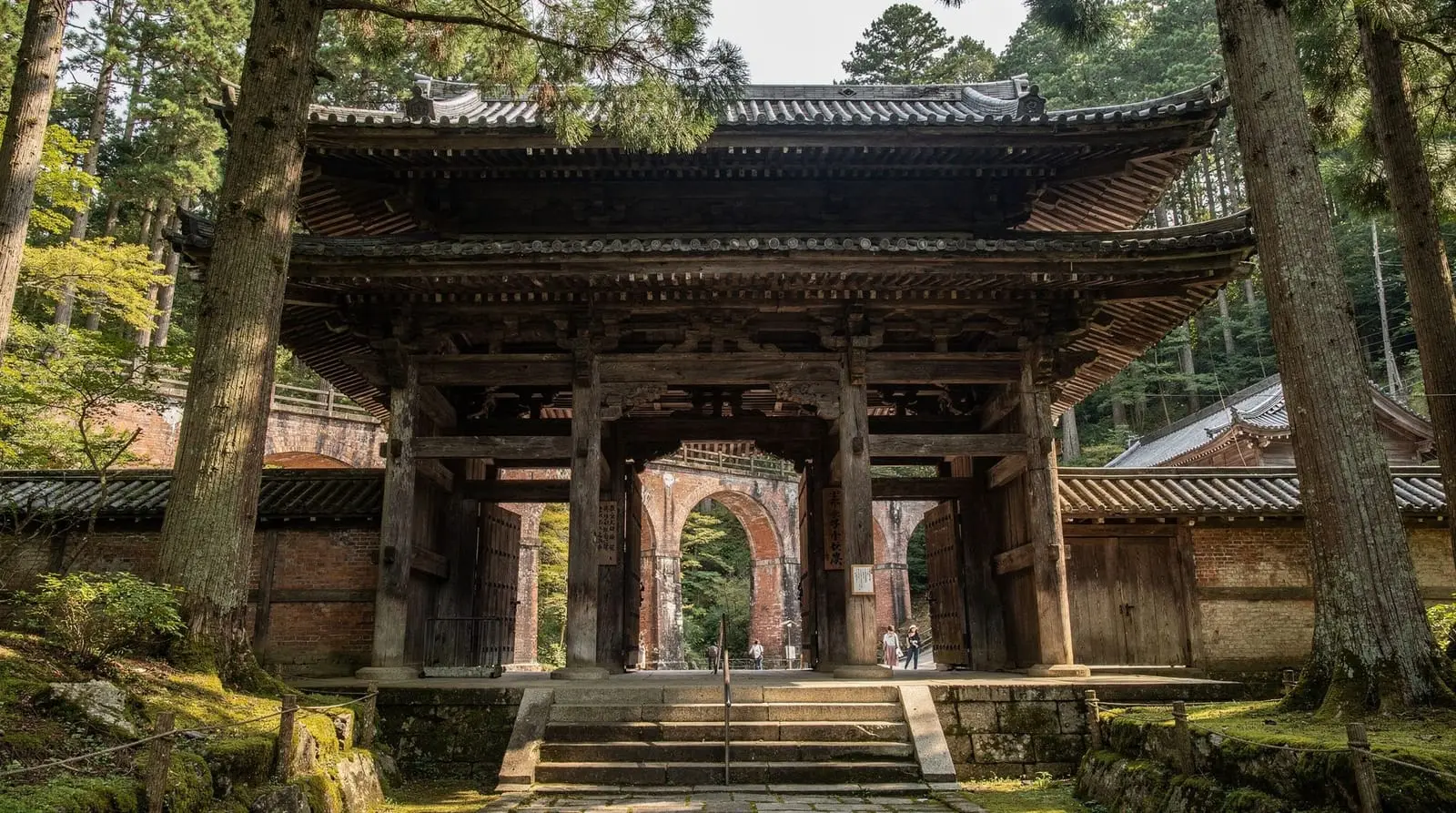
Nanzen-ji — Kyoto's highest-ranked Zen temple
Kyoto: Nanzenji Zen Walk Through Gardens and Historic Sanmon
What makes Nanzen-ji different from Kyoto's other big Zen temples?
Nanzen-ji holds a rank “above” the official Five Mountains (gozan) system of Rinzai Zen temples, making it formally the highest-ranked Zen temple in Japan. Its grounds combine a climbable Sanmon gate, a working 19th-century brick aqueduct (Suirokaku) that looks nothing like the rest of the temple, and several sub-temples with individually ticketed gardens. Entry to the main grounds is free; the Sanmon, Hojo garden and sub-temples charge ¥400–600 each.
Most first-time visitors to Nanzen-ji come for the aqueduct, not the temple. Suirokaku, a red-brick Meiji-era canal bridge running straight through the temple’s wooded grounds, is one of the more incongruous sights in Kyoto — Roman-looking arches in the middle of a 13th-century Zen complex — and it photographs well enough that it’s become the site’s most Instagrammed feature. That’s a reasonable entry point, but it undersells a temple that outranks every other Zen institution in Japan on paper and holds enough individually worthwhile corners to justify an hour or more beyond the bridge.
| Where | Southern end of the Philosopher’s Path, near Keage Station |
| Cost | Grounds/aqueduct free; Sanmon, Hojo, sub-temples ¥400-600 each |
| Time needed | 90 min (Sanmon + Hojo); 2-2.5 hrs with sub-temples |
| Getting there | 10 min walk from Keage Station (Tozai subway line) |
| Best time | Opening (8:40am) or after 3:30pm to avoid groups |
A temple ranked above the ranking system
Nanzen-ji was founded in 1291, when the retired emperor Kameyama converted his own detached palace on the site into a Zen temple, initially as a personal act of devotion after a dragon reportedly plagued the villa’s garden and a Zen priest (Mukan Fumon, the temple’s first abbot) was credited with calming it.
What matters more historically is its formal status: in the medieval Chinese-derived gozan (“five mountains”) ranking system that organized Japan’s major Rinzai Zen temples into a hierarchy, Nanzen-ji was placed not at the top of the five but formally above the ranking altogether — a category of its own, reflecting its direct imperial origin. In practical terms today that history shows up mostly in scale and endowment: Nanzen-ji is the head temple of its own branch of Rinzai Zen (the Nanzen-ji school), with more than 40 affiliated sub-temples nationwide and around a dozen on the immediate grounds, several of them individually open to visitors.
The Sanmon gate and the view from the top
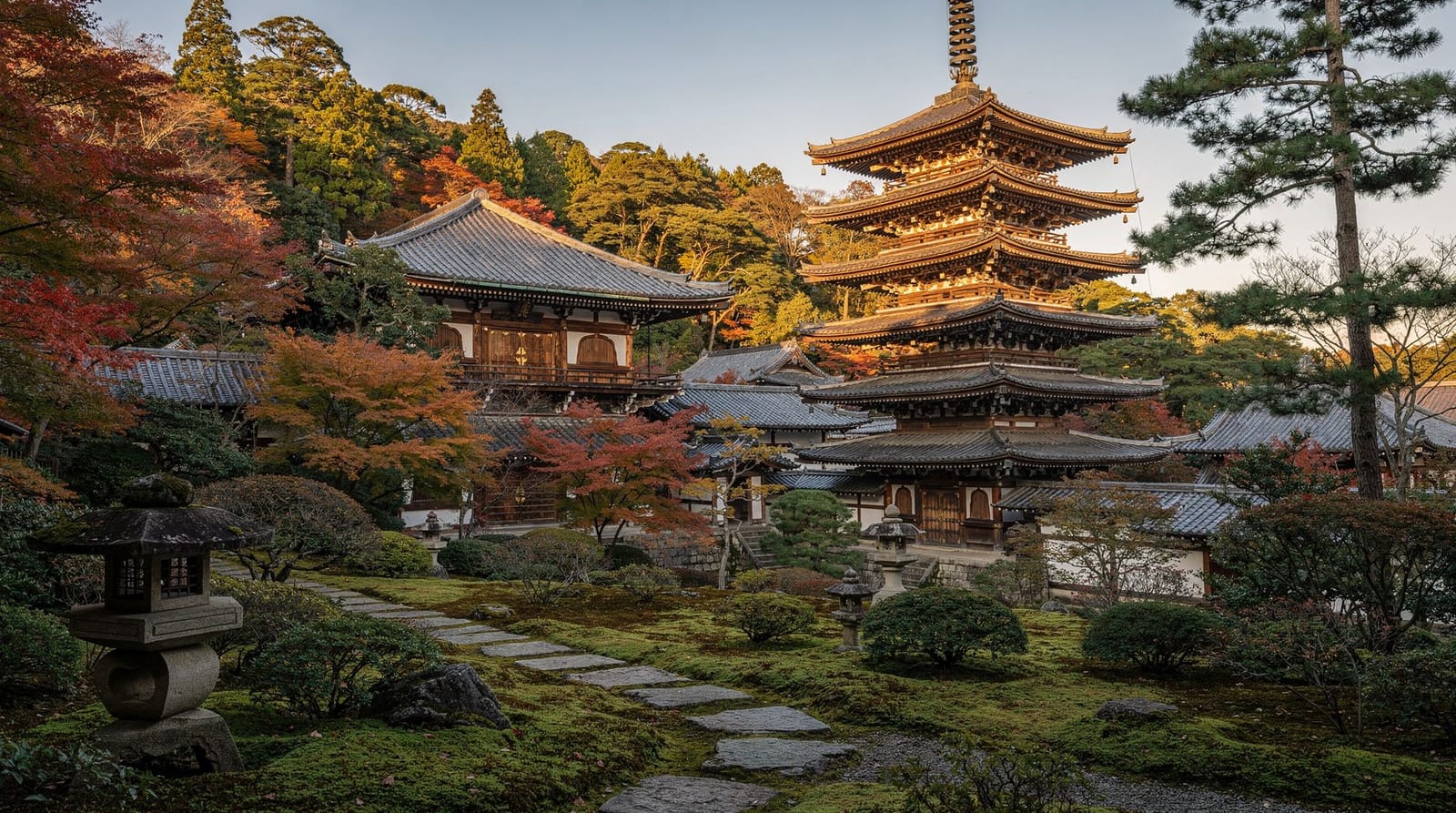
The Sanmon, Nanzen-ji’s main entrance gate, is a two-story wooden structure rebuilt in 1628 to honor soldiers who died in the Siege of Osaka, funded by the feudal lord Todo Takatora. It’s climbable — a steep, narrow staircase leads to an upper platform with views over the temple grounds and toward the eastern hills — for an admission fee of ¥600.
The gate has a specific pop-culture footnote in Japan: it’s the setting of a famous scene in the kabuki play Sanmon Gosan no Kiri, in which the legendary outlaw Ishikawa Goemon stands atop it, surveys the spring scenery, and declares “Zekkei kana, zekkei kana” (“what a view, what a view”), a line still quoted when Japanese visitors reach the top themselves. The climb is worth it less for the specific vista — pleasant but not dramatic by Kyoto standards — than for standing where a genuinely old piece of Japanese theater is set.
Guided walk through Nanzen-ji’s gardens and Sanmon gateSuirokaku: the aqueduct that shouldn’t be there
Suirokaku is a 93-metre brick aqueduct bridge, part of the Lake Biwa Canal (Biwako Sosui) project completed in 1890 to bring water — and hydroelectric power — from Lake Biwa in neighboring Shiga to Kyoto. Its Western-style red-brick construction was controversial when built, cutting directly through Nanzen-ji’s grounds at a time when the temple objected to the intrusion; more than a century later it has become one of the site’s defining images, and the canal still functions, carrying water audibly overhead when you stand underneath the arches.
It’s a five-minute walk from the Sanmon gate, clearly signposted, and free to view — no ticket required, unlike almost everything else on the grounds. Photographers come specifically for the symmetry of the brick arches receding into the trees; early morning, before tour groups arrive, is when the spot is actually empty enough to compose a shot without other people in frame. Water from the same canal continues north from here, feeding the flow that runs alongside the Philosopher’s Path.
The sub-temples: Nanzen-in, Konchi-in and Tenju-an
Nanzen-ji’s main hall and Sanmon are only part of the complex. Nanzen-in, reached by a short path past the aqueduct, occupies the site of Emperor Kameyama’s original villa and centers on a pond garden built around the same period as the temple’s founding — quieter and less visited than the main grounds, admission ¥400.
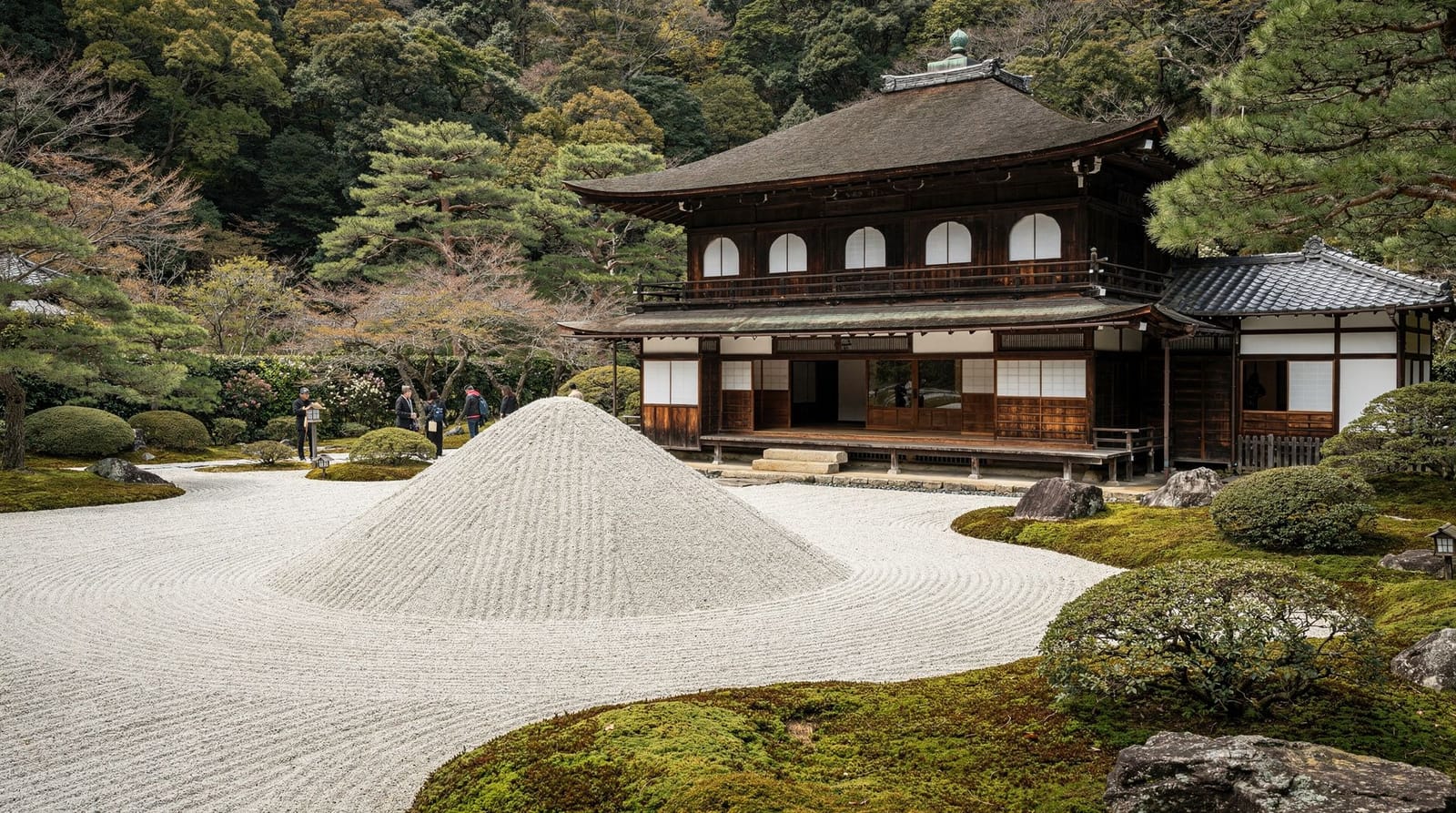
Konchi-in, a separate sub-temple a short walk from the main gate, holds a garden attributed to the influential landscape designer Kobori Enshu, commonly described as a “Crane and Tortoise” composition (rock groupings said to represent the two symbols of longevity) built to be viewed from a seated position inside the Kuri hall; Konchi-in also houses a small Toshogu shrine dedicated to Tokugawa Ieyasu, unusual for its setting inside a Zen temple compound. Admission to Konchi-in is ¥400. Tenju-an, near the main gate, has two connected gardens — a karesansui (dry rock) garden and a pond garden — and is often the quietest of the group even during peak momiji season, since it sits slightly off the main path most visitors follow.
The Hojo garden
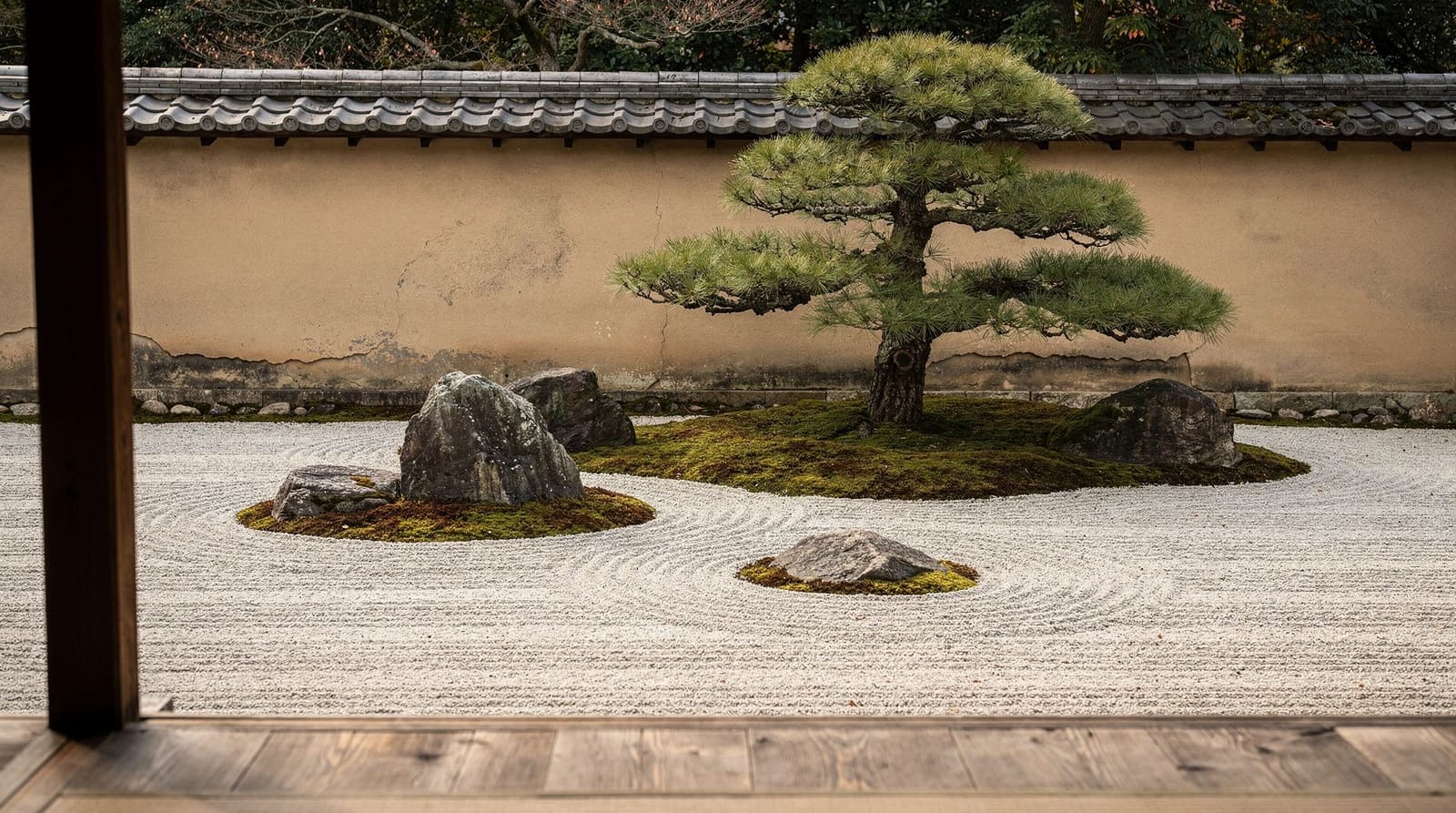
The temple’s main abbot’s-quarters garden (Hojo), separately ticketed at ¥600, is a karesansui rock garden traditionally known as “Tora no Ko Watashi” (“leaping tiger cubs crossing a river”), a reference to the arrangement of rocks set in raked white gravel. Attribution to Kobori Enshu is debated by garden historians, but the design is textbook late-Momoyama/early-Edo dry landscape work, meant to be viewed while seated on the veranda rather than walked through. It’s smaller and quieter than the equivalent gardens at Ryoan-ji or Tenryu-ji, and rarely crowded even when the aqueduct outside is busy with photographers.
Yudofu: Nanzen-ji’s specific food tradition
Nanzen-ji has one of the more specific food associations of any temple in Kyoto: yudofu, simmered tofu served in a simple kombu-based broth, has been made and eaten around the temple grounds since Edo times, when monks avoided meat and built entire meals around tofu’s texture and mild flavor. Several long-established restaurants sit directly on the approach to the temple, essentially unchanged in concept for generations — Okutan, just inside the temple precinct, has served yudofu on the same site since the 17th century, and Junsei, opposite the main approach, is similarly historic.
A yudofu set typically runs ¥3,500–6,000 per person, considerably more than an ordinary Kyoto lunch, and the meal is more about the ritual — small bites of plain tofu dipped in soy-based sauce with condiments, eaten slowly — than about bold flavor, which surprises visitors expecting something closer to a hearty meal. It’s a reasonable splurge if the concept of a centuries-old temple food tradition interests you, and a skippable one if it doesn’t; ordinary lunch options exist nearby for anyone not drawn to the yudofu experience specifically.
Seasonal notes: cherry blossoms and autumn foliage
Nanzen-ji doesn’t top most cherry-blossom lists — Maruyama Park and the Philosopher’s Path get more attention in early April — but the approach path and the area around the Sanmon gate have a reasonable scattering of cherry trees, and the nearby Keage Incline (described below) is a genuinely underrated bloom spot.
Autumn is the stronger season here: the wooded approach to the aqueduct and the grounds around Nanzen-in turn color in mid-to-late November, and because Nanzen-ji draws less specifically foliage-focused crowds than Tofuku-ji or Eikando (a foliage-famous temple a short walk north), the color here can be enjoyed with meaningfully less congestion. Eikando itself — technically a separate temple, not part of Nanzen-ji — is worth knowing about if in the area specifically for autumn leaves; it’s one of Kyoto’s most concentrated momiji displays and sits only a 10–15 minute walk north along the base of the hills.
Admission add up quickly — budget for it
Unlike temples with a single combined ticket, Nanzen-ji charges separately for each element: the main grounds and Suirokaku aqueduct are free to enter and view, but the Sanmon gate (¥600), Hojo garden (¥600), Nanzen-in (¥400) and Konchi-in (¥400) are each individually ticketed, with no discounted combination pass as of this writing. Seeing everything costs roughly ¥2,000 (about US$13) per adult. Most visitors are better served picking two or three elements rather than all of them — the Sanmon climb plus the Hojo garden covers the temple’s two signature architectural experiences in under 90 minutes, with the aqueduct as a free add-on on the way in or out.
The dragon ceiling and other details easy to miss
Beyond the headline features, a handful of smaller details reward visitors who slow down. The Hatto (Dharma Hall), rebuilt in 1909 after fire damaged the original, has a ceiling painting of a coiling dragon by the artist Imazu Tessin, in the tradition of “cloud dragon” ceiling paintings found at several major Rinzai Zen temples across Japan — the idea being that the dragon, as a rain deity, offers spiritual protection against fire for a wooden building.
The Hatto is generally viewable from the entrance without a separate ticket, though interior access is sometimes restricted; check current signage. Near the approach to Nanzen-in, small stone markers and inscriptions commemorate the site’s history as an imperial villa before its conversion to a temple, easy to walk past without noticing amid the more photogenic aqueduct nearby.
Why the aqueduct still matters today
It’s worth understanding that Suirokaku isn’t a decorative ruin — the Lake Biwa Canal it belongs to remains an active part of Kyoto’s water infrastructure, supplying drinking water and, historically, powering some of Japan’s earliest commercial hydroelectric plants, which in turn helped power the country’s first electric tram line, launched in Kyoto in 1895.
That the canal still functions, still audibly carrying water overhead when visitors stand beneath the brick arches, connects a 19th-century engineering project directly to the present in a way that’s easy to miss if the aqueduct is treated purely as a photo backdrop. The canal continues north from Nanzen-ji, its associated waterway feeding the stream that runs alongside the Philosopher’s Path — meaning the aqueduct at Nanzen-ji and the picturesque canal walk further north are, quite literally, the same body of water at different points along its route.
Getting there and timing the visit
Nanzen-ji sits at the southern end of the Philosopher’s Path, about a 10-minute walk from Keage Station on the Tozai subway line, or a similar walk from the southern trailhead of the path itself if arriving from Ginkaku-ji. The nearby Keage Incline — a disused railway incline once used to haul boats between canal levels, now a walking path lined with cherry trees — is worth the short detour in early April, when it becomes one of the city’s better cherry-blossom photo spots without Maruyama Park-level crowds.
Nanzen-ji itself is busiest late morning through early afternoon and during the November momiji season, when the approach path and aqueduct both fill with tour groups; arriving at opening (8:40am) or after 3:30pm avoids most of it. Combined with a walk up the Philosopher’s Path toward Ginkaku-ji, Nanzen-ji makes a natural half-day anchor for the eastern side of the city.
Comparing Nanzen-ji to Kyoto’s other major Zen temples
Kyoto has several large Rinzai Zen complexes that can start to blur together on a busy itinerary, and it’s worth being clear about what sets each apart. Tenryu-ji in Arashiyama shares Nanzen-ji’s “walkable complex” structure but centers its identity on a single, cohesive pond garden with borrowed-scenery views of the hillside behind it — a more unified visual experience than Nanzen-ji’s scattered mix of gate, aqueduct and separately ticketed sub-temples. Tofuku-ji, similarly large, is defined by its valley setting and modern Shigemori-designed gardens rather than any single architectural landmark.
Nanzen-ji’s distinguishing feature is really the contrast between elements: a 17th-century wooden gate, a 19th-century brick aqueduct, and Momoyama-era garden design all sit within a few minutes’ walk of each other, which makes it feel less like one coherent statement and more like a working museum of different periods of Japanese design history layered on top of each other. For a visitor trying to choose one Zen complex rather than several, Nanzen-ji is the strongest pick specifically for that variety; Tenryu-ji or Tofuku-ji are stronger picks for a single, more focused visual experience.
A brief note on Rinzai Zen practice
Nanzen-ji, like Tofuku-ji, remains an active Rinzai Zen training institution rather than a purely historical site, and its head-temple status means it oversees training and certification for affiliated temples in its branch nationwide. Rinzai Zen, one of the two major schools of Zen Buddhism practiced in Japan (the other being Soto), places particular emphasis on koan practice — contemplation of paradoxical questions or statements used to push a student past ordinary logical thinking toward direct insight — alongside seated meditation (zazen).
Most visitors won’t encounter this side of Nanzen-ji directly on an ordinary sightseeing visit, since training areas are generally closed to the public, but it’s useful context for understanding why the complex feels different in character from a purely ornamental garden temple: parts of it are, quite literally, still functioning as a monastery today, with monks in residence and a training schedule that continues regardless of the tourist season outside its walls.
A realistic one-hour route if you’re short on time
For visitors with limited time who still want the temple’s two signature elements, this order works well from the main approach: walk past the free Suirokaku aqueduct first (5-10 minutes, worth doing before the Sanmon since it’s on the way regardless), climb the Sanmon gate (¥600, allow 15-20 minutes including the stairs and the view from the top), then finish at the Hojo garden (¥600, 15-20 minutes seated on the veranda).
That covers the aqueduct, the climbable gate, and the main dry-landscape garden in roughly an hour including the walk between them, leaving the sub-temples (Nanzen-in, Konchi-in, Tenju-an) for a longer visit if time allows. Anyone connecting onward to Ginkaku-ji via the Philosopher’s Path should budget this hour before starting the walk north, since Nanzen-ji sits right at the trailhead.
Comparing Nanzen-ji’s paid elements
| Element | Cost | Time | Worth it if |
|---|---|---|---|
| Suirokaku aqueduct | Free | 5-10 min | Always — free and iconic |
| Sanmon gate climb | ¥600 | 15-20 min | You want the view + kabuki history |
| Hojo garden | ¥600 | 15-20 min | Dry-garden design interests you |
| Nanzen-in | ¥400 | 15-20 min | You want a quieter pond garden |
| Konchi-in | ¥400 | 20-25 min | Kobori Enshu gardens interest you |
Frequently asked questions about Nanzen-ji
Is Nanzen-ji free to visit?
The main grounds and the Suirokaku aqueduct are free to enter and view. The Sanmon gate (¥600), Hojo garden (¥600), and sub-temples Nanzen-in (¥400) and Konchi-in (¥400) each require a separate ticket.
What is Suirokaku and why does it look out of place?
Suirokaku is a red-brick aqueduct bridge completed in 1890 as part of the Lake Biwa Canal project, built in a Western engineering style that contrasts sharply with the surrounding Zen architecture. It still carries water today and is free to view.
Can you climb the Sanmon gate at Nanzen-ji?
Yes, for a ¥600 ticket. A steep interior staircase leads to an upper platform with views over the grounds — the same gate is the setting for a famous scene in the kabuki play Sanmon Gosan no Kiri.
How long does a full visit to Nanzen-ji take?
Seeing the aqueduct, climbing the Sanmon and visiting the Hojo garden takes about 90 minutes. Adding one or both sub-temples (Nanzen-in, Konchi-in) brings a thorough visit to 2–2.5 hours.
Is Nanzen-ji connected to the Philosopher’s Path?
Yes — Nanzen-ji sits at the southern trailhead of the Philosopher’s Path, the canal-side walking path that runs north toward Ginkaku-ji, making the two a natural half-day combination.
Is Nanzen-ji crowded during cherry blossom or autumn foliage season?
Yes, particularly the approach path and the aqueduct in November. Early morning (before 9am) is meaningfully quieter than midday during both peak seasons.
Is Nanzen-ji suitable for visitors with mobility concerns?
The main grounds and the path to the aqueduct are flat, wide gravel paths suitable for most visitors, including wheelchair users with assistance over gravel surfaces. The Sanmon gate’s interior staircase is steep, narrow and not accessible; visitors unable to manage stairs should treat the gate as a photo stop from outside rather than a climb.
Which sub-temple garden should I prioritize if I only have time for one?
Konchi-in, for its Kobori Enshu-attributed “Crane and Tortoise” garden and the unusual Toshogu shrine inside a Zen compound, edges out Nanzen-in and Tenju-an for most first-time visitors, though Tenju-an is the quietest option if avoiding crowds is the priority.
Top experiences
Bookable activities with verified prices and instant confirmation on GetYourGuide.