Kobe
Kobe day trip from Kyoto — where to actually eat certified Kobe beef, Nada sake breweries, Kitano-cho, and a 50-minute direct train.
Kobe: premium Kobe beef & sake tasting culinary experience
Duration: 4 hours
Quick facts
- Distance from Kyoto
- ~50-52 min by JR Special Rapid
- One-way fare
- ¥1,110 (~$7.40)
- Recommended time
- Full day
- Known for
- Kobe beef, Nada sake, Kitano-cho
- Best season
- Year-round; autumn for Mount Rokko views
- Combine well with
- Osaka, Himeji
Is Kobe worth a day trip from Kyoto? Yes, if you want to eat genuinely certified Kobe beef, taste sake at a working Nada district brewery, and walk a preserved 19th-century foreign settlement — three things Kyoto itself cannot offer. The train from Kyoto Station is direct and takes under an hour, and a full day lets you cover the beef, the sake, and the harbor without rushing — one of several worthwhile day trips from Kyoto.
Why so much “Kobe beef” outside Kobe isn’t actually Kobe beef
Kobe beef is not a marketing term you can slap on any expensive steak — it is a legally defined product tied to one specific animal, one specific region, and a strict certification process. To carry the name, the meat must come from Tajima-strain wagyu cattle that were born, raised, and slaughtered entirely within Hyogo Prefecture (the prefecture Kobe sits in), and the carcass has to meet a minimum marbling grade (BMS 6 or higher on Japan’s Beef Marbling Standard) along with weight and yield criteria set by the Kobe Beef Marketing and Distribution Promotion Association.
Only cattle that clear every one of those bars get a numbered certificate and a chrysanthemum-shaped seal — restaurants that genuinely serve it can produce that certificate on request, and the better ones frame it or print the head number on the menu.
The catch: none of that stops a menu in Osaka, Kyoto, or Tokyo from printing “Kobe beef” in English next to a photo of a marbled steak that is, in reality, generic wagyu or even non-Japanese beef with no certification behind it at all. This happens constantly around Kyoto’s tourist strips — Gion, Kawaramachi, and the streets near Kyoto Station all have restaurants trading on the name.
There is no law against printing “Kobe beef” on an English-language menu aimed at tourists the way there would be against a Japanese-language claim to a protected designation, so the burden falls on the diner to check. If real certified Kobe beef matters to you rather than just “a nice wagyu steak,” the reliable way to get it is to eat it in Kobe itself, at a restaurant that can show you the certificate.
Two Kobe teppanyaki restaurants worth naming: Steakland Kobe, a long-running Sannomiya spot that is comparatively affordable for the category (lunch courses from around ¥3,000-5,000, or roughly $20-33) and popular enough that it takes reservations days in advance for dinner; and Kobe Beef Steak Ishida, a smaller, higher-end teppanyaki counter where a chef grills each course in front of you and dinner courses commonly run ¥15,000-25,000 (~$100-167) per person.
Neither is a secret — both show up in most guidebooks — but both are certified, which is more than plenty of cheaper “Kobe beef” spots elsewhere in Japan can say. If you want to taste it without committing to a full steak dinner, a guided Kobe beef and sake tasting culinary experience packages a smaller certified portion with a sake flight, which is a reasonable way to sample the real thing without the teppanyaki price tag.
Nada — one of Japan’s great sake-brewing districts
Kobe’s Nada district, stretching along the coast between central Kobe and Osaka, has been one of Japan’s most important sake-producing regions since the Edo period, and it still accounts for a large share of national sake production today. The reason is water: the Rokko mountain range behind the city filters mineral-rich groundwater known as miyamizu, prized for centuries for producing clean, well-balanced sake, and several breweries built their operations specifically to draw on it.
Hakutsuru and Kiku-Masamune are the two most visitor-friendly names in Nada — both run museum-style brewery buildings a short walk or bus ride from Sumiyoshi or Uozaki stations, with old brewing equipment on display and tasting counters at the end. Entry to the museum sections is often free or a token ¥300-500 (~$2-3.30), and tastings typically run a similarly small fee per pour, though some seasonal or premium bottles cost more. It’s a low-commitment stop — most visits take 45 minutes to an hour — and unlike the Fushimi sake district back in Kyoto, Nada’s breweries are set right against the water, giving the area a different, more industrial-maritime character.
If you’d rather have a guide handle logistics and pick the pours, a Kobe sake brewery tour with tasting covers the walking and the language gap, and the sake brewery tour paired with Kobe beef nigiri is a tidy way to combine both of Kobe’s signature flavors into a single afternoon rather than treating them as two separate errands.
Kitano-cho: the most European corner of Japan
Kobe was one of the treaty ports forced open to foreign trade in 1868, and Kitano-cho — the hillside district just north of Sannomiya Station — is where the foreign merchants, diplomats, and traders who settled here built their homes. Roughly twenty of those Meiji- and Taisho-era Western-style houses, known locally as ijinkan (“foreigners’ houses”), survive today, and a cluster of the best-preserved ones is open to the public as small museums, each with its own modest entry fee (typically ¥300-750, ~$2-5, per house, with combination tickets available if you want to see several).
The effect walking these streets is genuinely unusual for Japan — half-timbered Tudor-style facades, a Dutch-consulate-turned-museum, a house built for a French trading family, all packed into a compact, walkable hillside neighborhood with narrow lanes and outdoor cafes. It’s not trying to be a theme park; these are real preserved buildings tied to a specific and unusual chapter of Japanese history, when Kobe functioned as one of the country’s few windows onto the outside world. Give it an hour to ninety minutes if you’re just walking through, longer if you want to go inside several of the houses.
Harborland, Meriken Park, and a quiet reminder of 1995
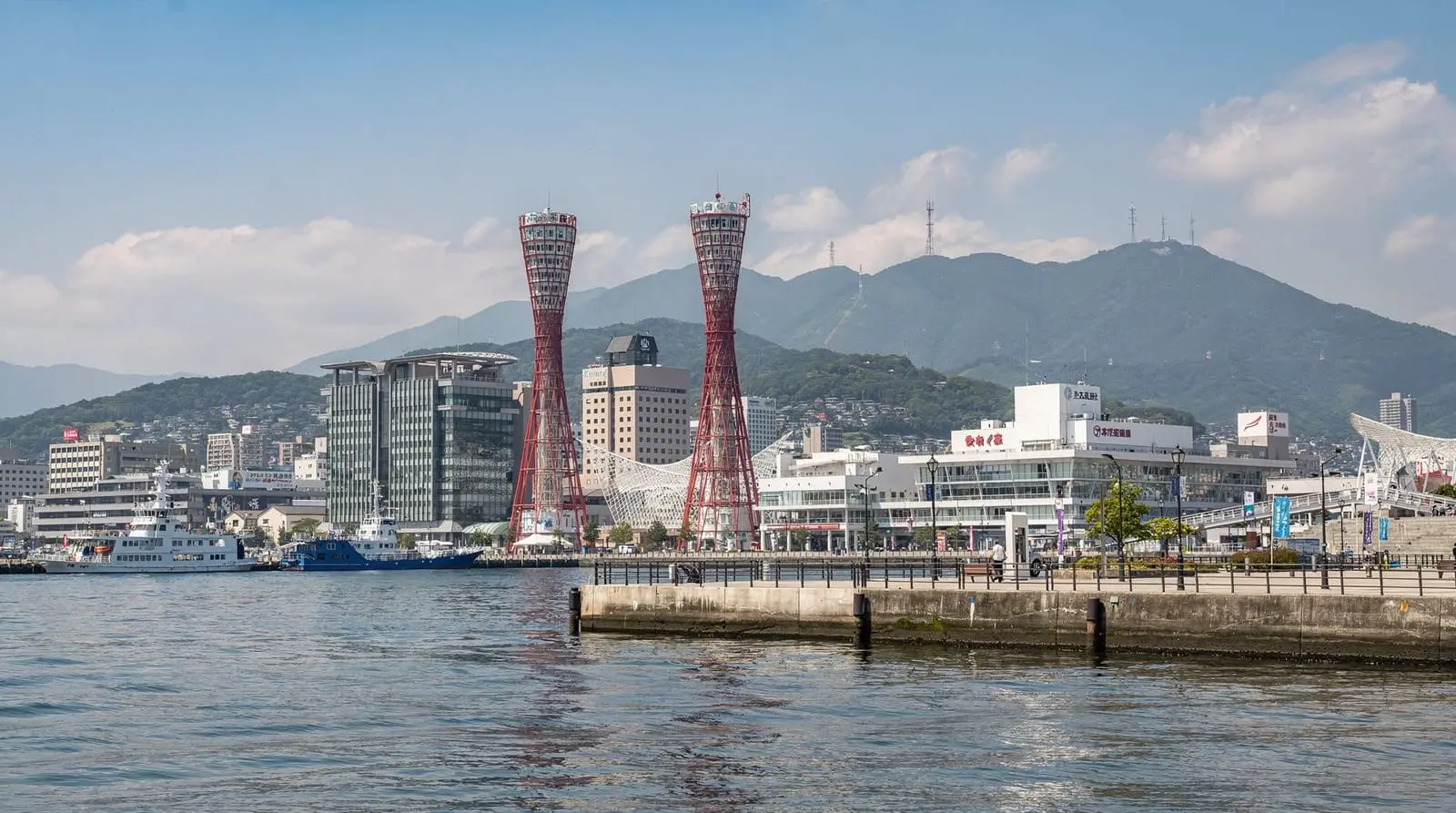
South of the main downtown grid, Kobe Harborland and the adjoining Meriken Park form the city’s waterfront face — a mix of shopping complexes, the red steel lattice of Kobe Port Tower, and open plaza space looking out over the bay. It’s a pleasant, unhurried place to walk after a heavier morning of eating and sightseeing, and it’s free to wander even if you skip the paid observation deck inside the Port Tower.
Meriken Park is also home to the Kobe Port Earthquake Memorial Park, a small preserved section of the original 1995 harbor that has been deliberately left tilted and cracked, with information panels explaining the damage. The Great Hanshin earthquake killed more than 6,000 people and devastated much of central Kobe, and the memorial is understated rather than dramatic — worth a quiet ten minutes if you’re in the area, both as a piece of real modern history and as context for how thoroughly the city has since rebuilt.
Mount Rokko: one of Japan’s “three great night views”
If you’re staying for evening, the Rokko mountain range that shelters Nada’s breweries also gives Kobe one of its best-known attractions after dark. A cable car (the Rokko Cable Line) climbs from the base near Rokko Cable Shita Station up toward the summit area, where an observation platform looks out over Kobe, Osaka Bay, and on a clear night, the lights of Osaka itself spread out below. The view is commonly ranked, along with Hakodate and Nagasaki, as one of Japan’s “three great night views” (Nihon Sankei Yakei), and it earns the comparison on a clear evening.
Getting to the base involves a short train-and-bus combination from central Kobe, and the round trip plus time at the top realistically takes two to three hours, so it works best as a capstone to the day rather than something squeezed in alongside everything else. If your schedule is tighter, it’s the single most skippable item on this list — the beef, the sake, and Kitano-cho are the harder-to-replicate reasons to come to Kobe specifically.
Kobe’s history as one of Japan’s treaty ports
Kitano-cho’s foreign houses only make sense in light of Kobe’s broader history as one of Japan’s earliest points of contact with the outside world. When the Tokugawa shogunate’s centuries of near-total isolation ended in the 1850s and 1860s, a handful of ports were designated for foreign trade and residence, and Kobe — then a modest fishing town — was opened in 1868, the same year as the Meiji Restoration. Within a few decades it had grown into one of Japan’s busiest international harbors, drawing merchants, missionaries, and diplomats from Britain, the Netherlands, France, and elsewhere, many of whom settled permanently in the hillside district that became Kitano-cho.
That port history is also why Kobe’s food culture developed differently from inland Kyoto’s. Beef itself was barely eaten in Japan before the Meiji era — Buddhist influence had discouraged eating four-legged animals for over a thousand years — and it was the opening of ports like Kobe to Western residents and Western tastes that helped normalize beef consumption in Japan more broadly.
Kobe beef’s now-famous reputation grew directly out of that 19th-century opening: local Tajima cattle, already valued for centuries as draft animals prized for their marbling under the skin, found a new market once beef-eating took hold. In a real sense, the certification system described above is a modern, bureaucratic descendant of a food culture that only exists because Kobe was a foreign gateway in the first place.
Where the day trip fits against staying overnight
Most travelers treat Kobe purely as a day trip from Kyoto or Osaka, and for good reason — there’s rarely a need to book a Kobe hotel when the train ride back is under an hour and evening trains run until close to midnight. That said, if Mount Rokko’s night view is a priority and you don’t want to rush the descent to catch a late train, or if you want to fit in both a leisurely Nada brewery afternoon and an unhurried Kobe beef dinner without watching the clock, an overnight in Sannomiya is a reasonable upgrade rather than a necessity. Business hotels in the area are generally well-priced compared to where most visitors stay in central Kyoto, since Kobe sees less tourist crowding than Kyoto or Osaka.
Getting to Kobe from Kyoto Station
The most direct route is the JR Kobe Line Special Rapid service, which runs from Kyoto Station straight through to Sannomiya Station (Kobe’s main downtown hub) in about 50-52 minutes with no transfer required. A one-way ticket costs ¥1,110 (~$7.40), and trains run frequently enough — roughly every 10-15 minutes through the day — that there’s no need to plan around a timetable. If you’re holding a Japan Rail Pass or a Kansai regional pass that covers the JR Kobe Line, the ride is included at no extra cost.
If you’re combining Kobe with a stop in Osaka on the same day, note that Osaka sits roughly midway along this same JR line, so it’s easy to break the journey there rather than treating Kobe and Osaka as separate round trips from Kyoto. A guided Osaka/Kyoto: Himeji Castle and Kobe luxury day trip bundles Kobe with Himeji Castle for travelers who’d rather not manage three separate train legs in one day, though be aware that pairing Kobe with a full Himeji Castle visit on the same day makes for a genuinely long day given how spread out Kobe’s own sights already are.
How much time to give Kobe
Kobe rewards a full day more than a rushed half-day, mainly because its highlights are not clustered together the way, say, Higashiyama’s temples are in Kyoto. Kitano-cho, Nada’s breweries, and the Harborland waterfront are each a meaningful train or bus ride apart from one another, and a proper Kobe beef meal — whether lunch or dinner — takes an hour or more once you factor in the wait for a teppanyaki counter seat. Trying to cram all four into a half-day from Kyoto usually means arriving back late and skipping at least one.
That said, a tighter half-day works fine if you narrow your goal: take the Special Rapid in around midday, walk Kitano-cho for ninety minutes, then have a proper certified Kobe beef lunch or early dinner before heading back. That combination alone justifies the trip for most travelers, and it’s realistic to be back in Kyoto by early evening. Save Nada and Mount Rokko for a version of the trip where you have the full day, or combine them into an overnight if you want to see Mount Rokko’s night view without a late train back.
A realistic full-day plan
Because Kobe’s highlights sit a meaningful train or bus ride apart from each other, a loose schedule helps more than a fixed checklist.
| Time | Stop | Notes |
|---|---|---|
| ~10:00am | Arrive Sannomiya via JR Special Rapid | ~50-52 min direct from Kyoto Station |
| 10:15am | Kitano-cho | 60-90 minutes walking the ijinkan houses |
| 12:00pm | Kobe beef lunch | Book ahead if targeting a well-known teppanyaki counter |
| 1:30pm | Nada sake district | 45 min-1 hour at Hakutsuru or Kiku-Masamune |
| 3:30pm | Harborland / Meriken Park | Free to wander, includes the 1995 earthquake memorial |
| Evening | Mount Rokko night view (optional) | Adds 2-3 hours; the most skippable stop if time is tight |
If you’re narrowing to a half-day instead, Kitano-cho plus a certified Kobe beef meal is the combination that justifies the trip on its own — save Nada and Mount Rokko for a version of the day with more time.
What to bring home from Kobe
Beyond the meal itself, Kobe has a few souvenirs worth knowing about that aren’t available in the same form back in Kyoto. Nada’s breweries sell bottles not distributed outside the region, including small-batch and seasonal sake only available at the brewery shop — a more distinctive gift than a generic airport bottle. Kitano-cho’s ijinkan district has a handful of shops selling Kobe-brand leather goods and imported goods tied to the area’s trading-port history. And several confectioners sell Kobe-specific sweets, a legacy of the city’s early exposure to Western baking through its foreign residents — worth a look if you want a food souvenir that isn’t matcha-flavored, which dominates Kyoto’s own gift shops.
Frequently asked questions about visiting Kobe from Kyoto
Is “Kobe beef” sold in Kyoto or Osaka ever real?
Sometimes, but you can’t assume it from the menu alone. A small number of certified restaurants outside Hyogo Prefecture do serve genuine certified Kobe beef sourced and shipped under the certification program, but the majority of “Kobe beef” advertised in Kyoto and Osaka tourist areas is uncertified wagyu or even non-Japanese beef using the name loosely. If it matters to you, ask to see the certificate, or simply eat it in Kobe.
How long does the train from Kyoto to Kobe take?
The JR Kobe Line Special Rapid runs direct from Kyoto Station to Sannomiya Station in about 50-52 minutes, no transfer required, for ¥1,110 (~$7.40) one way. It’s one of the more convenient day trips from Kyoto precisely because there’s no line change involved.
Do I need a JR Pass to visit Kobe from Kyoto?
No. A JR Pass covers the fare if you already have one for other travel, but at ¥1,110 (~$7.40) each way, the Kobe trip alone doesn’t come close to justifying buying a multi-day pass on its own.
Can I combine Kobe with Osaka or Himeji in one day?
Yes, and it’s common — Osaka sits on the same JR Kobe Line roughly midway between Kyoto and Kobe, so it’s easy to stop there en route. Combining with Himeji works too but makes for a long day, since Himeji Castle alone deserves two to three unhurried hours; a guided combination tour is often less stressful than self-navigating three cities in one day.
Is Mount Rokko worth the extra time?
If you have a full day and clear weather, yes — it’s genuinely ranked among Japan’s best night views. If you’re already tight on time after Kitano-cho, a beef meal, and Nada, it’s the easiest single stop to cut without losing what makes Kobe distinctive.
What’s the best area to try Kobe beef without overpaying?
Sannomiya, Kobe’s central downtown district, has the highest concentration of established teppanyaki restaurants, including Steakland Kobe and Kobe Beef Steak Ishida. Prices scale with cut and grade rather than location within Kobe, so the main risk of overpaying is going to a restaurant that isn’t actually certified — check for the certificate rather than assuming location guarantees authenticity.
Are the Nada sake breweries free to visit?
Many of the museum sections at Hakutsuru and Kiku-Masamune are free or near-free to enter, with tastings typically costing a small additional fee per pour, often in the ¥300-500 (~$2-3.30) range. It’s an inexpensive stop compared to most of Kobe’s other paid attractions.
Is Kobe safe to visit given the 1995 earthquake?
Yes — Kobe has been thoroughly rebuilt for decades and is a fully modern, functioning city today. The Great Hanshin earthquake memorial in Meriken Park is a small, respectful preserved fragment of the original damage rather than a sign of any ongoing risk, and it exists mainly to keep the history visible.
Should I book a Kobe beef restaurant in advance?
For the well-known certified restaurants, yes if you can — Steakland Kobe and similar teppanyaki spots regularly fill up for dinner, especially on weekends, and walk-in waits can run well over an hour. Lunch service is generally easier to get into without a reservation than dinner.
Is Kitano-cho open every day?
Most of the individual foreign houses keep regular daily hours, roughly 9am to 5 or 6pm, though a few close on a specific weekday for maintenance, which varies house to house. The district itself, as an outdoor neighborhood, is walkable and viewable at any time, even if a particular house is closed.
What’s a good souvenir to buy in Kobe that I can’t get in Kyoto?
Small-batch sake sold only at Nada’s brewery shops, Kobe-brand leather goods from the Kitano-cho district, and Western-influenced confectionery tied to the city’s history as a foreign treaty port are all distinctive to Kobe rather than generic Kyoto matcha-themed gifts.
What if I only have a half-day for Kobe?
Narrow your goal rather than trying to see everything. Kitano-cho plus a certified Kobe beef lunch or early dinner is a complete, satisfying half-day on its own; save Nada’s sake breweries and Mount Rokko for a version of the trip where you have a full day.
Top experiences
Bookable activities with verified prices and instant confirmation on GetYourGuide.

Kobe: premium Kobe beef & sake tasting culinary experience

Kobe private food tour with local guide
Kobe: sake brewery tour with tasting and Kobe beef nigiri
Kobe: sake brewery tour with tasting

Kobe: explore every bit of Nunobiki Herb Garden in 90 minutes