Himeji Castle day trip from Kyoto: the honest cost and time breakdown
Best of Himeji Castle: 3-hour tour with licensed guide
Duration: 3 hours
Is Himeji Castle worth a day trip from Kyoto?
Yes, if you care about original architecture and UNESCO sites. Himeji is Japan's best-preserved original castle, about 1 hour from Kyoto by shinkansen (¥5,810/~$38.70) or 1.5-2 hours by local train (¥2,310/~$15.40). It's the longest and most expensive of Kyoto's classic day trips, so it suits architecture and history fans more than a first-time, short-stay visitor.
Is Himeji Castle worth a day trip from Kyoto? Yes, if you care about original architecture and UNESCO sites. Himeji is Japan’s best-preserved original castle, about 1 hour from Kyoto by shinkansen (¥5,810, roughly $38.70) or 1.5-2 hours by local train (¥2,310, roughly $15.40). It’s the longest and most expensive of Kyoto’s classic day trips, so it suits architecture and history fans more than a first-time, short-stay visitor trying to cover Kyoto’s own sights.
| Distance | About 1hr by shinkansen, 1.5–2hrs by local train |
| Train cost | Around ¥2,310–5,810 (~$15.40–38.70) one way |
| Castle admission | Around ¥1,000–1,050, incl. Koko-en Garden |
| Time needed | 5–6 hrs door to door, castle + garden only |
| Best season | Late March–early April, or November |
What makes Himeji different from other Japanese castles
Most of the famous castles tourists visit in Japan, including Osaka Castle, are concrete reconstructions built in the 20th century, with elevators and museum interiors standing in for the original wooden keeps that were lost to fire, war, or demolition. Himeji Castle is not one of those. Its main keep is the original wooden structure completed in 1609 under the daimyo Ikeda Terumasa, and it has survived more than four centuries intact, including American bombing raids on Himeji during the Second World War that destroyed much of the surrounding city, and multiple major earthquakes.
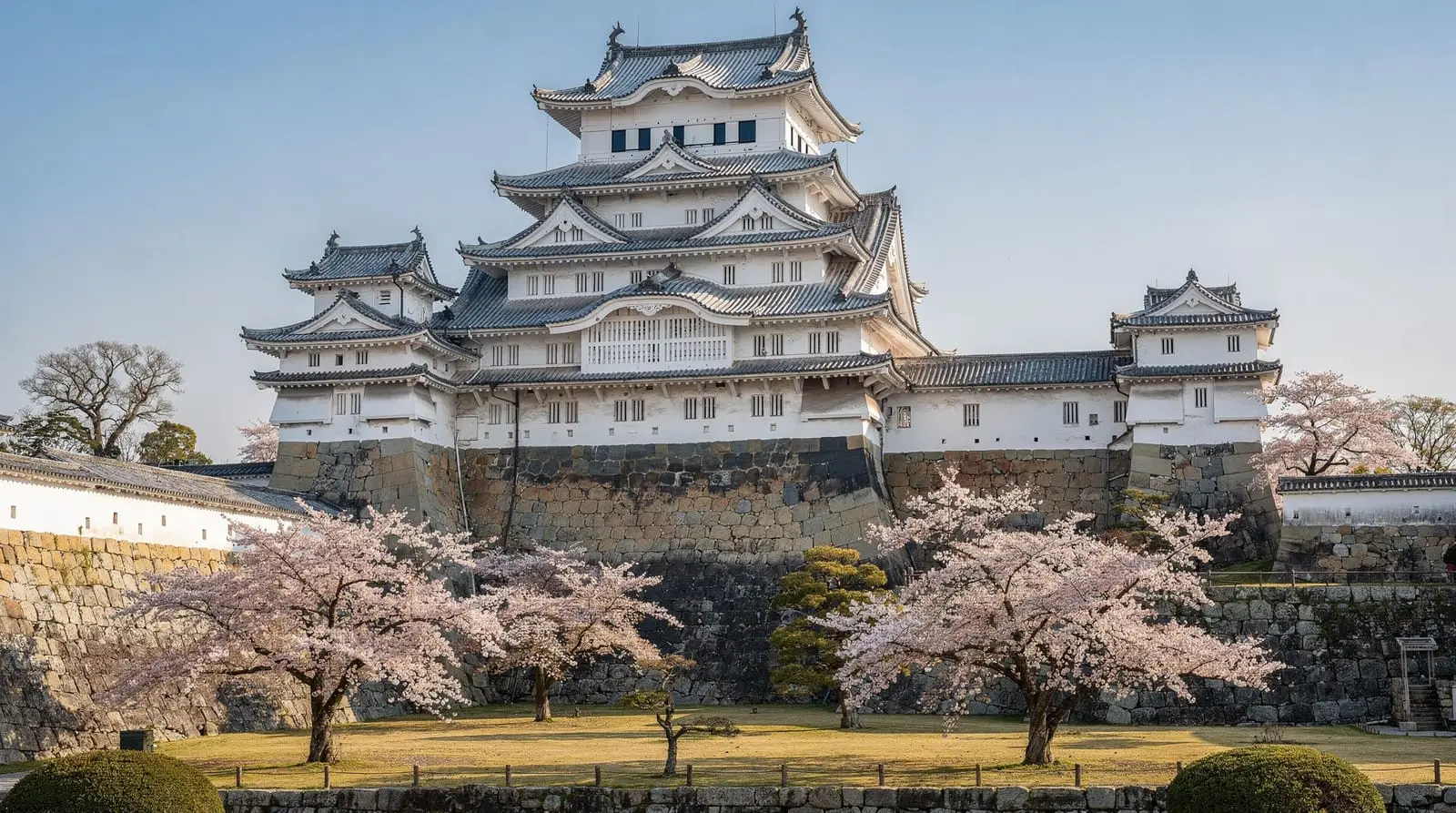
That survival is why UNESCO listed Himeji Castle as a World Heritage Site in 1993, one of Japan’s first, and why it’s often described as the country’s finest surviving example of castle architecture from the era. Locally it’s nicknamed Hakuro-jo, the White Heron Castle, for the bright white plaster walls that give the building its silhouette, said to resemble a heron taking flight. If you’ve already worked through Kyoto’s own UNESCO sites, Himeji is worth adding to that list even though it sits outside the city, since it represents a different category of heritage architecture than Kyoto’s temples and shrines.
Beyond the castle itself, the town of Himeji is a workable, low-key day-trip base: a compact station district built almost entirely around funneling visitors toward the keep, with a scattering of soba shops and cafes along the way if you want lunch before or after the visit. It’s not a destination in its own right the way Kobe or Osaka are, but that focus is part of what makes it an efficient single-purpose day trip.
Getting from Kyoto to Himeji: shinkansen vs local train
There are two realistic ways to make this trip, and the choice matters more here than on most Kyoto day trips because the price and time gap between them is unusually wide.
Shinkansen (Hikari or Kodama): About 1 hour, ¥5,810 (~$38.70) one way. This is the fast option, and it’s the one most visitors default to for a day trip this far out. One detail trips people up regularly: the Nozomi, the fastest shinkansen service on the Tokaido-Sanyo line, is not covered by any JR Pass. If you’re traveling on a JR Pass, you need to book a Hikari or Kodama service specifically, both of which are pass-eligible but slightly slower than the Nozomi. If you’re paying out of pocket rather than using a pass, Hikari and Kodama are also usually the cheaper shinkansen tickets of the three.
JR Special Rapid (local/direct train): About 1.5-2 hours, ¥2,310 (~$15.40) one way. This is the budget option, and the time difference is real but manageable if you’re not in a hurry. The route runs through Osaka and Kobe on the way to Himeji, which means it doubles as a scenic look at the Kansai rail corridor and gives you the option of breaking the trip with a stop in either city if you plan ahead.
For a party of two or more paying full fare each way, the shinkansen premium adds up to roughly ¥7,000 (~$47) round trip compared to the local train, which is a meaningful amount for a single day trip. Unless you’re short on time or specifically value the shinkansen experience, the JR Special Rapid is a defensible choice, especially if this isn’t your only long-distance train day covered by a JR Pass.
Both trains depart from the same place: the JR platforms at Kyoto Station. If you’re not familiar with the station’s layout, give yourself an extra 10-15 minutes on your first trip through, since the JR concourse is large and shinkansen platforms sit in a separate ticketed area from the local lines. Once you’ve made the trip once, the return leg is straightforward.
A typical day-trip itinerary
Here’s how a full Himeji day from Kyoto tends to break down for visitors who want to see the castle properly without rushing:
- Depart Kyoto Station by 8-9am, earlier if you’re also planning to add Kobe later in the day.
- Arrive at Himeji Station and walk roughly 15-20 minutes up Otemae-dori to the castle gate. The keep is visible from the station exit the entire way, so navigation isn’t an issue.
- Spend 1.5-2 hours touring the castle interior and grounds.
- Walk to the adjacent Koko-en Garden and spend 45 minutes to an hour there.
- Either head back toward Kyoto, or continue on to Kobe for the afternoon and evening if you started early enough.
A castle-and-garden-only day trip, without Kobe, comfortably fits into 5-6 hours door to door including travel, which leaves you back in Kyoto by mid-afternoon if you left in the morning.
The castle in detail: history, architecture, and the climb
The current keep complex dates to 1609, though a fortress has stood on the site since the 14th century. What makes the building significant isn’t just its age but its scale and completeness: a five-story main keep connected to three smaller keeps by covered corridors, surrounded by a maze of gates, walls, and moats designed to slow down any attacking army that made it past the outer defenses. None of that layout is decorative reconstruction. It’s the actual defensive design, still walkable today.
Inside, the experience is very different from a modern museum. There’s no elevator and no climate control, just the original wooden staircases, steep, narrow, and uneven by modern building standards, connecting each floor of the keep. Shoes come off at the entrance, and you carry them in a bag provided at the door as you climb. Budget 1.5-2 hours for a full visit to the donjon and grounds, more if you’re visiting during a crowded season when the stairways bottleneck. This part of the visit is genuinely not well suited to visitors with mobility limitations; there’s no way around the stairs to reach the upper floors, and the uneven wooden steps can be difficult even for visitors who don’t normally use mobility aids.
Adult admission to the castle alone is ¥1,000 ($6.70). A combined ticket covering both the castle and Koko-en Garden costs ¥1,050 ($7), which is worth the extra fifty yen if you have time for the garden as well. If you’d rather have someone walk you through the history and architecture rather than reading placards in Japanese and English, a three-hour tour with a licensed guide covers the keep in more depth than most people manage on their own, or a shorter 90-minute express guided tour works well if you’re tight on time and mainly want the highlights explained.
Koko-en Garden: the quieter half of the visit
Right next to the castle, on the site of what used to be the samurai residences of the castle’s feudal retainers, is Koko-en Garden. Unlike the castle, Koko-en isn’t historic in the strict sense; it was built in 1992 as a modern Japanese garden. What it offers is nine distinct garden spaces, each designed in a different Edo-period style, connected by walking paths and separated by earthen walls that echo the layout of the old samurai quarter that once stood there.
Koko-en draws a fraction of the crowd that the castle does, which makes it a genuinely useful pacing tool for the day: after the noise and stair-climbing of the keep, it’s a slower, quieter stop where you can sit by a pond, walk through a bamboo grove, or get tea in the garden’s teahouse without jostling for space. Most visitors spend 45 minutes to an hour here, though it can easily absorb longer if you’re in no rush.
Combining Himeji with Kobe
If you want to stretch the day trip into something bigger, Kobe is the natural add-on. Himeji to Kobe takes about 40 minutes by JR Special Rapid, which makes a castle-then-Kobe day logistically workable, though it is an ambitious itinerary rather than a relaxed one.
The typical structure looks like this: leave Kyoto before 8am, spend the morning at Himeji Castle and Koko-en, take the Special Rapid to Kobe by early-to-mid afternoon, and spend the rest of the day in Kobe. That could mean a Kobe beef lunch or dinner, a walk through the European-influenced Kitano-cho district, or the night view from Mt. Rokko if you’re willing to stay out late before the train back to Kyoto. A guided Himeji Castle, Koko-en Garden, and Kobe nightscape tour packages this exact combination if you’d rather not stitch the train legs together yourself.
The honest caveat: this only works if you commit to an early departure from Kyoto. Starting after 9 or 10am, you’ll likely have to cut either the castle interior or Kobe short, and rushing the castle visit specifically means skipping the parts of the keep that make the trip worthwhile in the first place. If you’re not confident about an early start, treat Himeji and Kobe as separate day trips instead of combining them, the same way Nara is usually better as a standalone day than paired with something else.
Practical tips for planning your visit
This is the longest and most expensive of Kyoto’s standard day trips. Compared to Nara or Osaka, both of which are closer and cheaper, Himeji asks for more time and more money for a narrower payoff: one exceptional building rather than a cluster of sights. That’s a reasonable trade if original castle architecture and UNESCO status matter to you specifically, but it’s not automatically a must-do for every Kyoto itinerary, especially a short one. If you’re weighing it against Kyoto’s other options, our guide to the best day trips from Kyoto lays out how it compares.
Go in cherry blossom or autumn foliage season if you can time it. Late March through early April brings the cherry blossoms that frame the white castle in one of the most photographed scenes in Japan, and November brings strong autumn color across the grounds. Both seasons also bring the heaviest crowds of the year, so arriving at opening matters more during these windows than at any other time.
Book ahead during peak weeks. Individual castle entry doesn’t strictly require advance booking outside peak season, but ticket lines during cherry blossom, Golden Week, and autumn foliage periods can run long enough to eat into your visit time. A guided tour that bundles admission removes that uncertainty.
Check your JR Pass status before booking shinkansen tickets. The Nozomi service isn’t pass-eligible; Hikari and Kodama are. This trips up enough travelers that it’s worth double-checking your ticket type at the machine or counter before boarding.
Fit it into a longer Kyoto stay rather than a short one. If you’re only in Kyoto for two or three days total, a full day given to Himeji is a bigger commitment than a Nara or Osaka half-day trip, and it may be worth saving for a return visit or a longer stay.
For general trip budgeting, our Kyoto travel budget guide covers how a day like this fits into overall costs, and if you’re trying to time your visits around crowds more broadly, avoiding crowds in Kyoto applies to Himeji’s peak seasons as well. If this is your first time in the region and you’re still sequencing your whole trip, our first-time Kyoto guide is a useful starting point before you commit a full day to a trip this far out.
If you’re still deciding which day trips are worth the time, it’s worth reading how Himeji compares to the shorter Nara day trip, the closer Osaka day trip, and the longer Hiroshima and Miyajima day trip, which is a useful comparison since both Hiroshima and Himeji sit on the same westbound shinkansen line. And if you’re still choosing a home base for your stay, our Kyoto vs Osaka comparison touches on how each city’s train access affects a Himeji day trip specifically.
Frequently asked questions about visiting Himeji Castle from Kyoto
How do I get from Kyoto to Himeji?
By shinkansen (Hikari or Kodama, not Nozomi) in about 1 hour for ¥5,810 ($38.70) one way, or by JR Special Rapid local train in 1.5-2 hours for ¥2,310 ($15.40). The local train is much cheaper and passes through Osaka and Kobe, so it’s the better choice if budget matters more than speed.
Is Himeji Castle covered by the JR Pass?
The Hikari and Kodama shinkansen and the JR Special Rapid local train are both covered by a valid JR Pass. The Nozomi, the fastest shinkansen on this route, is not covered by any JR Pass, so if you’re using a pass, book a Hikari or Kodama service instead.
How much does it cost to enter Himeji Castle?
Adult admission is ¥1,000 ($6.70) for the castle alone, or ¥1,050 ($7) for a combined ticket that also includes Koko-en Garden next door. The combined ticket is worth the extra ¥50 if you have time for both.
How long does it take to walk from Himeji Station to the castle?
About 15-20 minutes on foot, straight up Otemae-dori, the wide boulevard that runs directly from the station to the castle gate. The castle is visible from the station exit, so there’s no risk of getting lost.
Is Himeji Castle accessible for visitors with mobility issues?
The castle grounds and gardens are manageable, but the donjon interior is not. The keep’s original wooden staircases are steep, narrow, and uneven, with no elevator, and shoes must be removed at the entrance. Visitors with mobility limitations may prefer to enjoy the exterior and Koko-en Garden rather than attempt the full climb.
Can I combine Himeji Castle with Kobe in the same day?
Yes, but it’s an ambitious day. Himeji to Kobe is about 40 minutes by JR Special Rapid, which lets you do the castle in the morning and Kobe (Kobe beef, Kitano-cho, or the Mt. Rokko night view) in the afternoon and evening. It only works comfortably if you leave Kyoto before 8am.
When is the best time to visit Himeji Castle?
Late March to early April for cherry blossoms, when the white castle framed by pink blooms is one of the most photographed scenes in Japan, or November for autumn foliage. Both seasons bring bigger crowds, so arrive at opening if you’re visiting during either window.
Should I book Himeji Castle tickets in advance?
It’s not strictly required for individual entry, but during cherry blossom season, Golden Week, and autumn foliage weeks, ticket lines can run long. A guided tour that includes admission removes that uncertainty and adds historical context you won’t get from the on-site signage alone.
Shinkansen vs local train, side by side
| Shinkansen (Hikari/Kodama) | JR Special Rapid (local) | |
|---|---|---|
| Time | About 1 hour | About 1.5–2 hours |
| Cost one way | Around ¥5,810 (~$38.70) | Around ¥2,310 (~$15.40) |
| JR Pass eligible | Yes (not Nozomi) | Yes |
| Route | Direct | Via Osaka & Kobe |
| Best for | Time-limited visitors | Budget-conscious, flexible schedules |
Frequently asked questions about Himeji Castle day trip from Kyoto: the honest cost and time breakdown
How do I get from Kyoto to Himeji?
Is Himeji Castle covered by the JR Pass?
How much does it cost to enter Himeji Castle?
How long does it take to walk from Himeji Station to the castle?
Is Himeji Castle accessible for visitors with mobility issues?
Can I combine Himeji Castle with Kobe in the same day?
When is the best time to visit Himeji Castle?
Should I book Himeji Castle tickets in advance?
Top experiences
Bookable activities with verified prices and instant confirmation on GetYourGuide.