Nara day trip from Kyoto: temples, deer, and the real train costs
From Kyoto: Nara heritage half-day tour
Duration: Half day
Is Nara worth a day trip from Kyoto?
Yes. Nara is 35-45 minutes from Kyoto by train, and the Todai-ji Great Buddha hall, Nara Park's free-roaming deer, and Kasuga Taisha's lantern-lined forest path can all be covered in a half day. A full day adds Isuien Garden and the Naramachi old town.
Nara gets compared to Kyoto constantly, usually unfavorably, as the smaller, quieter cousin. That comparison misses the point. Nara isn’t trying to be a miniature Kyoto — it was Japan’s capital first, and its main sights are close enough together that you can walk between all three (Todai-ji, the deer park, and Kasuga Taisha) without a taxi or bus. It’s one of the more efficient day trips out of Kyoto, and one of the least likely to disappoint if you go in with realistic expectations about the deer.
| Where | Nara, 35-45 min south of Kyoto by train |
| Cost | ¥720 JR one-way; Todai-ji ¥600; deer crackers ¥200 |
| Time needed | Half day (4-5 hrs) for the three main sights |
| Getting there | JR Nara Line rapid or Kintetsu Limited Express |
| Best time | Opening (7:30-8am) before tour buses arrive |
A capital before Kyoto existed
Nara, then called Heijō-kyō, was Japan’s capital from 710 to 784, decades before Kyoto (Heian-kyō) took over that role in 794. Todai-ji was built during this period as the head temple of all provincial Buddhist temples in the country, and its scale still reflects that original ambition. Kasuga Taisha was founded in 768, tied to the Fujiwara clan that dominated the imperial court at the time. Walking between these sites today, you’re covering ground that predates almost everything associated with old Kyoto, including Kiyomizu-dera and the geisha districts of Gion.
If you’ve already read up on Kyoto’s own UNESCO sites, Nara is a useful contrast: it’s a smaller city built around a cluster of ancient religious sites rather than a sprawl of temples across multiple districts, which is part of why it works so well as a single day trip.
There’s also a practical reason Nara stays manageable while Kyoto’s downtown sights can eat an entire day each: Todai-ji, Nara Park, and Kasuga Taisha sit on essentially one contiguous stretch of parkland east of the train stations. You’re not zigzagging across a city by bus or subway. You walk in one direction, see three major sights, and walk back. That geography is the real reason this trip works as a half day rather than requiring two.
Getting from Kyoto to Nara
Two train companies run the route, and the choice actually matters for your budget and schedule.
The JR Nara Line rapid train departs from Kyoto Station and takes about 45 minutes to reach JR Nara Station. A one-way ticket costs ¥720 (~$4.80). It’s not covered by any Kyoto city pass, but it is the cheapest direct option and departs roughly every 15-30 minutes through the day.
The Kintetsu Limited Express departs from Kyoto Station’s Kintetsu platforms and reaches Kintetsu Nara Station in about 35 minutes. It costs ¥1,160 (~$7.70) one way, includes a reserved seat, and is noticeably more comfortable if you’re traveling with kids or during a hot afternoon. The Kintetsu line also has a slower local/rapid service for less than the limited express fare, but it takes longer and involves a transfer at Saidaiji.
Station choice matters because of the walk that follows. Kintetsu Nara Station is about 20 minutes on foot from Nara Park and Todai-ji. JR Nara Station is farther, roughly 30 minutes, or a short bus ride if you don’t want to walk. If cost isn’t the deciding factor, Kintetsu is the more convenient arrival point for this specific itinerary.
One more note on cost: a JR Pass is not worth buying just for this trip. A single JR Nara Line ticket at ¥720 is a fraction of what even one day of a 7-day JR Pass (¥50,000) would cost if this is your only long-distance leg of the day. Only factor a JR Pass into your Nara trip if you’re also using it for Tokyo, Hiroshima, or other Shinkansen travel during your stay.
Half-day itinerary: the efficient version
If you’re squeezing Nara into a Kyoto-based trip and want to be back by early afternoon, this order works well from Kintetsu Nara Station:
- Walk to Todai-ji (about 20 minutes), arriving as close to opening as you can manage.
- See the Great Buddha hall and the hole-in-the-pillar, then exit through the temple grounds into Nara Park.
- Feed the deer with a pack of shika senbei if you want the experience, then walk east.
- Walk the forest path to Kasuga Taisha, browsing the stone lantern-lined approach.
- Return to Kintetsu Nara Station via the park.
Realistically this takes 4-5 hours including the round-trip train, which means you can still have most of an afternoon back in Kyoto. It’s the version most people who are Kyoto-based and short on time actually do, and it’s also roughly what a guided half-day Kyoto-Nara heritage tour covers if you’d rather not navigate the train transfers yourself.
Full-day itinerary: adding Isuien and Naramachi
If you’re not rushing back to Kyoto, extend the same route:
- After Kasuga Taisha, backtrack toward Isuien Garden, a strolling garden near Todai-ji’s western edge that borrows the temple’s Nandaimon Gate as part of its view. It’s a quieter, slower stop after the deer park crowds.
- Finish with Naramachi, the old merchant quarter south of Kintetsu Nara Station, a grid of preserved Edo-period wooden townhouses now holding small shops, cafes, and a few sake breweries open for tastings. It’s a good place for lunch or a late-afternoon coffee before the train back.
A full day like this runs 7-8 hours door to door and doesn’t feel rushed at any point, which is more than you can say for most single-day excursions out of Kyoto.
Naramachi rewards unhurried walking more than a checklist of stops. The district grew up around Gango-ji, a temple with its own UNESCO listing that’s easy to miss because it sits quietly among the shops rather than dominating a plaza the way Todai-ji does. Local specialties worth trying while you’re there include kakinoha-zushi (persimmon-leaf-wrapped sushi, a Nara-region specialty rather than a Kyoto one) and narazuke (vegetables pickled in sake lees), both sold in small family-run shops rather than chain restaurants. If you only have time for one stop in Naramachi, a short sake tasting at one of the district’s remaining breweries is a reasonable way to end the day before the walk back to Kintetsu Nara Station.
Todai-ji: what you’re actually paying to see
Todai-ji’s Daibutsuden (Great Buddha Hall) is open 7:30am-5:30pm from April to October and 8am-5pm from November to March, with last entry 30 minutes before closing. Adult admission is ¥600 (~$4).
Inside is the Great Buddha, a bronze statue of Vairocana Buddha roughly 15 meters tall, originally cast in 752. The hall around it has been rebuilt multiple times after fire and war damage; the current building dates to 1709 and is about two-thirds the size of the original structure. Even at reduced scale, it’s still the largest wooden building in the world by volume, which is the detail that tends to land better in person than in a guidebook description — the roofline alone dwarfs the crowds underneath it.
Near the back of the hall is a wooden pillar with a hole cut through its base, roughly the size of one of the Buddha’s nostrils. Tradition holds that anyone who crawls through it earns enlightenment in their next life. It’s free, it’s genuinely fun to watch (mostly kids, occasionally a determined adult), and it’s one of the few moments in the hall that isn’t just standing and looking up.
Before you even reach the hall, the approach is worth slowing down for. The Nandaimon Gate, the massive wooden entrance about 200 meters south of the Daibutsuden, holds two carved wooden guardian statues, the Kongorikishi, on either side. They’re roughly 8 meters tall and were carved in the space of about three months in 1203 by a team of sculptors led by Unkei and Kaikei, two of the best-known Buddhist sculptors of the period. Most visitors walk straight past them on the way to the main hall, which is a mistake — they’re some of the most technically impressive wooden carving in the country and rarely have a crowd in front of them the way the Great Buddha does.
The honest caveat: Todai-ji gets crowded, particularly from mid-morning onward and heavily during cherry blossom season, Golden Week, and autumn foliage weeks in November. Arriving at opening is the single best thing you can do to see the hall without shuffling through a crowd. A dedicated two-hour Todai-ji and Great Buddha tour can also help if you want context on the statue’s restoration history without researching it yourself.
Nara Park and the deer: what to actually expect
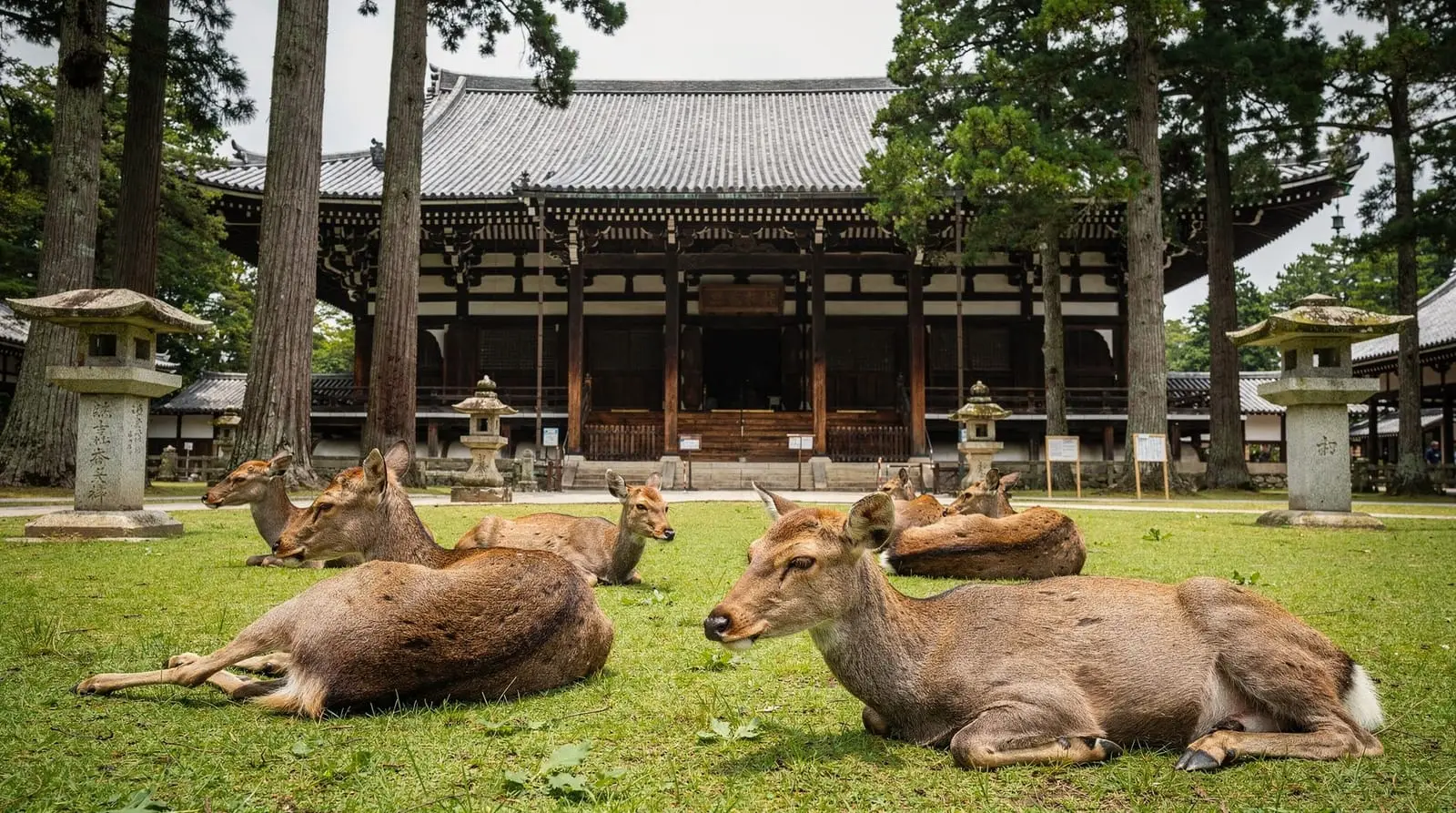
Nara Park is home to roughly 1,200 wild deer, traditionally considered sacred messengers of the gods enshrined at Kasuga Taisha. They roam freely across the park and the approach paths to both Todai-ji and the shrine, and for most visitors this is the single most memorable part of the day.
Vendors around the park sell shika senbei (deer crackers) for ¥200 (~$1.30) a pack. Feeding them is the main interaction most people come for, and it’s worth doing once.
Here’s the part guidebooks tend to gloss over: these are wild animals, not park mascots. Deer that are used to being fed can get pushy, and some will nudge, headbutt, or nip at clothing or bags if you’re slow to hand over a cracker, if you tease them by not giving it up, or if you run out mid-feeding and they don’t understand that.
It’s usually harmless — a bump, not an attack — but small children have been knocked over, and it happens often enough that it’s worth mentioning honestly rather than pretending it’s all photogenic bowing. Bowing to a deer before offering food genuinely does calm most of them down and is a fun bit of local etiquette, but keep a hand on kids’ snack bags and don’t wave crackers around without intending to give them up quickly.
A few things help in practice. Buy crackers from one of the official green-and-white vendor stalls rather than carrying other food from outside the park — deer can smell regular snacks in bags and will go after them more aggressively than they go after senbei they recognize as their usual handout. Hand the crackers over quickly, one at a time, rather than holding a stack out and making the deer wait.
If a deer starts nudging insistently and you’re out of crackers, show empty palms clearly; most will lose interest within a few seconds once they register there’s nothing left. And if you’re traveling with a toddler, it’s worth letting an adult hold and dispense the crackers rather than putting the pack directly in a small child’s hands, since a determined deer can tug it away entirely.
Deer roam the entire park, not just around Todai-ji’s approach, so you’ll keep encountering them on the walk toward Kasuga Taisha as well. They’re generally calmer away from the main cracker-vendor clusters, which makes for better photos if you’re not trying to fight through a feeding scrum.
Kasuga Taisha: the lantern walk
Kasuga Taisha, founded in 768, is best known for its roughly 3,000 stone and bronze lanterns, donated over centuries by worshippers and lining both the forest approach path and the shrine’s covered walkways. The lanterns are only lit twice a year: during Setsubun in early February and the Obon lantern festival in mid-August. Outside those two windows, they’re unlit, which surprises some visitors expecting the illuminated photos they’ve seen online.
That said, the walk itself doesn’t need lit lanterns to be worthwhile. The path from Nara Park to the shrine runs through old-growth forest, moss-covered stone lanterns lining both sides, and it’s one of the more atmospheric short walks in the Kyoto-Nara area regardless of season. If you want the lantern context explained on-site, a guided Kasuga Taisha and sacred deer shrine tour covers both the shrine’s history and deer-park etiquette in one stop.
Practical tips for timing your visit
Go early. Both Todai-ji and the deer park are calmest before 9:30am. If you can catch the first Kintetsu Limited Express of the morning from Kyoto Station, you’ll beat most of the day-trip crowd and the tour buses.
Avoid peak cherry blossom and autumn foliage weekends if you can. Nara Park’s deer and Todai-ji’s grounds are popular for seasonal photography, and both get considerably more crowded in early April and mid-to-late November. If your Kyoto trip falls during one of these windows, an early start matters even more than usual.
Decide upfront: guided or independent. The train and walking route to Nara is simple enough that most travelers manage it without a guide. But if you’d rather not deal with ticket machines, station transfers, or figuring out which Nara station to use, a guided day trip removes that friction and usually includes some historical context you won’t get reading temple signage in Japanese and English side by side.
Don’t try to add a second city. Nara pairs poorly with Osaka or Uji in the same day if you also want to see Todai-ji, the deer park, and Kasuga Taisha properly. If you’re weighing Nara against other day trips from Kyoto, treat it as a standalone day rather than a stop on a multi-city itinerary.
Check your Kyoto plans before committing a full day. If you’re only in Kyoto for two or three days total, a half-day Nara trip protects more time for Kyoto’s own sights like Fushimi Inari or the Kyoto Station area. If you have four days or more, the full-day version with Isuien and Naramachi is easier to justify.
For general planning around costs, see our Kyoto travel budget guide, and if you’re building out a full day-trip itinerary for your stay, our overview of avoiding crowds in Kyoto applies to Nara’s peak-season timing as well.
If Nara is one of several day trips you’re considering, it’s worth reading how it stacks up against Osaka as a day trip, Himeji Castle, or the longer Hiroshima and Miyajima day trip — Nara is the shortest and least logistically demanding of the group, which is part of why it’s often the first one people add to a Kyoto vs Osaka or Kyoto vs Tokyo base-city debate. And if this is your first visit to the region altogether, our first-time Kyoto guide covers how a Nara day fits into a broader itinerary.
What Nara costs, roughly, for the day
Round-trip JR Nara Line fare runs about ¥1,440 ($9.60), Todai-ji entry is ¥600 ($4), and a pack or two of shika senbei for the deer adds another ¥400-600 ($2.70-4). Kasuga Taisha’s grounds are free to walk, though the inner shrine area sometimes carries a small separate fee for special exhibits. Add lunch in Naramachi if you’re doing the full-day version, typically ¥1,200-2,500 ($8-17) for a casual meal. All told, a half-day Nara trip runs roughly ¥2,500-3,500 (~$17-23) per person before any guided tour, making it one of the cheaper day trips out of Kyoto alongside its ease of logistics.
Naramachi’s sake breweries, briefly
A handful of sake breweries still operate in Naramachi, some open for short tastings in the afternoon — a genuinely different experience from a full brewery tour, more a quick flight of two or three cups at a counter than a guided walkthrough. Nara’s brewing history ties back to the same Buddhist temple culture that shaped the city, since several historic sake techniques are credited to monks experimenting with fermentation at temples in the region centuries ago. It’s a low-commitment way to end a full-day itinerary before the walk back to Kintetsu Nara Station, and pairs naturally with the kakinoha-zushi and narazuke pickles sold in the same neighborhood.
Frequently asked questions about visiting Nara from Kyoto
How long does it take to get from Kyoto to Nara?
35-45 minutes by train, depending on the line. The JR Nara Line rapid train takes about 45 minutes; the Kintetsu Limited Express takes about 35 minutes with a reserved seat.
Do I need a JR Pass to visit Nara from Kyoto?
No. A single JR Nara Line ticket costs ¥720 (~$4.80), which is cheaper than any fraction of a 7-day JR Pass at ¥50,000 if Nara is your only trip that day. Only consider a pass if you’re also using JR trains for several other long-distance legs.
Should I get off at JR Nara Station or Kintetsu Nara Station?
Kintetsu Nara Station is closer to Nara Park and Todai-ji, roughly a 20-minute walk versus about 30 minutes from JR Nara Station. If you took the JR line, plan for the longer walk or a short bus ride.
Are the deer in Nara Park dangerous?
Usually not, but they are wild animals, not pets. Deer that expect food can headbutt or nip if you’re slow to hand over a cracker or if you tease them, and minor bumps and scrapes happen every year, mostly to small children. Bow to a deer and most will bow back before you feed them.
Can I see Kasuga Taisha’s lanterns lit up?
Only during two annual events: Setsubun in early February and the Obon lantern festival in mid-August. The rest of the year the roughly 3,000 stone and bronze lanterns are unlit, but the forest approach to the shrine is worth walking regardless.
Is one day enough to see Nara properly?
For Todai-ji, Nara Park, and Kasuga Taisha, a half day is enough, roughly 4-5 hours including travel. A full day lets you add Isuien Garden and a wander through the Naramachi merchant district without rushing.
What’s the best time of day to visit Todai-ji to avoid crowds?
Arrive at opening time, 7:30am in the April-October season or 8am in November-March. Tour buses tend to arrive from mid-morning onward, and by early afternoon the approach to the Great Buddha hall is genuinely congested, especially on weekends and during cherry blossom or autumn foliage weeks.
Can I combine Nara with another day trip from Kyoto?
Not comfortably in one day. Nara alone takes a half or full day once you include the deer park and Kasuga Taisha, and combining it with Osaka or Uji in the same trip usually means shortchanging one of them. Most visitors do better treating Nara as its own day and saving other day trips like Osaka or Himeji for separate outings.