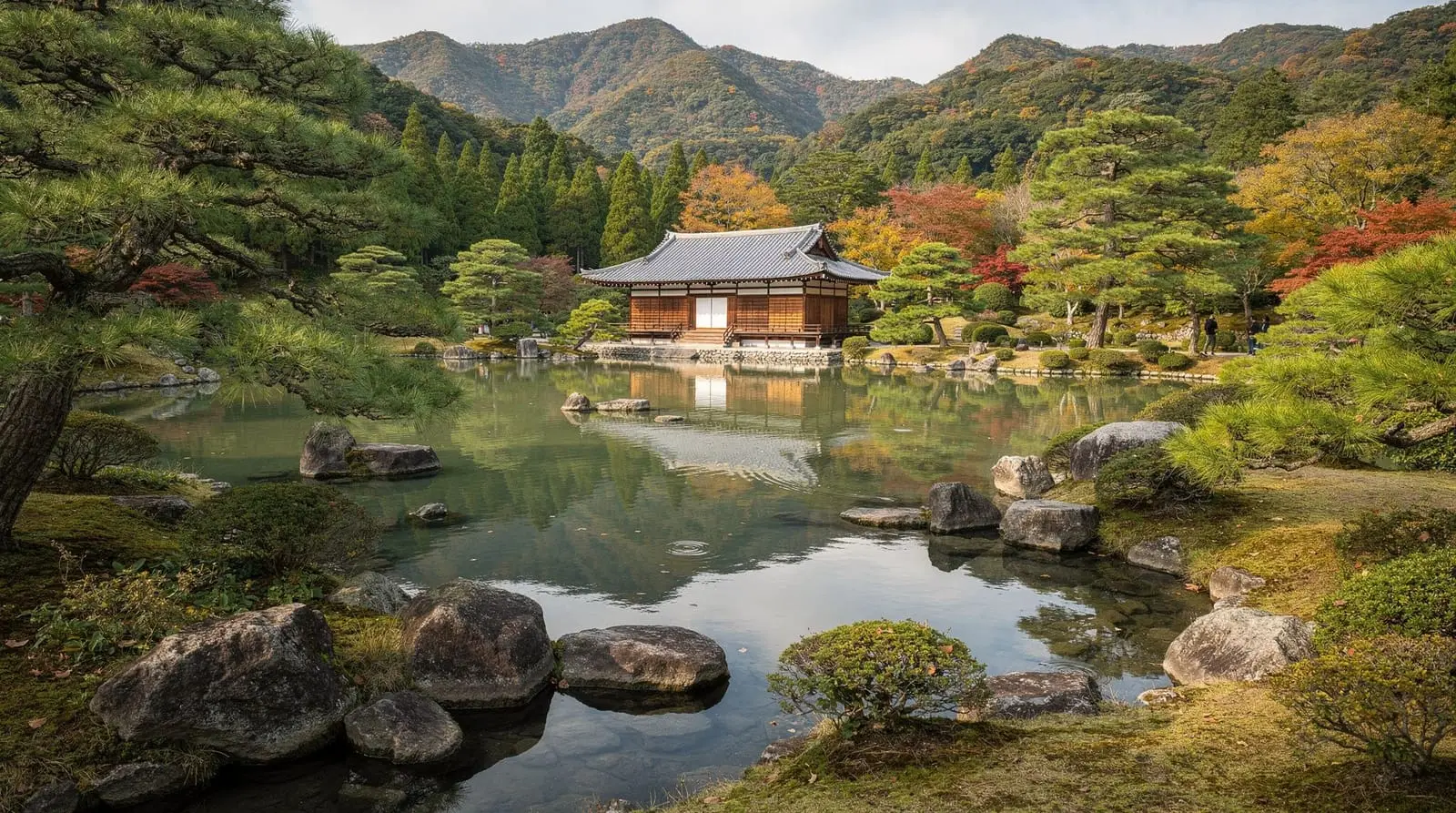
Tenryu-ji guide — Arashiyama's world heritage Zen temple
Arashiyama/Tenryu-ji Temple Guided Tour
How much does Tenryu-ji cost and does it connect to the Bamboo Grove?
Garden admission is ¥500; adding the temple buildings costs ¥300 more. Hours run 8:30am-5:30pm (5pm in winter). Tenryu-ji's north gate opens directly onto the Arashiyama Bamboo Grove path, making the temple the natural first or last stop on a bamboo grove walk rather than a separate detour.
| Where | Arashiyama, north gate opens onto the Bamboo Grove |
| Cost | Around ¥500 garden; +¥300 for temple buildings |
| Time needed | Around 20-30 min garden only, 45-60 min with buildings |
| Getting there | JR Saga-Arashiyama or Randen Arashiyama, around 5-10 min walk |
| Best time | Right at 8:30am opening, before the crowd surge |
The temple gate that opens straight into the bamboo grove
Tenryu-ji is the Zen temple most visitors to Arashiyama walk through without quite realizing it’s a UNESCO World Heritage Site — a fact that gets overshadowed by the bamboo grove just outside its north gate, which is the reason most people are in this part of Kyoto in the first place. That’s a mistake worth correcting: Tenryu-ji’s garden, Sogenchi, predates the bamboo grove’s fame by roughly 600 years and is one of the earliest documented examples of shakkei, or “borrowed scenery” — landscape design that folds the surrounding hills into the garden’s composition rather than enclosing the view.
The temple was founded in 1339 by the shogun Ashikaga Takauji, dedicated to the memory of Emperor Go-Daigo, with the garden itself attributed to the monk and garden designer Muso Soseki. Repeated fires — including damage during the Onin War in the 15th century and again in the 19th century — mean almost none of the current buildings are original, but the garden layout has been maintained close to its founding design throughout, which is part of why it’s included in the 1994 UNESCO listing covering 17 Historic Monuments of Ancient Kyoto.
Sogenchi garden: a pond designed to include the mountain
The garden’s central feature is Sogenchi, a pond positioned to be viewed from the temple’s main hall (Hojo), with the wooded slopes of Arashiyama rising directly behind it. Rather than building walls or planting to screen out the surrounding landscape, the garden’s design incorporates those hills as part of the composition — a technique that became influential in later Japanese garden design but was, at the time, a genuinely novel approach.
Tenryu-ji temple guided tour in ArashiyamaWalking the garden path takes 20-30 minutes at a relaxed pace, circling the pond and passing through small groves before reaching the north gate. Seasonal color changes the garden considerably: cherry blossoms along the paths in late March/early April, deep green in summer, and maple foliage in mid-to-late November that draws some of the heaviest crowds of the year.
Admission: garden only, or garden plus buildings
Garden admission (Sogenchi and the surrounding grounds) is ¥500. Adding entry to the temple’s main hall buildings — which include painted ceiling artwork and additional interior rooms — costs an extra ¥300 on top of the garden ticket. Most visitors find the garden-only ticket sufficient for a satisfying visit; the building add-on suits travelers specifically interested in temple interior art and architecture rather than garden design.
Hours run 8:30am to 5:30pm from March through October, and 8:30am to 5pm from late October through February, with last entry roughly 30 minutes before closing. There are no separate evening illumination hours here.
The bamboo grove connection: enter or exit through Tenryu-ji
The single most practical thing to know about Tenryu-ji is its north gate, which opens directly onto the Arashiyama Bamboo Grove path — one of the most photographed short walks in Japan, a few hundred meters of towering bamboo stalks filtering light overhead. Because of this direct connection, most visitors treat Tenryu-ji and the bamboo grove as one continuous stop rather than two separate destinations: enter the temple through the main south gate near Randen Arashiyama Station, walk the garden, then exit north straight into the bamboo (or do the walk in reverse, depending which direction you’re arriving from).
Arashiyama bamboo grove and monkey mountain walking tourThis sequencing matters for crowd timing. The bamboo grove itself has no entrance fee and no gate, which means it gets busy early and stays busy — arriving at Tenryu-ji right at 8:30am opening and walking through to the bamboo grove immediately after gets you both in relative quiet, before Arashiyama’s mid-morning surge of tour groups and day-trippers from central Kyoto.
Arashiyama Bamboo Forest morning bike tourShojin ryori: temple vegetarian cuisine on site
Tenryu-ji’s on-site restaurant, Shigetsu, serves shojin ryori — the vegetarian cuisine developed in Zen Buddhist monasteries, built around seasonal vegetables, tofu, and grains, with no meat, fish, or strong alliums like garlic and onion. The multi-course set meal is served in a room overlooking the Sogenchi garden, which is as much the draw as the food itself for many diners.
Reservations are recommended, and close to essential during peak cherry blossom and autumn foliage weeks when the restaurant’s limited seating fills quickly. If shojin ryori interests you but you’d rather not commit to a full sit-down meal, several smaller cafes along the approach to Tenryu-ji’s main gate serve lighter versions of similar dishes.
Crowds and the best time to visit
Arashiyama as a whole gets significantly busier from mid-morning through mid-afternoon, and Tenryu-ji is no exception, particularly given its direct bamboo grove connection. The 8:30am opening is the clearest window for a quiet garden walk; by 10am, both the temple grounds and the bamboo path immediately outside are considerably more crowded.
Arashiyama hidden temples and bamboo grove guided tourAutumn foliage weeks (mid-to-late November) bring the heaviest crowds of the year to both the garden and the surrounding district — worth the visit for the color, but expect a slower pace throughout.
Getting there and combining with the rest of Arashiyama
Tenryu-ji’s main gate is a short walk from Randen Arashiyama Station, JR Saga-Arashiyama Station, or Hankyu Arashiyama Station, all within 5-10 minutes on foot depending on which line you’re arriving on. See the Arashiyama destination guide for the full breakdown of stations and how they connect to other district sights like the Togetsukyo Bridge and Iwatayama Monkey Park.
Because the temple sits at the entrance to the bamboo grove, it’s the natural anchor for a half-day Arashiyama visit: Tenryu-ji and the garden first, bamboo grove immediately after, then onward to the monkey park or riverside if time allows. For a different temple pairing on the other side of the city, the Ryoan-ji guide covers Kyoto’s other major Zen garden tradition, built around raked stone rather than a borrowed-scenery pond.
What to wear and practical tips
The garden path around Sogenchi is mostly flat, well-maintained gravel and stone, manageable for most visitors without significant mobility concerns, though a few sections near the pond’s edge can be uneven. If you add the temple’s interior buildings to your ticket, shoes come off before entering, so easily removable footwear and presentable socks are worth planning for.
Restrooms are available near the main entrance before the ticket gate. A small shop near the exit sells temple charms, matcha, and Tenryu-ji-specific souvenirs. Given the direct connection to the bamboo grove, many visitors carry cameras and phones for the entire loop — the garden’s paths are wide enough to accommodate this without significant congestion outside peak hours, though the bamboo grove itself does get crowded enough that photography can mean waiting for gaps in foot traffic.
Common mistakes first-time visitors make
The most common mistake is treating Tenryu-ji purely as a gateway to the bamboo grove and rushing through the garden without pausing at Sogenchi’s main viewing point from the Hojo hall — the pond and borrowed-scenery composition rewards a slower look, and a rushed walk-through misses the specific design achievement that got the site its UNESCO listing in the first place.
A second mistake is skipping the ¥300 building add-on without knowing what it includes, then wondering afterward what was missed — the interior rooms and painted ceiling art are a reasonable addition for visitors interested in temple architecture and interior art, but genuinely skippable for those focused primarily on the garden and bamboo grove.
A third mistake, specific to timing, is arriving at Tenryu-ji in the early afternoon assuming the bamboo grove will still be relatively quiet on the other side — by early afternoon, both the temple grounds and the bamboo path are at their busiest, and the crowd-avoidance benefit of the temple-to-bamboo sequence depends heavily on an early start.
Nearby food: shojin ryori and beyond
Beyond Tenryu-ji’s own Shigetsu restaurant, the streets around the temple’s main gate and the nearby Togetsukyo Bridge area offer a range of dining, from casual yudofu (hot tofu) restaurants — a specialty strongly associated with this part of Kyoto — to soba shops and matcha cafes. Prices in the immediate Arashiyama tourist core run somewhat higher than less-visited parts of the city, but genuine quality options exist alongside the more generic tourist-oriented restaurants, particularly a short walk away from the main bridge and station area.
How Tenryu-ji compares to Kyoto’s other major gardens
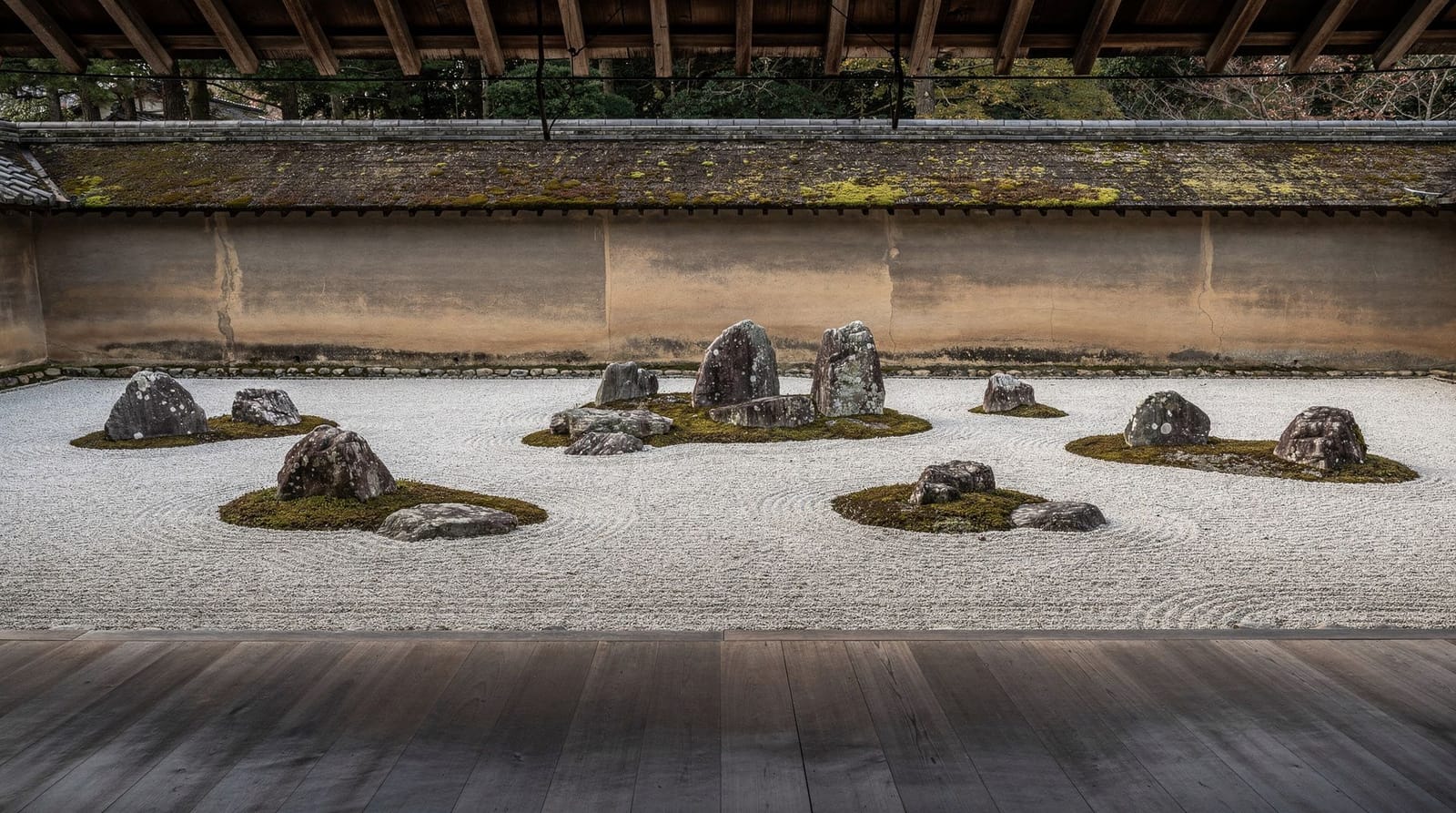
Sogenchi’s borrowed-scenery technique, incorporating the Arashiyama hillside directly into the garden’s composition, is a fundamentally different design approach from Ryoan-ji’s enclosed dry rock garden or Ginkaku-ji’s raked sand garden — both of which are self-contained compositions that don’t rely on the landscape beyond their walls. If you’re comparing Kyoto’s major Zen gardens across a single trip, Tenryu-ji offers the clearest example of a garden designed to extend visually into its natural surroundings, making it a useful counterpoint to the more abstract, enclosed gardens elsewhere in the city.
Seasonal notes
Cherry blossom season, typically late March into early April, brings blossoms around the garden’s paths and along the approach from Randen Arashiyama Station, coinciding with some of the year’s heaviest crowds in the district. Autumn foliage, usually peaking in mid-to-late November, is Arashiyama’s single busiest season overall, with Sogenchi’s maples reflected in the pond drawing crowds that rival or exceed the bamboo grove’s own peak crowding.
Summer brings green, humid conditions with the garden’s pond and shade offering some relief compared to more exposed parts of the district. Winter is the quietest season, and a rare snow-dusted visit to Sogenchi, with the borrowed hillside scenery under snow, is considered by repeat visitors one of the more striking versions of the garden, though — as with the rest of Kyoto — it’s not something that can be reliably planned around.
A brief history: emperor’s memory, five fires, one enduring garden
Tenryu-ji’s founding is tied directly to a political reconciliation. Shogun Ashikaga Takauji had defeated Emperor Go-Daigo in a civil conflict, but founded the temple in 1339, shortly after the emperor’s death, specifically to pray for his soul and, by most historical readings, to smooth over the political rupture the conflict had caused. Muso Soseki, a monk and garden designer already renowned for his work at other major temples, was appointed the temple’s founding abbot and is credited with designing Sogenchi.
The temple ranks first among Kyoto’s “Five Mountains” (Gozan), a formal ranking system for the city’s most important Rinzai Zen temples established under the Ashikaga shogunate — a reflection of Tenryu-ji’s political and religious significance at its founding, distinct from its later fame as an Arashiyama sightseeing stop.
That significance came at a cost: records document at least eight major fires affecting the temple across its history, including significant destruction during the Onin War in the 15th century and again during the Hamaguri Rebellion in 1864. Almost none of the current buildings predate the late 19th century as a result, which makes Sogenchi’s preserved layout — maintained close to its original 14th-century design despite the buildings around it burning down repeatedly — a genuinely unusual case of garden continuity outlasting architecture.
Accessibility
The main garden loop around Sogenchi is relatively flat and manageable for most visitors with limited mobility, with paved and packed-gravel paths for most of the route. A few sections near the pond’s edge involve slight unevenness, and the connection north into the bamboo grove is flat as well, making the combined temple-and-bamboo route one of the more accessible pairings among Kyoto’s major sights compared to hillside locations like Kiyomizu-dera. The temple’s interior buildings, if you add that ticket, do involve some stepped thresholds typical of traditional Japanese architecture.
Budgeting your time
A focused visit to just the Sogenchi garden takes 20-30 minutes at a steady pace. Adding the temple’s interior buildings brings the total to 45-60 minutes. Continuing north through the bamboo grove immediately after adds another 15-20 minutes for the grove itself, or longer if you continue on to the monkey park or riverside. A realistic half-day plan — Tenryu-ji, the bamboo grove, and one additional Arashiyama sight such as the Togetsukyo Bridge — runs 3-4 hours including transit time from central Kyoto.
Photography tips
Sogenchi’s main viewpoint from the Hojo hall’s veranda is the classic composition — pond, pines, and the borrowed Arashiyama hillside in a single frame — and it photographs best in the morning, when light angles across the pond rather than glaring off its surface. The garden’s paths also offer several secondary angles as they curve around the pond, worth exploring rather than shooting only from the main veranda viewpoint.
The bamboo grove immediately north of the temple is famously difficult to photograph without other visitors in frame during peak hours, since the path is narrow and heavily used — an early-morning visit right after Tenryu-ji’s opening is the most reliable way to get a clear shot of the bamboo stalks without a crowd of fellow photographers in the same frame.
Getting there from central Kyoto
From Kyoto Station, the JR Sagano/San-in Line runs directly to JR Saga-Arashiyama Station in about 15-20 minutes, from which Tenryu-ji’s main gate is a 5-10 minute walk. The Randen (Keifuku) tram line’s Arashiyama terminus is even closer to the temple’s main entrance, though it requires a transfer from central Kyoto via the Randen Shijo-Omiya line. A taxi from Kyoto Station takes roughly 25-30 minutes depending on traffic, longer than the train in most cases given Arashiyama’s distance from the station.
Combining Tenryu-ji with the rest of Arashiyama in one day
Beyond the bamboo grove immediately north of Tenryu-ji, Arashiyama’s other main draws — Iwatayama Monkey Park, the Togetsukyo Bridge, and the Sagano scenic railway — sit within a 10-20 minute walk of the temple’s main gate, making a full-day Arashiyama itinerary genuinely walkable once you’re in the district, unlike Kitayama’s more scattered, bus-dependent temple cluster. Starting at Tenryu-ji right at opening, moving through the bamboo grove, and continuing to the bridge and riverside by late morning leaves the early afternoon free for the monkey park’s climb or a slower lunch before heading back toward central Kyoto.
For gardens elsewhere in the city that offer a different design philosophy, see the best gardens in Kyoto and best zen gardens roundups; the Saiho-ji moss temple guide covers a reservation-only alternative attributed to the same garden designer, Muso Soseki.
Frequently asked questions about Tenryu-ji guide — Arashiyama's world heritage Zen temple
Why is Tenryu-ji a UNESCO World Heritage Site?
What is the Sogenchi garden known for?
Does Tenryu-ji connect directly to the Bamboo Grove?
How much does it cost to visit Tenryu-ji and what's included?
What are Tenryu-ji's hours?
What is shojin ryori and can you eat it at Tenryu-ji?
When is the best time to visit Tenryu-ji to avoid crowds?
Is Tenryu-ji worth visiting if you've already seen other Kyoto Zen gardens?
Top experiences
Bookable activities with verified prices and instant confirmation on GetYourGuide.