Sanjusangendo — the hall of 1,001 Kannon statues
Kyoto: 1,001 Kannon Statues at Sanjūsangen-dō Temple
Duration: 1.5 hours
How much does it cost to visit Sanjusangendo and what will I actually see?
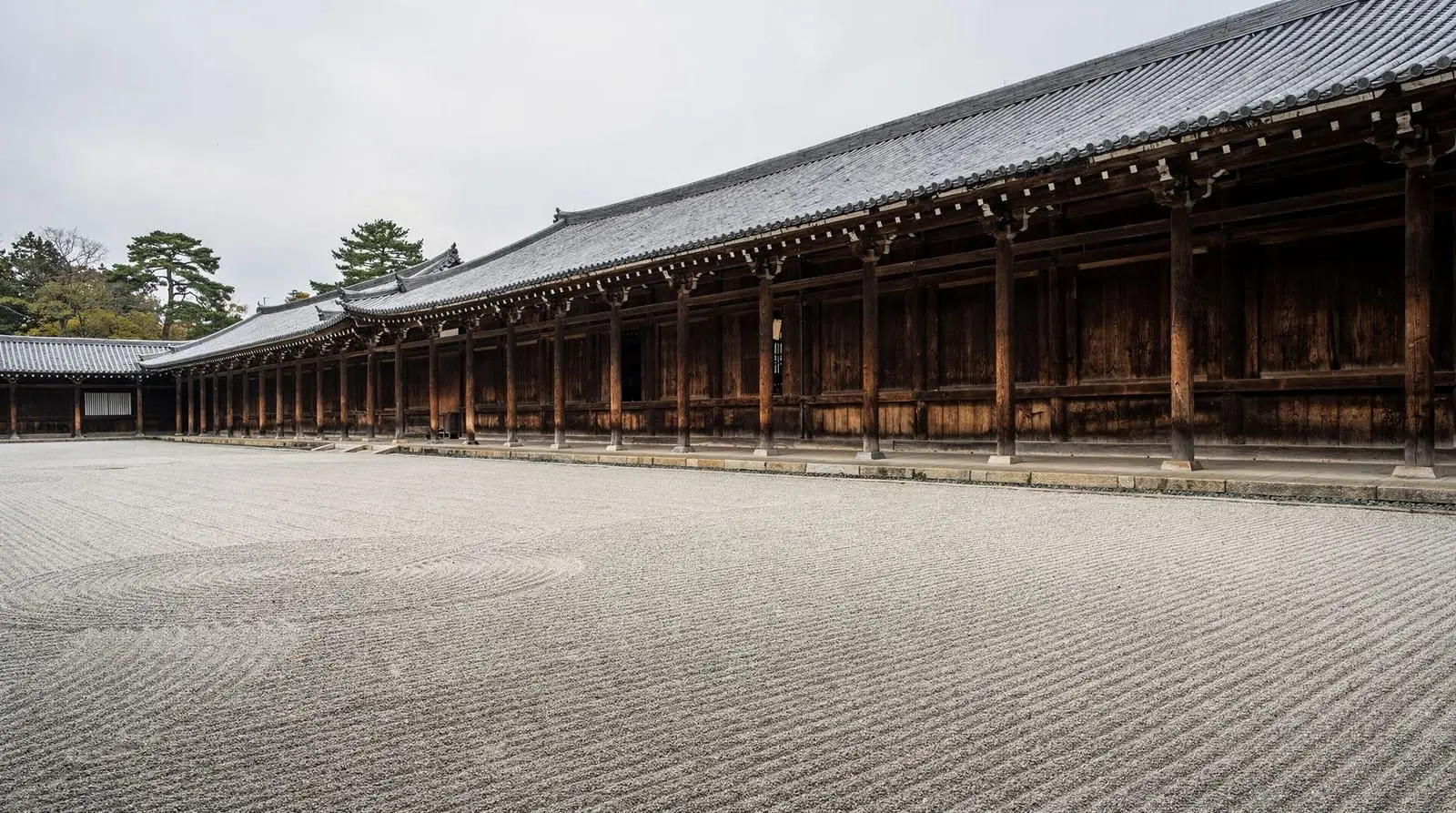
Admission is ¥600 (about US$4) for adults. Inside the 120-metre wooden hall — the longest wooden structure in Japan — stand 1,001 carved statues of the Thousand-Armed Kannon, arranged in ten rows of 50 around a large central seated figure by the sculptor Tankei, plus 28 guardian deities. Photography is not allowed inside. Budget 45–60 minutes.
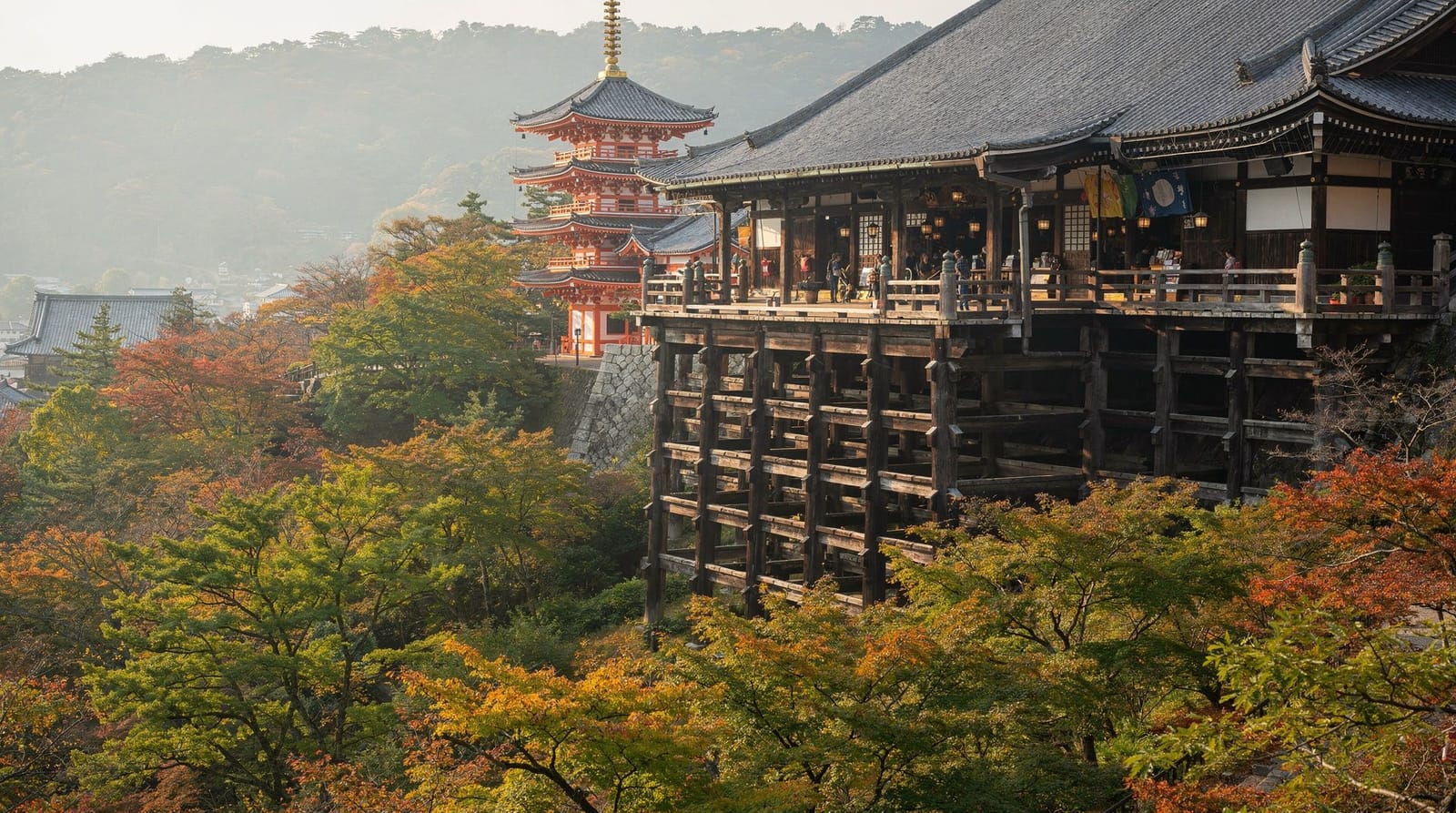
Sanjusangendo doesn’t photograph well, which is probably why it’s less known outside Japan than Kiyomizu-dera or Fushimi Inari, both a short bus ride away. There’s no dramatic torii corridor and no wooden stage over a hillside — just a long, low, unassuming hall that turns out to hold one of the most striking single collections of Buddhist sculpture anywhere in the country. No photography is permitted inside, which means most visitors leave with no image of what they saw, only a description that tends to undersell it.
| Where | Southern Higashiyama, near Kyoto Station |
| Cost | Around ¥600 adults, ¥400 students, ¥300 children |
| Time needed | Around 30-45 minutes, up to an hour |
| Getting there | Bus 100/206 from Kyoto Station (around 10 min) or 20-min walk |
| Photography | Not allowed inside the main hall |
What “Sanjusangendo” actually means and what’s inside
The temple’s formal name is Rengeo-in; Sanjusangendo — “hall of 33 bays” — refers to the number of spaces between the pillars along its length, and is the name almost everyone uses. It was founded in 1164 by the retired emperor Go-Shirakawa, with the powerful warrior-statesman Taira no Kiyomori funding the construction. A fire destroyed the original building in 1249; the hall standing today dates from the rebuilding completed in 1266, which makes it roughly 760 years old and one of the older wooden structures still serving its original purpose in Kyoto.
At 120 metres long, it’s the longest wooden building in Japan, and the scale is the point: the hall exists to house 1,001 statues of Kannon, the bodhisattva of mercy, in her thousand-armed form (Senju Kannon). A large seated central statue, carved by the sculptor Tankei — son of the more famous Unkei, both from the Kei school workshop responsible for much of the era’s finest Buddhist sculpture — anchors the hall. Around it, 1,000 standing Kannon statues are arranged in ten tiered rows of 50, five rows on each side, receding into the gloom in both directions until the far ends of the hall are barely visible.
Each statue has 42 arms rather than a literal thousand (each arm, in the doctrine, is said to help 25 realms of existence, giving the effective count of a thousand), and each carries slightly different attributes and facial expression: pause at a few and you’ll notice no two faces are quite identical, which local guides sometimes explain as intentional — the promise being that somewhere among the thousand is a face resembling someone you’ve lost.
Guided visit to Sanjusangendo’s 1,001 Kannon statuesIn front of the main rows stand 28 guardian deities (Nijuhachi Bushu), a set of individually expressive, almost theatrical statues protecting the Kannon — look for Karura, a bird-headed figure with a flute, and the wind and thunder gods Fujin and Raijin at either end of the hall, both rendered with a dynamism that’s unusual for religious sculpture of the period. All of it is designated National Treasure or Important Cultural Property, and most of it survived the 1249 fire — of the 1,001 statues, 124 are originals rescued from the burning first hall, and the rest were carved over roughly a 17-year period to replace what was lost.
Admission, hours and what a visit actually involves
Admission is ¥600 (roughly US$4) for adults, ¥400 for junior/senior high school students, and ¥300 for children — reasonable by Kyoto’s current fee scale, which has risen at most major sites since 2023. Opening hours run 8am–5pm from April through mid-November, and 9am–4pm from November 16 through March (last entry 30 minutes before close in both windows). The hall is unheated and has bare wooden floors — cold in winter, and visitors remove nothing but keep shoes on, unlike at many other temples, since the walking route is along a raised corridor rather than tatami.
A visit is entirely self-paced: there’s no guided tour built into general admission, just a one-way walking corridor along the full 120-metre length of the statue rows, then back out past a smaller side hall with additional historical items. Most visitors spend 30–45 minutes; anyone reading the accompanying English-language signage carefully, or simply slowing down to look at individual faces, can easily spend an hour. No photography, video, or sketching is allowed inside the main hall — staff enforce this, and phones are expected to stay in pockets — so this is a visit to actually look rather than to collect images.
Crowds and timing
Sanjusangendo draws a fraction of the crowd that Kiyomizu-dera does, partly because it isn’t on the main Higashiyama walking route and partly because “hall of statues” is a harder sell on an itinerary than a hillside temple with a view. Tour groups do stop here, usually mid-morning, and the hall can feel busy for 20–30 minutes at a time when a coach group works through it. Arriving right at opening (8am in high season) or after 3:30pm avoids most of this. Unlike Kiyomizu-dera or Fushimi Inari, there’s no meaningful early-morning versus midday difference in light or atmosphere, since the entire visit happens indoors — timing here is about avoiding tour buses, not about photography conditions.
The Toshiya archery contest
Sanjusangendo’s most photographed annual event has nothing to do with the statues. The Toshiya (“passing arrows”) archery contest traces back to an Edo-period practice of shooting arrows the full 120-metre length of the hall’s west veranda, a feat that required extraordinary accuracy and stamina and produced records still cited today — one 17th-century archer is recorded as having landed over 8,000 arrows in 24 hours.
The modern version, held on the Sunday closest to Coming-of-Age Day (mid-January) as the Rite of Adulthood Grand Archery Contest, is a different format — roughly 2,000 archers, many of them 20-year-olds marking adulthood, shoot at fixed targets from 60 metres, with young women competing in furisode kimono with bow in hand. It’s a striking, crowded, cold event that packs the temple grounds and is well worth timing a January trip around if archery or kimono photography is a specific interest, though it’s not representative of a typical visit and the main hall itself has restricted access on the day.
How Sanjusangendo compares to Nara’s Great Buddha
Visitors combining Kyoto with a Nara day trip sometimes ask how Sanjusangendo compares to Todai-ji’s Great Buddha Hall, since both are large-scale Buddhist sculpture experiences reachable within the same general trip. They’re different in almost every respect beyond raw scale. Todai-ji’s Daibutsu is a single enormous bronze seated Buddha, roughly 15 meters tall, housed in what remains one of the largest wooden buildings in the world — a visit centers on one overwhelming object viewed from a distance across an open hall.
Sanjusangendo is the inverse: 1,001 human-scale wooden statues viewed up close along a narrow corridor, with no single dominant figure beyond the central Kannon. Visitors who found Todai-ji’s scale impressive but slightly impersonal often respond differently to Sanjusangendo’s repetition-with-variation approach, where the interest comes from studying individual faces rather than absorbing one overwhelming image. Neither substitutes for the other, and doing both across a Kyoto-Nara trip is a reasonable way to see two genuinely different approaches to large-scale Buddhist sculpture within a few days of each other.
What locals and repeat visitors say about a second visit
Sanjusangendo is one of the few major Kyoto sites where a second, later-in-trip visit is commonly recommended by people who’ve been before, on the logic that the hall makes more sense once a visitor has some context for Kyoto’s Buddhist sculpture tradition from other, more explanatory sites (the Kyoto National Museum across the street, in particular).
A rushed first visit early in a trip, before knowing what yosegi-zukuri or gyokugan even are, tends to register mainly as “a lot of statues.” Visitors who return later in a trip, or who read up on the carving techniques and guardian iconography beforehand, generally report a noticeably richer experience walking the same corridor a second time. This isn’t a requirement — a first-time, uninformed visit is still worthwhile — but it’s a useful data point if deciding whether to schedule Sanjusangendo early or late in a multi-day Kyoto itinerary.
Getting there and combining the visit
Sanjusangendo sits at the southern end of Higashiyama, closer to Kyoto Station than to the main Kiyomizu-dera cluster. From Kyoto Station, city bus 100 or 206 takes about 10 minutes to the Sanjusangendo-mae stop, or it’s a 20-minute walk. The temple is directly across the street from the Kyoto National Museum, which makes a natural pairing if either is on the itinerary — the museum’s permanent collection of Buddhist sculpture and Kyoto-area archaeology complements what’s inside the hall.
From here it’s a further 15–20 minute walk or short bus ride north to the base of Higashiyama and Kiyomizu-dera, so most visitors treat Sanjusangendo as either the first stop of a Higashiyama day (starting from Kyoto Station) or the last one heading back.
Because it’s off the main tourist artery, Sanjusangendo pairs less naturally with Gion or Yasaka Shrine on foot — the walk is 25–30 minutes — but works well combined with a Kyoto Station-area morning before heading into central Higashiyama.
How the statues were carved, and what to actually look for
The 1,001 Kannon statues aren’t uniform mass production, even though the scale suggests an assembly-line approach. Most were made using yosegi-zukuri, a joined-block technique developed in the 11th and 12th centuries in which a statue is carved from multiple pieces of Japanese cypress (hinoki) rather than a single log, then assembled, which let workshops produce large numbers of statues faster and with less risk of the wood splitting than a single-block carving would allow.
Many of the statues have inlaid crystal eyes (gyokugan), a technique that gives the faces a startlingly lifelike quality up close — a detail that’s easy to miss from the walking corridor’s normal viewing distance but worth pausing for at the front rows, where the statues are closest to visitors.
Look specifically for variation in hand-held attributes: each of the 1,000 standing Kannon carries different objects across its 42 arms — a small Buddha figure, a bow, a lotus flower, a rope, a vase — each representing a different method of saving different beings, according to the doctrine behind the thousand-armed form. Guides and the English-language signage point out a small number of “celebrity” statues, including one said to resemble the actor and warrior guides sometimes mention, though the more reliable approach is simply to walk slowly and let a few faces catch your attention rather than searching for a specific one.
The 28 guardian deities in front of the main rows are worth equal attention and are frequently rushed past by visitors focused on the Kannon themselves. Look for Ashura, a three-faced, six-armed figure originally a hostile deity in Buddhist cosmology who became a protector; Karura, with a bird’s head and a flute, based on the mythical Garuda; and the wind and thunder gods Fujin and Raijin bookending the hall, rendered with a windswept, almost cartoonish dynamism that stands in deliberate contrast to the calm, repetitive symmetry of the Kannon rows behind them. Together the 28 guardians and two wind/thunder gods form one of the most complete and best-preserved sets of Kamakura-period Buddhist sculpture anywhere in Japan.
History: Kiyomori’s temple, the 1249 fire, and the 17-year rebuild
The context behind Sanjusangendo’s founding is worth knowing because it explains the urgency behind the original construction. Taira no Kiyomori, the head of the Taira clan and effectively the most powerful man in Japan in the 1160s, funded the hall as a gift to the retired emperor Go-Shirakawa, part of a broader pattern of the Taira using religious patronage to cement political alliance with the imperial family. The original 1164 hall stood for 85 years before a fire — one of many that have repeatedly destroyed and required rebuilding of Kyoto’s major temples over the centuries — swept through the complex in 1249, destroying most of the statues along with the building.
Reconstruction began quickly under the sponsorship of the retired emperor Go-Fukakusa and took roughly 17 years, drawing on sculptors from the Kei school, the same lineage of workshops responsible for the famous Nio guardian statues at Todai-ji’s Great South Gate in Nara. That the hall standing today has survived intact since 1266 — through wars, earthquakes and centuries of Kyoto’s turbulent history — is itself notable; relatively few of Kyoto’s most significant wooden structures are this old without at least one intervening rebuild.
Facilities and practical visit tips
The hall itself has no seating along the corridor — visitors walk the full length standing, which for anyone with mobility concerns is worth planning around; benches exist only near the entrance and exit. Coin lockers and a small gift shop are available near the entrance, and restrooms are on-site. There’s no dedicated café inside the grounds, but the Kyoto National Museum directly across the street has a visitor café, and the Higashiyama-nana-chome area a short walk north has ordinary neighborhood restaurants that don’t cater specifically to tourists — a reasonable lunch option if working through a Kyoto Station-to-Higashiyama day and wanting to avoid the more crowded, tourist-priced options directly around Kiyomizu-dera.
Is it worth the detour?
For visitors with a single day in Kyoto prioritizing Kiyomizu-dera, Fushimi Inari and Kinkaku-ji, Sanjusangendo is a reasonable cut if time is genuinely short — it’s the kind of stop that rewards slowing down rather than a five-minute photo op, and a rushed visit undersells it. For anyone with two or more days, or with a specific interest in Buddhist sculpture, it’s one of the more genuinely underrated sites in the city: less crowded, historically significant, and unlike almost anything else on a typical Kyoto itinerary. See our guide to prioritizing Kyoto’s temples for how it stacks up against the bigger names.
Pairing it with the rest of the Higashiyama walking route works especially well; see the Kiyomizu-dera guide and the wider best shrines in Kyoto roundup for what else to prioritize nearby. If you’re deciding how many days to give the city overall, how many days in Kyoto covers where a stop like this fits.
Kiyomizu-dera, Higashiyama and Yasaka discovery tourFrequently asked questions about Sanjusangendo
Is photography allowed inside Sanjusangendo?
No. Photography, video and sketching are prohibited inside the main hall, and staff actively enforce this. Photos are allowed of the exterior grounds and garden.
How long does a visit to Sanjusangendo take?
Most visitors spend 30–45 minutes walking the length of the hall and back; readers who study the English signage or slow down at individual statues often take closer to an hour.
Is Sanjusangendo the same as Kyoto National Museum?
No, but they’re directly across the street from each other. Sanjusangendo is a Buddhist temple with its own admission (¥600); the Kyoto National Museum is a separate institution with a separate ticket, and the two are commonly visited together.
Are all 1,001 statues original?
No. Of the 1,001 Kannon statues, 124 survive from the original 1164 hall (rescued from the 1249 fire); the remaining 877 were carved over roughly 17 years following the fire, largely by sculptors of the Kei school workshop.
What’s the best time to visit to avoid crowds?
Right at opening (8am in high season) or in the last 30–45 minutes before closing. Tour groups tend to arrive mid-morning through early afternoon.
Can I combine Sanjusangendo with Kiyomizu-dera in one visit?
Yes — it’s about a 15–20 minute walk or short bus ride from the base of Higashiyama, making it a natural add-on to a Higashiyama and Kiyomizu-dera visit, typically done first if starting from Kyoto Station or last if working south from Gion.
Is Sanjusangendo wheelchair accessible?
The main corridor is a flat, wide walkway suitable for wheelchairs, though the entrance involves a few steps in places — check current accessibility notes on the temple’s official site before visiting, as facilities have been gradually upgraded.
What is the Toshiya archery contest and can visitors watch it?
Toshiya is an annual archery contest held on the Sunday nearest Coming-of-Age Day (mid-January), when roughly 2,000 archers — many marking their 20th birthday — shoot at targets from 60 metres along the temple grounds. It’s open to the public to watch, draws large crowds, and is unrelated to the statue hall’s usual quiet, uncrowded character.
Top experiences
Bookable activities with verified prices and instant confirmation on GetYourGuide.