Kyoto bus guide — routes, fares, and how to actually use them
Kyoto: Hop-on Hop-off Sightseeing Bus Ticket
How does the Kyoto bus system work?
Board at the rear door, pay a flat ¥230 fare by tapping an IC card or dropping coins when you exit at the front. Routes 100 and 206 cover most of the major Higashiyama sights (Kiyomizu-dera, Gion, Ginkaku-ji), while routes 101, 102, and 205 reach Kinkaku-ji and the northern temples. Buses are Kyoto's most useful transport mode for sightseeing but also its most crowded, especially 10am-1pm.
City buses reach more of Kyoto’s temples and shrines than any train line, which makes them unavoidable for most itineraries and, by the same token, the most crowded transport option in the city. This guide covers how the system actually works — boarding, paying, the routes worth memorizing — and the specific mistakes that waste time or money for first-time riders, drawing on real fares and route numbers rather than generic “just use the buses” advice.
| Flat fare | ¥230 (central zone) |
| Board / exit | Rear door in, front door out |
| Key routes | 100, 206 (Higashiyama); 101, 102, 205 (Kinkaku-ji) |
| Worst crowding | 10am-1pm, worse in peak season |
| Day pass | Discontinued March 2023 — use an Icoca card |
The municipal bus network, not the private ones, is what most visitors need
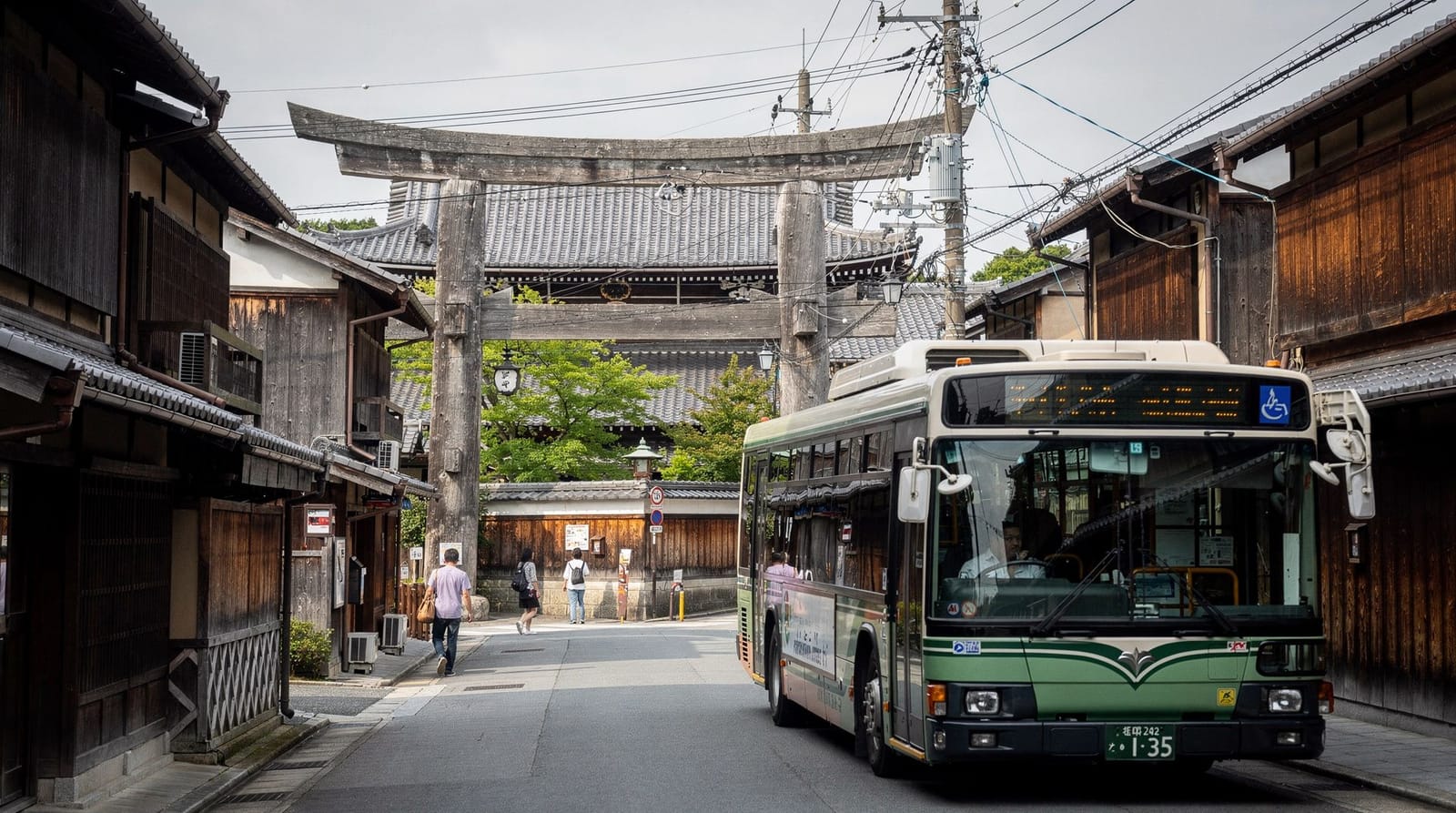
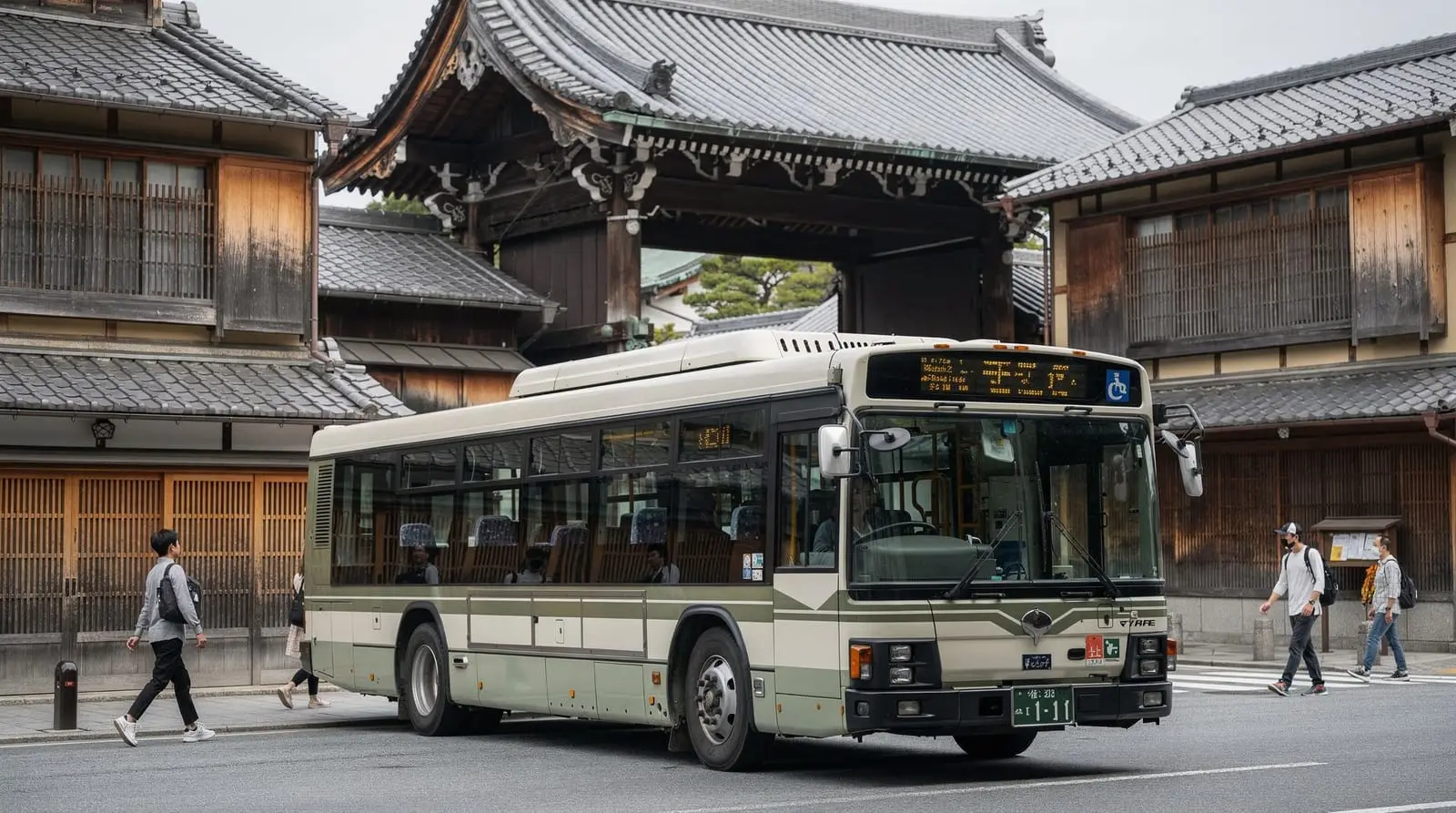
Kyoto Bus and Kyoto City Bus are the two main operators, distinguishable by livery (green-and-cream for city buses, cream-and-maroon for the private Kyoto Bus company) and both accept the same IC cards and similar flat fares. A handful of other private operators run specific routes (airport limousine buses, long-distance highway buses), but for day-to-day sightseeing, “the bus” in this guide means the municipal and Kyoto Bus network shown by default in Google Maps and most transit apps.
How to board, pay, and exit
Board through the rear or middle door — this matters, since boarding at the front confuses drivers and other riders on a system designed around rear-boarding. Take a numbered ticket from a machine by the door only if the bus displays a fare board showing rising fares by boarding stop (this applies mainly to buses heading into the outer suburbs, not the flat-fare central zone). Exit through the front door, tapping an IC card on the reader as you pass, or dropping the correct flat fare (¥230 for most central routes) into the farebox, which includes a change machine for coins and small notes.
The flat fare and where it applies
Within Kyoto’s central sightseeing zone — which covers the large majority of temples, shrines, and neighborhoods a typical visitor sees — the bus fare is a flat ¥230 (about US$1.55) regardless of distance traveled. Routes extending into the outer suburbs and some mountain areas (Kurama, parts of Ohara) switch to a distance-based fare shown on a rising fare board at the front, in which case the boarding-stop ticket determines what you owe on exit. An IC card handles both fare types automatically without needing to read the board yourself.
Route 100 and 206: the Higashiyama workhorses
These two routes, both starting from Kyoto Station, cover the highest concentration of major sights in the city: Kiyomizu-dera (Gojo-zaka or Kiyomizu-michi stop), Gion (Gion stop), Yasaka Shrine, and continuing on to Heian Shrine and Ginkaku-ji on route 206’s extended run. They’re also, unsurprisingly, the most crowded buses in Kyoto during peak hours, since a large share of first-time visitors are riding the exact same route to the exact same handful of stops.
Hop-on hop-off sightseeing bus ticket — an alternative to the regular city bus network on the busiest sightseeing daysRoute 101, 102, and 205: Kinkaku-ji and the north
For the Golden Pavilion and nearby Ryoan-ji and Ninna-ji, routes 101 and 102 run more directly from Kyoto Station, while 205 approaches from a slightly different angle via downtown Kyoto. These routes see less tourist crowding than the 100/206 pair but still run full during the late-morning peak, particularly on weekends.
Route 28 and getting to Arashiyama by bus
Route 28 connects Kyoto Station to Arashiyama, though it’s a slower option (35-45 minutes with traffic) than the JR Sagano line’s direct 15-20 minute train ride covered in the getting around Kyoto guide. The bus is worth choosing specifically when a hotel or the day’s earlier stops sit directly on its route, avoiding a walk or transfer to a train station.
Reading a bus stop sign
Kyoto’s bus stop signage lists the routes serving that stop, their destinations, and approximate arrival frequency, in both Japanese and English at most central stops. Digital displays at major stops (Kyoto Station’s bus terminal, Gion) show real-time arrival countdowns; smaller stops rely on printed schedules. A transit app remains more reliable than reading the physical signage cold, particularly for anyone unfamiliar with how Japanese bus destination naming works (buses are labeled by final destination, not by the sights along the route).
Where buses genuinely beat trains
Buses win specifically for point-to-point trips within Higashiyama, Gion, and the northern temple cluster, where no train line runs and walking would take 30+ minutes. They also win for door-to-door convenience when carrying light bags between sights during the day, since bus stops are far more numerous than train stations. Where they lose is speed on any route a train also serves — Fushimi Inari, Arashiyama, and Uji are all faster by JR or Keihan than by the equivalent bus route.
The now-discontinued one-day bus pass
Older travel guides and forum posts still reference a ¥700 one-day bus pass, which the city discontinued in March 2023 after years of complaints about overcrowding linked to pass holders, who tended to ride more casually and board without preparing exact information about their route, slowing boarding at busy stops. No replacement bus-only pass exists, and the city’s current guidance for visitors is to use an Icoca IC card instead — worth knowing so an outdated recommendation doesn’t shape a trip’s planning.
Pitfall: assuming buses are always faster than walking
For short hops of under 1.5 kilometers within already-walkable areas — Kiyomizu-dera to Yasaka Shrine, for instance — waiting for a bus, boarding, and exiting frequently takes longer than walking the same distance directly, especially during the crowded 10am-1pm window when buses run behind schedule and boarding itself takes several minutes per stop. Checking the walking-time estimate before automatically defaulting to a bus is a small habit that saves real time over a multi-day trip.
Pitfall: not knowing your stop name in advance
Bus stop announcements are made in Japanese and English on most routes, but relying entirely on catching the announcement rather than tracking the route on a map app risks missing a stop, particularly on crowded buses where the interior display isn’t visible from a standing position near the rear door. Setting a transit app’s live tracking before boarding removes this risk entirely.
Pitfall: rush-hour and event-day crowding
Beyond the standard 10am-1pm tourist peak, specific event days — Gion Matsuri in July, the peak weekends of cherry blossom and autumn foliage season — push bus crowding to a level where buses on the 100 and 206 routes sometimes skip stops entirely because they’re already full. On these specific days, the subway plus a longer walk, or a taxi, is often the more reliable choice even though the bus is nominally the direct route.
Children’s fares and traveling with family
Children under 6 ride free on Kyoto city buses, and children aged 6-11 pay a reduced fare of ¥120, roughly half the adult flat fare, whether paying cash or using an IC card registered as a child card (a separate card type issued at ticket offices with ID showing the child’s age). A standard adult IC card charges the adult fare regardless of the rider’s actual age if it isn’t registered as a child card, so families traveling with school-age children may want to set this up on arrival at Kyoto Station rather than defaulting to adult cards for everyone.
What to do if you run out of change or your IC card fails
Fareboxes on Kyoto buses include a change-making machine that accepts ¥1,000 notes and breaks them into coins, so running short of exact change rarely causes a real problem — feed a note into the machine before or as you exit rather than holding up the line searching pockets. If an IC card fails to read (rare, but it happens with damaged or very low-balance cards), the driver can process the fare manually; carrying a small amount of backup cash for this scenario is a reasonable precaution rather than relying entirely on a single card.
The airport limousine bus is a different service entirely
It’s worth flagging explicitly: the airport limousine buses connecting Kansai Airport to Kyoto Station are a separate, reservation-friendly long-distance service, not part of the city bus network or fare system covered in this guide. They’re covered in full in the Kansai Airport to Kyoto guide, including current fares and journey times.
Night buses and late-evening service
Most city bus routes wind down by 10-11pm, with reduced frequency after 8pm generally. For dinner plans in Gion or Pontocho running past 9pm, checking the last bus time back to a hotel in advance — or planning to walk, taxi, or use the subway if it runs later on the relevant line — avoids getting stranded waiting for an infrequent late bus.
How Kyoto’s route numbering actually works
Route numbers in the 1-99 range mostly serve central Kyoto and radiate from Kyoto Station or downtown; the 100-series numbers (100, 101, 102, 105, 106) are the “sightseeing” routes explicitly designed to link Kyoto Station with the major temple clusters, running more frequently and with more English signage than the lower-numbered local routes. Numbers above 200 mix local commuter routes with a handful of tourist-relevant ones (205, 206) that happen to pass through sightseeing areas on an otherwise residential route. This isn’t a rule you need to memorize, but recognizing that the 100-series buses are built for visitors explains why they’re both more convenient and more crowded than a similar-looking three-digit alternative.
Bus etiquette worth knowing
Kyoto buses run on a few unwritten rules that aren’t posted anywhere but that locals notice when broken. Priority seats near the front are reserved for elderly, pregnant, and disabled riders, and are expected to be vacated without being asked. Loud phone conversations are considered rude, though texting and quiet phone use are fine.
Large luggage is technically permitted but discouraged during crowded hours, since buses have minimal storage and standing room shrinks fast with a full-size suitcase aboard — this is one of several reasons a taxi is the better choice for hotel-to-hotel moves with bags, covered in the getting around Kyoto guide. Queueing at the stop in the order of arrival, rather than clustering at the door, is standard practice at busy stops like Kyoto Station’s bus terminal, which has numbered platforms for specific routes to keep the queueing orderly.
Low-floor buses and accessibility
Most Kyoto city buses on central routes have been upgraded to low-floor models with a fold-out ramp for wheelchairs and strollers, activated by the driver on request. Older buses on some outer or less-trafficked routes haven’t been fully replaced, so accessibility isn’t guaranteed on every single route the way it is on, say, Kyoto Station’s elevators. Announcing a need for the ramp to the driver on boarding, rather than assuming it will be offered automatically, gets a faster response.
Bus versus subway versus train: a quick decision rule
As a rule of thumb: use the subway when your route runs along the Karasuma or Tozai line corridor and speed matters; use JR, Keihan, Hankyu, or Randen when heading toward Fushimi Inari, Uji, Arashiyama, or a day trip city; use the bus for everything else, particularly Higashiyama, Gion, and the northern temple cluster, where no train line runs close enough to avoid a long walk. Mixing all three across a single day, rather than picking one mode and forcing every trip through it, is normal and often the fastest overall approach — a pattern the sample itinerary below illustrates.
A sample bus-heavy sightseeing day
A typical Higashiyama day might run: bus 100 from Kyoto Station to Kiyomizu-michi (¥230, roughly 25 minutes with traffic), walking down through Sannenzaka and Ninenzaka to Yasaka Shrine and Gion (25-30 minutes on foot, no bus needed), then bus 206 from Gion back toward Ginkaku-ji and the Philosopher’s Path (¥230, 15-20 minutes), finishing with a bus or subway-plus-walk back to central Kyoto for dinner. Total bus spend for the day: ¥690-920 (US$4.60-6.15) for three or four rides, comfortably inside the daily transport budget covered in the Kyoto travel budget guide.
Weather and seasonal bus disruption
Heavy rain, which Kyoto gets in the June-July rainy season and occasionally from typhoons in late summer, slows buses further through added traffic and boarding delays as riders manage umbrellas. Snow, which falls a handful of times most winters and rarely accumulates heavily in the city center, can delay buses on routes into the northern hills (Kurama, Ohara) more than central routes. Building 10-15 extra minutes into any bus-dependent plan during these conditions, or defaulting to the subway or a taxi where available, avoids the knock-on effect of a late bus disrupting a timed reservation later in the day.
Buses for day trips versus buses for city sightseeing
The routes covered in this guide are city sightseeing routes. Day trips to Osaka, Nara, Kobe, or Himeji run on JR or private rail lines instead, not city buses — see the getting around Kyoto guide for those connections, and Kansai Thru Pass guide for whether a regional pass makes sense if several day trips are planned.
Arriving from Kansai Airport, note that the airport buses and Kyoto’s city buses are entirely separate fare systems — the Kansai Airport to Kyoto guide covers that transfer specifically.
Frequently asked questions about the Kyoto bus system
How do I pay on a Kyoto bus?
Board at the rear or middle door and exit at the front, tapping an IC card on the reader as you exit or dropping exact change into the farebox. The flat fare within the central zone is ¥230.
What’s the difference between city buses and Kyoto Bus (private)?
Kyoto City Bus (green/cream) and Kyoto Bus (a private operator, cream/maroon) both serve the city and accept the same IC cards, but run different route numbers. Transit apps distinguish between them automatically.
Which bus routes should I actually know?
Routes 100 and 206 for Higashiyama, Kiyomizu-dera, Gion, and Ginkaku-ji; 101, 102, and 205 for Kinkaku-ji and the northern temples; 28 for Arashiyama from Kyoto Station.
Is there still a one-day bus pass in Kyoto?
No — the paper one-day bus pass was discontinued in March 2023 due to overcrowding. The city now recommends an Icoca IC card for all visitors instead.
How crowded do Kyoto buses actually get?
Very, on the 100 and 206 routes between roughly 10am and 1pm, worse during cherry blossom and autumn foliage season. Riding before 8:30am or after 3pm avoids most of the crowding.
Do Kyoto buses run on time?
Reasonably well outside peak traffic, but schedules slip during rush hour and around major sightseeing areas on weekends, sometimes by 10-15 minutes.
Can I use the same IC card on buses that I use for the subway and trains?
Yes — an Icoca card (or Suica, Pasmo, and other nationally interoperable cards) works identically across city buses, the subway, and JR, Keihan, Hankyu, and Randen trains, with fares deducted automatically per mode.
Frequently asked questions about Kyoto bus guide — routes, fares, and how to actually use them
How do I pay on a Kyoto bus?
What's the difference between city buses and Kyoto Bus (private)?
Which bus routes should I actually know?
Is there still a one-day bus pass in Kyoto?
How crowded do Kyoto buses actually get?
Do Kyoto buses run on time?
Top experiences
Bookable activities with verified prices and instant confirmation on GetYourGuide.