Nishiki Market guide — Kyoto's Kitchen, what to eat and the etiquette
Kyoto: Local Food Tasting Tour at the Nishiki Market
What is Nishiki Market and when is it open?
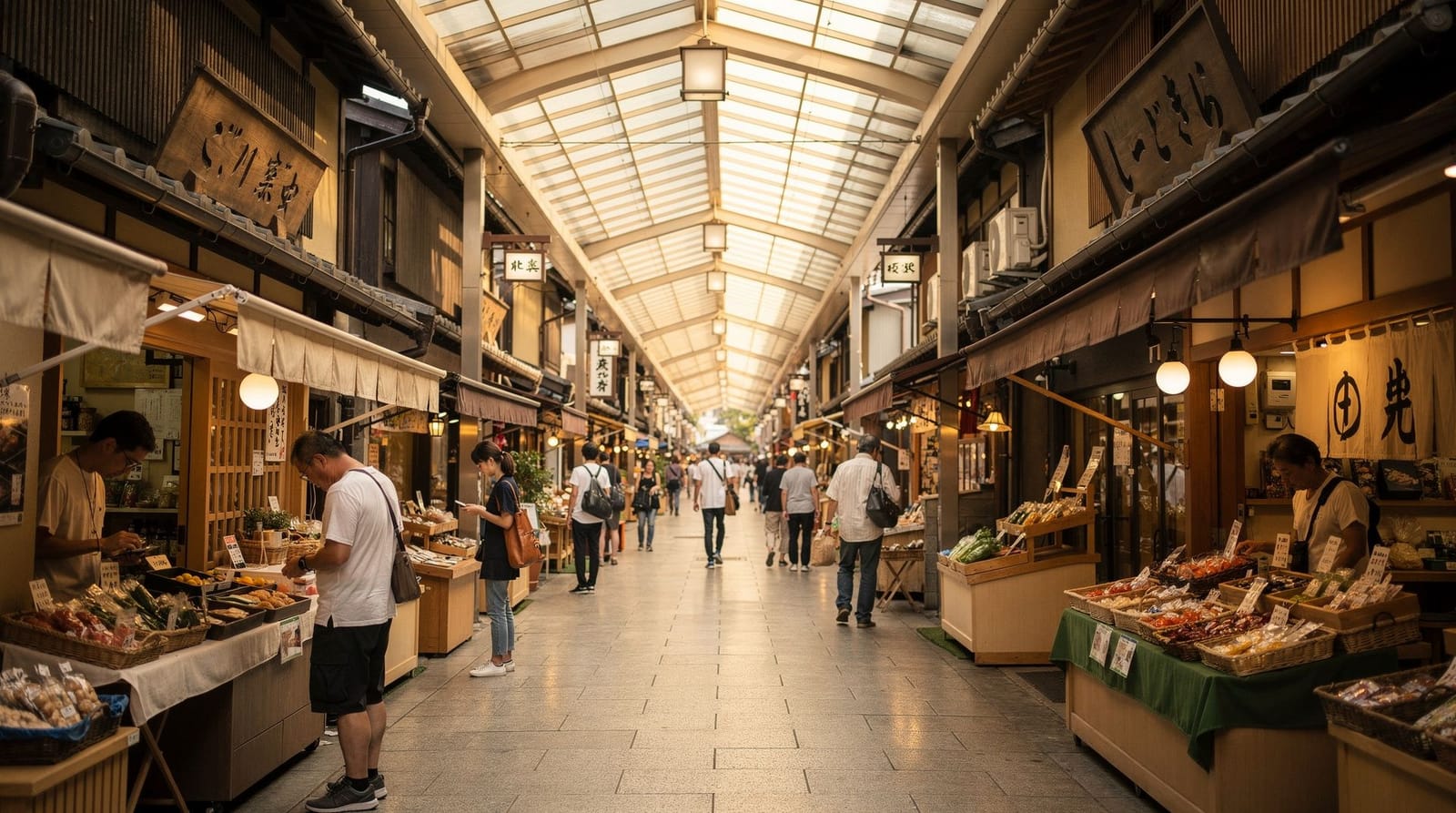
Nishiki Market is a roughly 400-meter covered shopping street in downtown Kyoto with about 130 stalls and small shops selling fresh produce, pickles, seafood, sweets and street snacks — nicknamed Kyoto's Kitchen. Most stalls operate daily from around 9am to 6pm, though hours vary by shop and a handful close one day a week (often Wednesday). Mid-morning to early afternoon is busiest; arriving right at opening is the quietest window.
A working market first, a tourist attraction second
Nishiki Market has operated on roughly the same stretch of downtown Kyoto since the early Edo period, when it started as a fish and produce wholesale street taking advantage of unusually cool groundwater that helped keep seafood fresh before refrigeration. That practical origin still shows: alongside the tourist-facing skewer stalls, you’ll find shops selling nothing but pickles, shops selling only dried fish, and a knife specialist that professional chefs actually travel to buy from. It’s nicknamed Kyoto’s Kitchen for a reason — this is genuinely where a lot of the city’s restaurants and home cooks have sourced ingredients for generations, not a market invented for visitors.
| Where | Downtown Kyoto, one block north of Shijo-dori |
| Hours | Roughly 9am-6pm daily; some shops closed Wed |
| Budget | Around ¥1,500-2,500 for 5-6 tasting items |
| Time needed | 45 min-1.5 hrs grazing; 1.5-2 hrs for a full lunch |
| Getting there | Karasuma-Oike/Shijo or Kawaramachi Station |
| Best time | Right at 9am opening for the quietest walk |
That mixed identity — working market plus major attraction — is the most useful thing to understand before you go. Some sections cater heavily to walking tourists with pre-packaged, easy-to-photograph snacks; others are unchanged shops where the customer next to you is a chef from a restaurant three streets over. Both are real. Knowing which is which makes for a much better visit.
Layout: about 130 stalls over 400 meters
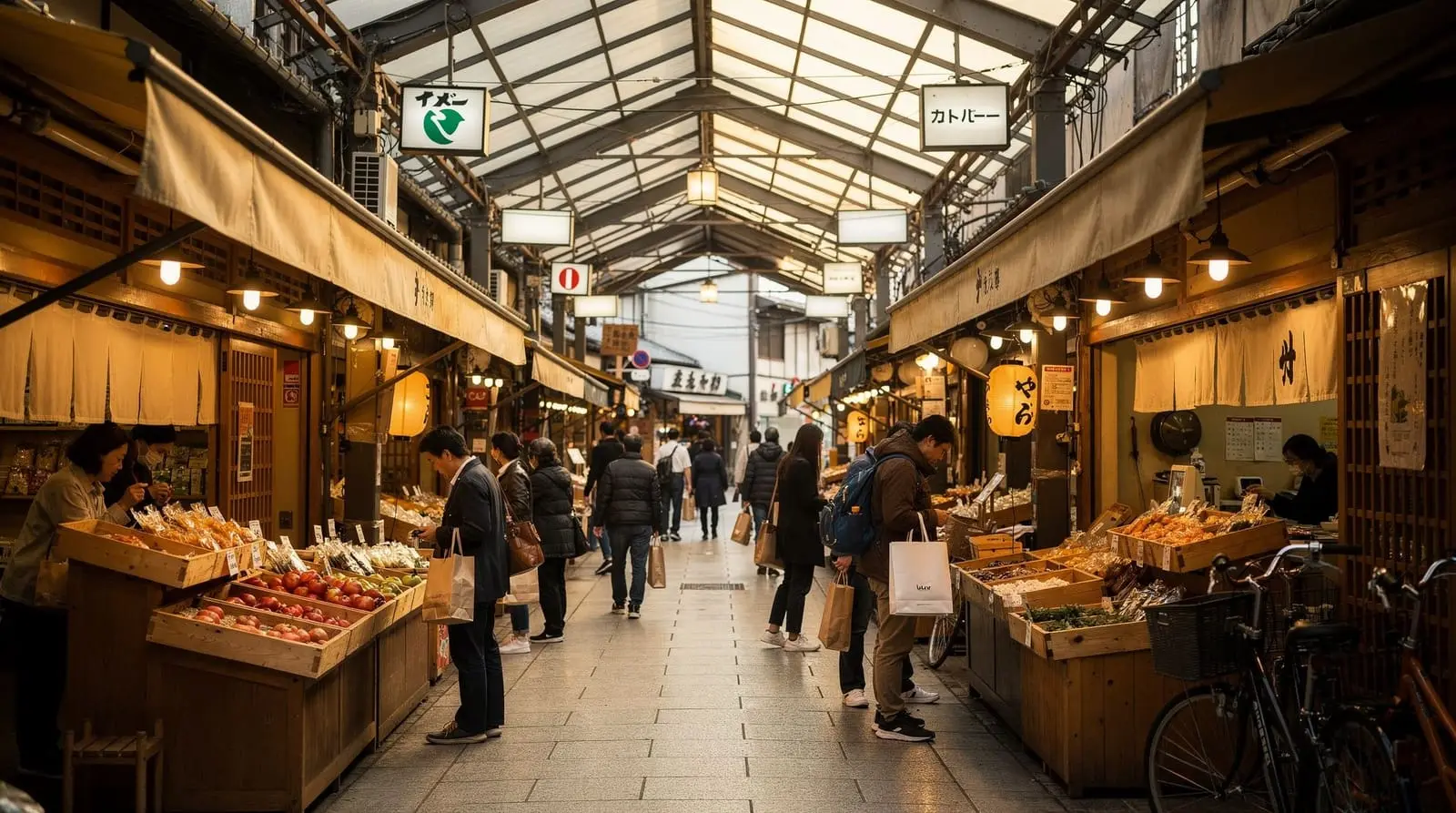
Nishiki Market runs as a narrow, covered pedestrian arcade roughly 400 meters long, one block north of and parallel to Shijo-dori, Kyoto’s main downtown shopping street. It’s lined with around 130 shops and stalls — not all of them food, since ceramics, lacquerware, kitchen tools and dry goods sellers are mixed in throughout.
The market runs roughly from Takakura-dori at the western end to Teramachi-dori at the eastern end, where it connects almost directly into the covered Teramachi and Shinkyogoku shopping arcades — useful if you want to keep browsing after you’ve eaten your way through. The nearest subway stations are Karasuma-Oike and Shijo on the Karasuma Line, and Kawaramachi Station on the Hankyu Line, each about a 5-10 minute walk from one end or the other.
Hours and the best time to go
Most stalls open around 9am and close around 6pm, though this varies by shop — some specialty stands open earlier for the morning produce trade, others don’t get going until 10 or 11am. A number of shops close one day a week, often Wednesday, so if a specific stall is the reason for your visit, it’s worth checking in advance rather than assuming daily hours.
The market is busiest from around 11am through mid-afternoon, when both day-trippers and lunch-hour locals converge on the same narrow arcade. Arriving right at opening — 9 to 10am — gets you a noticeably quieter walk and first pick of items that sell out, like the daily-limited tamagoyaki batches at some stalls. Late afternoon, close to 5 or 6pm, is the second-quietest window, though by then some stalls have already sold out of their best items.
What to actually eat: a realistic tasting list
A grazing session that hits the market’s genuine specialties without overspending on tourist-priced novelty items:
Tako tamago — a whole baby octopus stuffed with a quail egg on a skewer, glazed and grilled. It’s the market’s single most-photographed item and tastes better than it sounds — roughly ¥300-500 (US$2-3.30) per skewer.
Tamagoyaki — Kyoto-style rolled sweet-savory omelette, sold warm on a stick from a handful of stalls. It’s a genuinely different texture from the tamagoyaki in a supermarket bento — light, custardy, still warm. Around ¥300-400 (US$2-2.70).
Fresh yuba — tofu skin, either eaten plain with a little soy sauce or wrapped around other fillings; one of the clearest examples of Kyoto’s soft-water tofu tradition showing up as street food. ¥300-600 (US$2-4).
Tsukemono — Kyoto’s famous pickled vegetables, sold by weight or in small pre-packed portions at several dedicated pickle shops. Worth a stop even just to see the variety — dozens of vegetables, pickling styles and colors in one shop window. ¥300-800 (US$2-5.30) for a small pack.
Yatsuhashi and mochi sweets — small cinnamon-scented rice-flour sweets and fresh mochi, sold both plain and stuffed with red bean. ¥150-400 (US$1-2.70) per piece; see the Kyoto street food guide for more on yatsuhashi’s origins.
Matcha or hojicha soft-serve — not historically part of the market, but genuinely good, and useful as a mid-walk cooldown. ¥400-600 (US$2.70-4).
Budget roughly ¥1,500-2,500 (US$10-17) for five or six items — enough for a light lunch’s worth of grazing without needing a sit-down meal afterward.
Local food tasting tour at Nishiki MarketAritsugu and the non-food side of the market
Not everything in Nishiki Market is edible. Aritsugu, a knife and kitchenware shop that’s operated on this street since the 1560s, is one of the market’s most genuinely famous stops — it sells professional-grade Japanese kitchen knives, with custom name engraving done on the spot, and is used by working chefs, not just souvenir hunters. A good knife here starts around ¥15,000-20,000 (US$100-133) and climbs well past that for higher-end steel.
There are also several ceramics, lacquerware and dried-goods shops scattered through the arcade — worth a slower look if you’re interested in Kyoto craft rather than just food, and a useful counterpoint to the idea that the market is only for tourists passing through.
Where the tourist-trap pricing actually shows up
The market isn’t uniformly a trap, but pricing for identical or near-identical items does vary noticeably along its length. Stalls closest to the eastern (Teramachi) and western (Takakura) entrances — the ends most visitors enter from — sometimes charge a premium for pre-packaged, grab-and-go versions of items that cost less from a stall in the middle of the arcade making them fresh to order. If a skewer or sweet looks identical at two stalls with a visible price difference, the cheaper one made in front of you is usually the better choice, not just the better value.
The other pattern worth knowing: a few stalls, particularly ones selling wagyu skewers or scallops grilled to order, charge premium prices (¥800-1,500 / US$5.30-10 per skewer) that are fair for the ingredient but easy to over-order without noticing the total climbing fast. It’s not a scam, just worth pacing yourself against.
Etiquette: eat where you buy, don’t walk and eat through the whole arcade
Nishiki Market is narrow — genuinely too narrow, in peak hours, for a crowd of people eating while walking four abreast. The expected etiquette is to buy an item, step to the side or use the small standing counter many stalls provide, eat it there, and dispose of the skewer or wrapper in the bin at or near that same stall before moving on. Most shops don’t want their competitors’ trash left in front of their storefront, and carrying a half-eaten skewer through the crowd is both a minor faux pas and a genuine trip hazard in the busiest hours.
Nishiki Market and depachika food tour with a localPhotography of stall displays is generally fine; photographing shopkeepers directly without asking is not well received, particularly at the older, less tourist-oriented shops. If a stall has a visible “no photos” sign — a handful do, especially fishmongers — respect it.
Cash, cards and what to bring
Card and contactless payment acceptance has improved across Nishiki Market in recent years, but it’s still inconsistent — many of the smallest, oldest stalls remain cash-only, particularly for purchases under ¥1,000. Carrying ¥3,000-5,000 (US$20-33) in small bills and coins for a grazing session avoids the awkwardness of a stall not being able to break a large note or take a card for a ¥300 skewer. IC transit cards (Suica, ICOCA and similar) are accepted at a growing number of stalls, mainly the newer ones aimed at younger customers, but don’t count on it market-wide.
Bring a small bag or reusable tote if you’re planning to buy pickles, ceramics or knives to take home — plastic bags are sometimes provided but not universally, and some shops charge a small fee for one. If you’re staying at a hotel some distance away, note that fresh items like yuba or prepared skewers don’t travel well for more than an hour or two without refrigeration, so plan food purchases for consumption on the spot rather than saving them for later.
How Nishiki Market compares to other Japanese food markets
Visitors who’ve already been to Tokyo’s Tsukiji Outer Market or Osaka’s Kuromon Ichiba tend to draw comparisons, and the differences are worth knowing before you go in with the wrong expectations. Kuromon Ichiba in Osaka is larger, more seafood-heavy, and generally louder and more overtly tourist-oriented in its central stretch, with bigger portions and a more raucous atmosphere. Nishiki Market is narrower, quieter, and leans harder into Kyoto’s specific food identity — pickles, tofu, wagashi and delicate rather than showy seafood presentations — which makes it feel more like browsing a historic shopping street than a food hall built for volume.
If you’re doing both Kyoto and Osaka on the same trip, they’re different enough experiences to justify visiting both rather than treating one as a substitute for the other; see the Osaka destination guide for planning a combined day trip.
Combining Nishiki Market with the rest of downtown
Nishiki Market sits inside a dense downtown pocket that’s easy to combine with a broader afternoon — the covered Teramachi and Shinkyogoku arcades continue directly from its eastern end, and Kawaramachi’s main shopping streets are a few minutes’ walk south. See the downtown Kyoto destination guide for the fuller neighborhood picture, including Pontocho’s evening dining alley a short walk away.
If you’d rather have a guide do the stall selection and ordering for you — useful if you’re unsure which shops are worth the price and which aren’t — a local-led food tour through the market is one of the more efficient ways to see it, particularly on a first visit. For a comparison of the different Nishiki and Gion food tour formats, see best food tours in Kyoto.
Taste of Nishiki Market walking food tourFrequently asked questions about Nishiki Market
How many stalls does Nishiki Market have?
Around 130 shops and stalls line the roughly 400-meter covered arcade. Not all sell food to eat on the spot — several are dry-goods, ceramics or kitchenware sellers — so the actual number of street-food stops is closer to 40-60 depending on the day.
What is the etiquette for eating while walking in Nishiki Market?
Buy from a stall, eat the item at or right next to that stall rather than walking and eating through the arcade, and dispose of skewers and wrappers in the bin near where you bought them. Some stalls have a short standing counter for this.
What should first-time visitors actually eat at Nishiki Market?
Tamagoyaki on a stick, tako tamago (baby octopus stuffed with a quail egg), fresh yuba, a few pieces of tsukemono pickles, and a matcha or hojicha soft-serve. Budget roughly ¥1,500-2,500 (US$10-17) for five or six items.
Is Nishiki Market a tourist trap?
Parts of it, yes — stalls near the main entrances sometimes charge more for pre-packaged snacks aimed at tour groups. The core of the market is still a genuine, centuries-old food market that locals shop at, so it’s more about picking your stalls than avoiding the whole place.
How long does it take to walk through Nishiki Market?
The arcade itself is a 10-15 minute walk end to end without stopping. With tasting stops and browsing, most visitors spend 45 minutes to 1.5 hours; a proper grazing lunch takes closer to 2 hours.
Where does Nishiki Market start and end, and how do you get there?
It runs roughly from Takakura-dori to Teramachi-dori, one block north of Shijo-dori. The nearest stations are Karasuma-Oike or Shijo (Karasuma Line) and Kawaramachi (Hankyu Line), each a 5-10 minute walk.
Can you buy knives or ceramics at Nishiki Market, not just food?
Yes — Aritsugu, a knife shop operating since the 1560s, is one of the market’s most famous non-food stops, selling professional-grade knives with custom engraving. Several ceramics and lacquerware shops are also mixed through the arcade.
Rainy-day and hot-weather appeal
Because the entire arcade is covered, Nishiki Market is one of the more reliable rainy-day activities in central Kyoto, alongside the connecting Teramachi and Shinkyogoku arcades that let you stay under cover for a much longer stretch than most Kyoto sightseeing allows. It’s also a genuine relief during Kyoto’s hot, humid summer months, since the covered roof cuts direct sun even if the arcade itself isn’t air-conditioned — worth keeping in mind if you’re planning around a July or August heatwave and want an indoor-feeling stop that isn’t a museum or a shopping mall. See the Kyoto in summer guide for how a market visit fits into a hot-weather itinerary.
Seasonal specialties worth knowing about
A handful of stalls sell items tied specifically to the calendar rather than year-round staples — fresh bamboo shoots (takenoko) in spring, matsutake mushroom-topped skewers and grilled sweet potato in autumn, and New Year osechi ingredients in the final days of December, when the market gets genuinely packed with locals doing holiday shopping rather than tourists grazing. Visiting during one of these windows adds a layer beyond the standard tasting list, though it also means heavier crowds — late December specifically is worth avoiding if crowd-avoidance matters more to you than the seasonal ingredients themselves.
Planning your visit around it
Nishiki Market works best as a mid-morning or late-afternoon stop rather than the anchor of your whole day — an hour to 90 minutes of grazing, combined with a browse through the connecting Teramachi arcade or a proper sit-down lunch nearby, covers it without over-scheduling. It also pairs naturally with a broader look at Kyoto’s food culture; see the Kyoto food guide for how the market fits into obanzai, kaiseki and the rest of the city’s cuisine.
Frequently asked questions about Nishiki Market guide — Kyoto's Kitchen, what to eat and the etiquette
How many stalls does Nishiki Market have?
What is the etiquette for eating while walking in Nishiki Market?
What should first-time visitors actually eat at Nishiki Market?
Is Nishiki Market a tourist trap?
How long does it take to walk through Nishiki Market?
Where does Nishiki Market start and end, and how do you get there?
Can you buy knives or ceramics at Nishiki Market, not just food?
Top experiences
Bookable activities with verified prices and instant confirmation on GetYourGuide.