Ohara
Ohara is a rural farming village north of Kyoto with Sanzen-in's moss garden, centuries-old pines at Hosen-in, and real pickled-vegetable culture.
Kyoto: Private Full-Day Tour by Car (Customizable)
Quick facts
- Distance from Kyoto
- 50-60 min by Kyoto City Bus 17 or 18
- One-way fare
- About ¥560
- Time needed
- Half day to full day
- Best known for
- Sanzen-in Temple's moss garden and warabe jizo
- Best time to visit
- Mid-to-late November for autumn foliage
Is Ohara worth the trip from Kyoto without a train connection? Yes, though it takes commitment: Ohara has no train station, and the only way in is a 50-to-60-minute Kyoto City Bus ride (route 17 or 18) from Kyoto Station or Demachiyanagi for about ¥560 (~$3.70) one way. What you get is Sanzen-in Temple’s moss garden, a 700-year-old cloud-pruned pine at Hosen-in, and a genuinely rural farming village that feels nothing like the rest of tourist Kyoto.
What makes Ohara different from Kyoto’s other temple towns
Most northern-Kyoto excursions still orbit around a temple with a gift shop and a bus parking lot. Ohara is a working agricultural village first and a temple destination second — a small, scattered settlement in a mountain valley where rice paddies and vegetable fields sit directly next to the temple approach roads. It’s also the birthplace of shiba-zuke, one of Kyoto’s three most famous pickled-vegetable styles, still made and sold here by small family producers rather than as a branded souvenir product. There is no direct train to Ohara at all — no station, no rail line — which alone filters out a meaningful share of casual day-trippers and keeps the pace noticeably slower than almost anywhere else covered in this guide.
Getting to Ohara from Kyoto
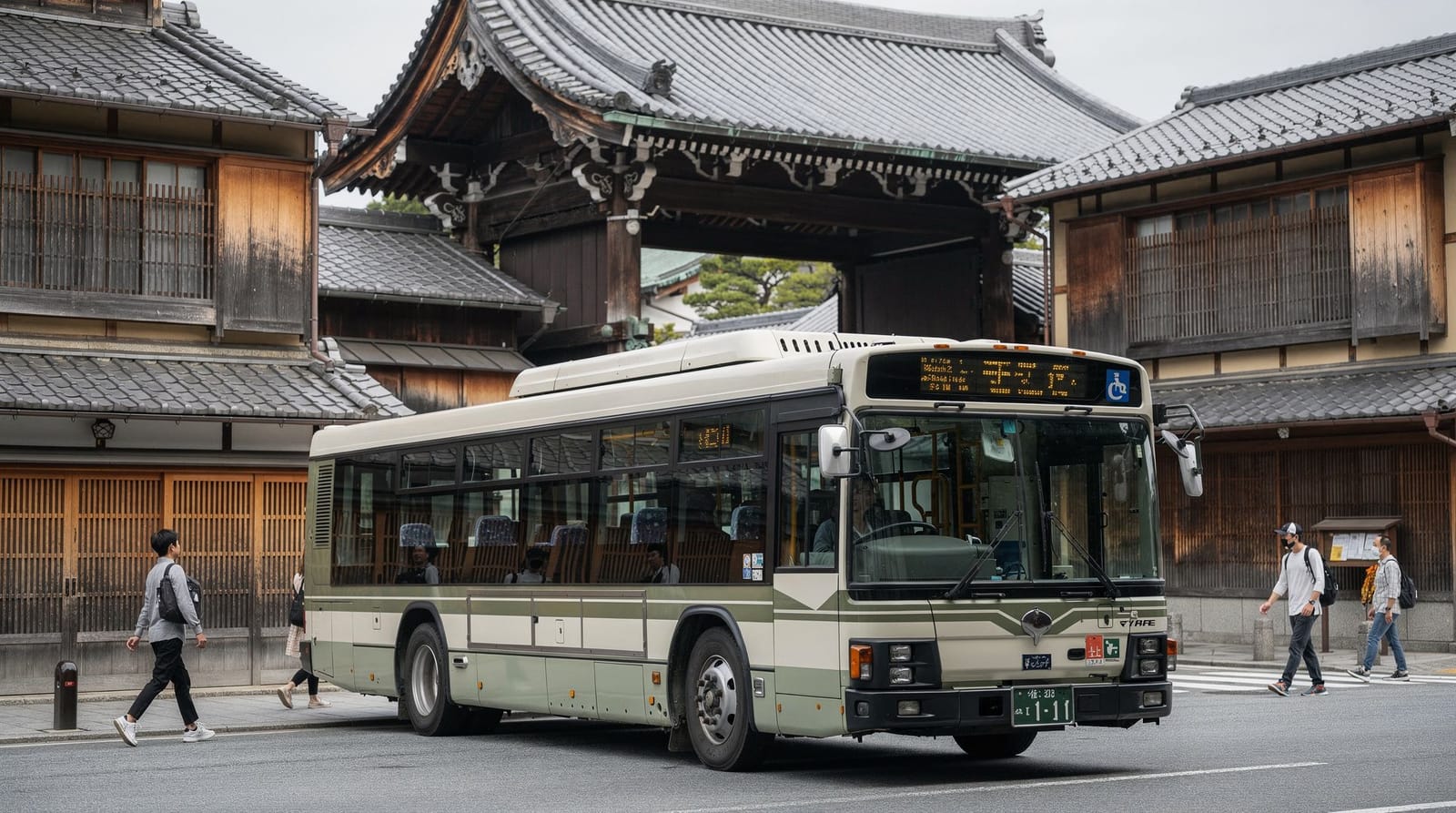
Bus is the only realistic option. Kyoto City Bus route 17 runs from Kyoto Station, and route 18 runs a similar route via Demachiyanagi and central Kyoto stops — both terminate at the Ohara bus stop after roughly 50 to 60 minutes, depending on traffic and the exact boarding point. The fare is a flat rate, currently around ¥560 (~$3.70) one way, payable by IC card (Icoca, Suica, Pasmo, etc.) or cash on exit. If you’re using a Kyoto City Bus day pass or a broader regional pass, check current coverage, since Ohara sits at the outer edge of the standard city bus zone and fare rules occasionally differ from central-Kyoto routes; see our Kyoto bus guide for how the fare and pass system works generally.
Traffic matters more here than on train-based day trips. These buses run on regular city streets for a meaningful stretch of the route, and delays of 10-20 minutes aren’t unusual during rush hour or in poor weather — build in buffer time, especially if you’re catching a specific return service or connecting onward the same evening.
There is no train alternative, and taxis, while possible, are expensive for a one-way trip of this length; a private car or driver, such as a customizable private full-day tour by car, is the only way to skip the bus commute entirely, and can be worth it if you’re also combining Ohara with Kurama and Kibune in the same northern-hills day, since the two aren’t well connected to each other by public transit.
Sanzen-in Temple: moss, jizo, and one of Kyoto’s most atmospheric gardens
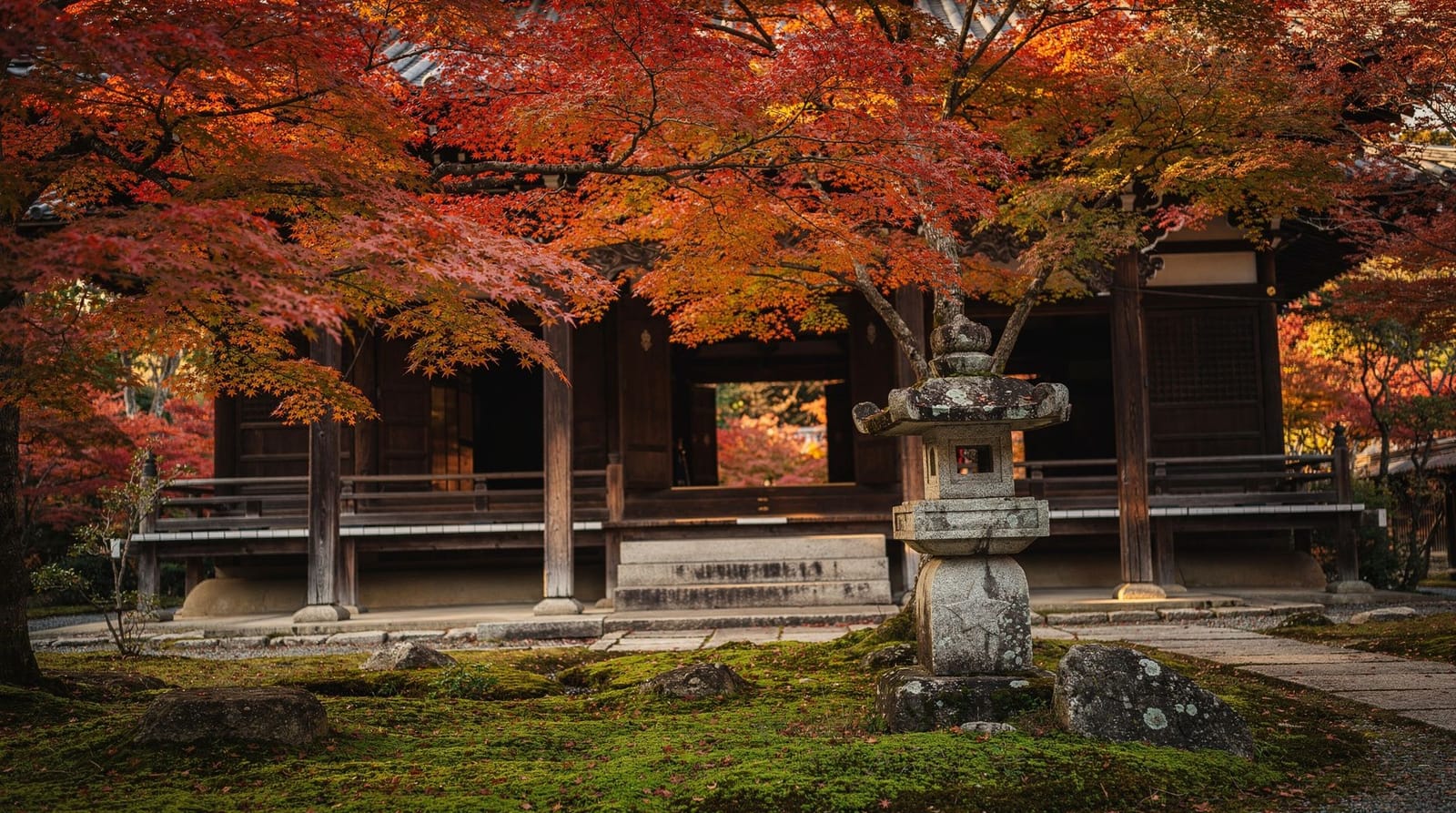
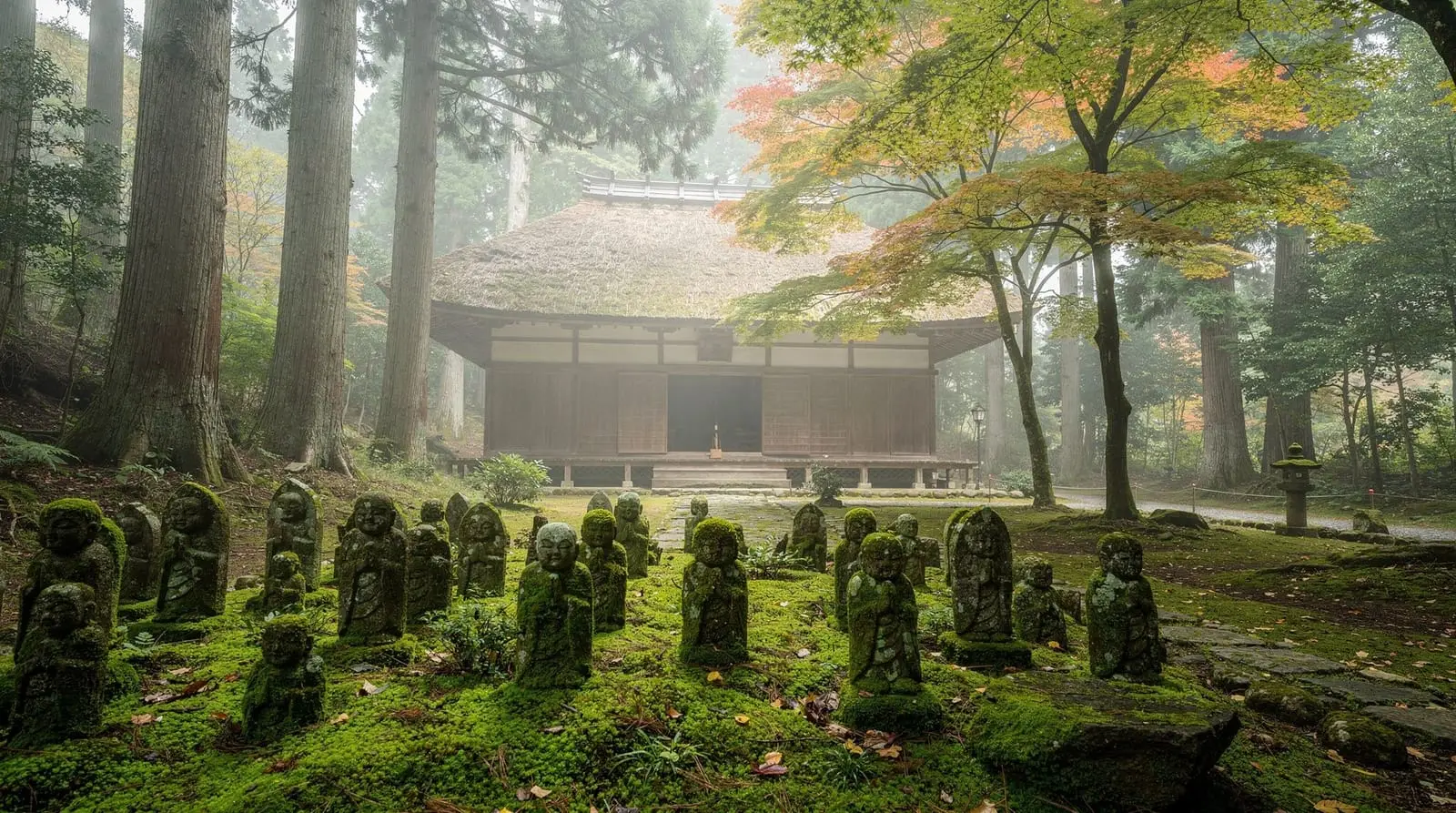
Sanzen-in is Ohara’s main attraction and, for many visitors, one of the best temple gardens anywhere around Kyoto — quieter and arguably more atmospheric than several far more famous names in the city center. The temple’s Yusei-en moss garden, a dense carpet of moss beneath tall cedars and maples, surrounds the Ojo Gokuraku-in hall, a Heian-period building housing a trio of Amida Buddha statues.
Scattered through the moss, easy to miss if you’re not looking for them, are small stone jizo statues known as warabe jizo — “child jizo” — rounder and more playful in expression than typical jizo figures, added to the garden in the modern era and now one of the most photographed details in Ohara, peeking out from moss and undergrowth at odd, half-hidden angles.
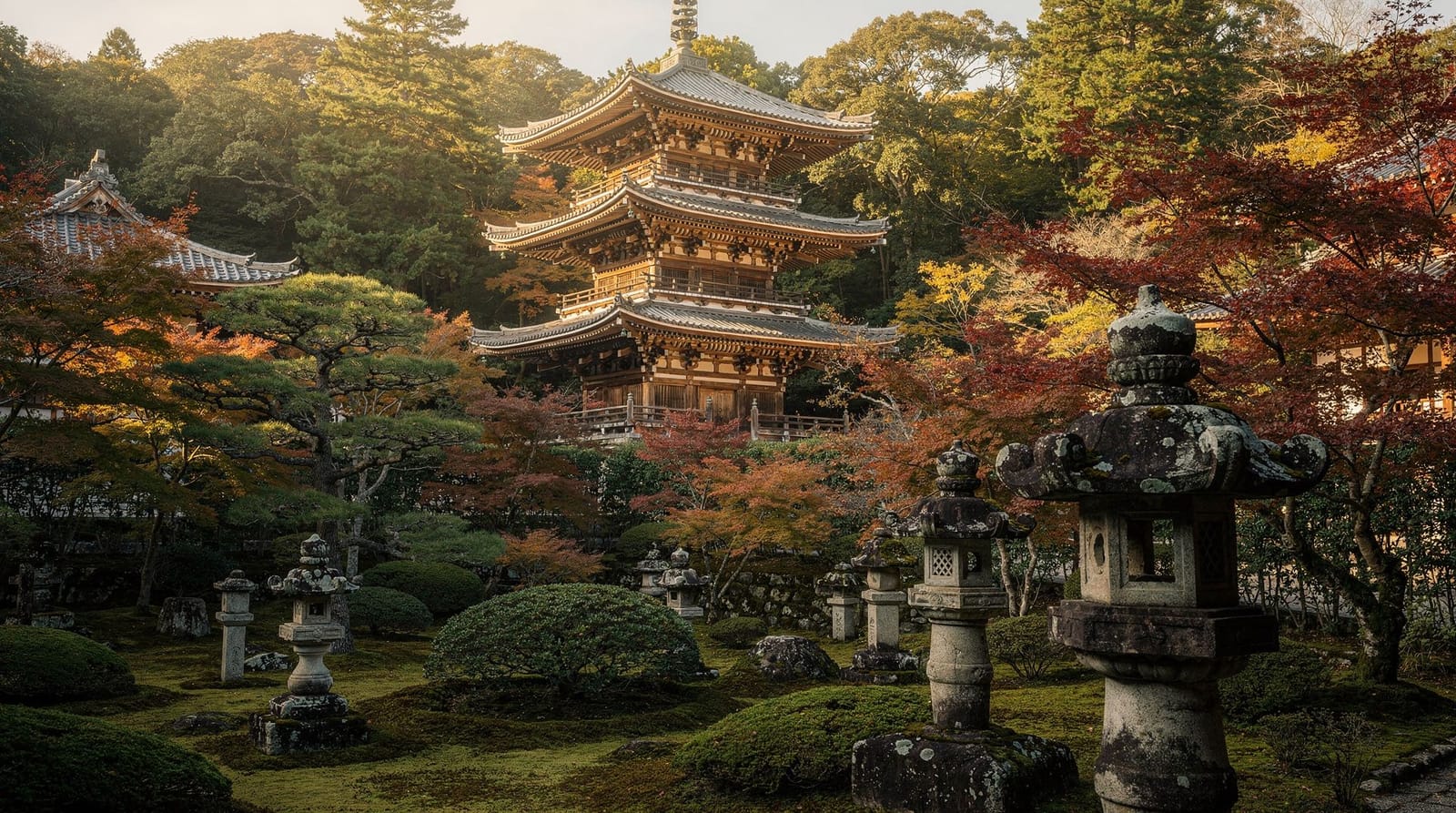
Sanzen-in is at its most crowded and most beautiful during autumn foliage, roughly mid-to-late November, when the maples surrounding the moss garden turn deep red against the green — a combination that draws serious photographers as well as casual visitors, and worth timing deliberately if foliage is your priority; see our autumn foliage in Kyoto guide for how Ohara’s peak compares to central Kyoto’s. Outside that window, spring brings fresh green moss and a calmer version of the same garden. Admission is ¥700 (~$4.70) for adults, and the temple is open daily, roughly 9am-5pm (shorter hours, until around 4:30pm, November through February).
Hosen-in: a 700-year-old pine and a dark relic
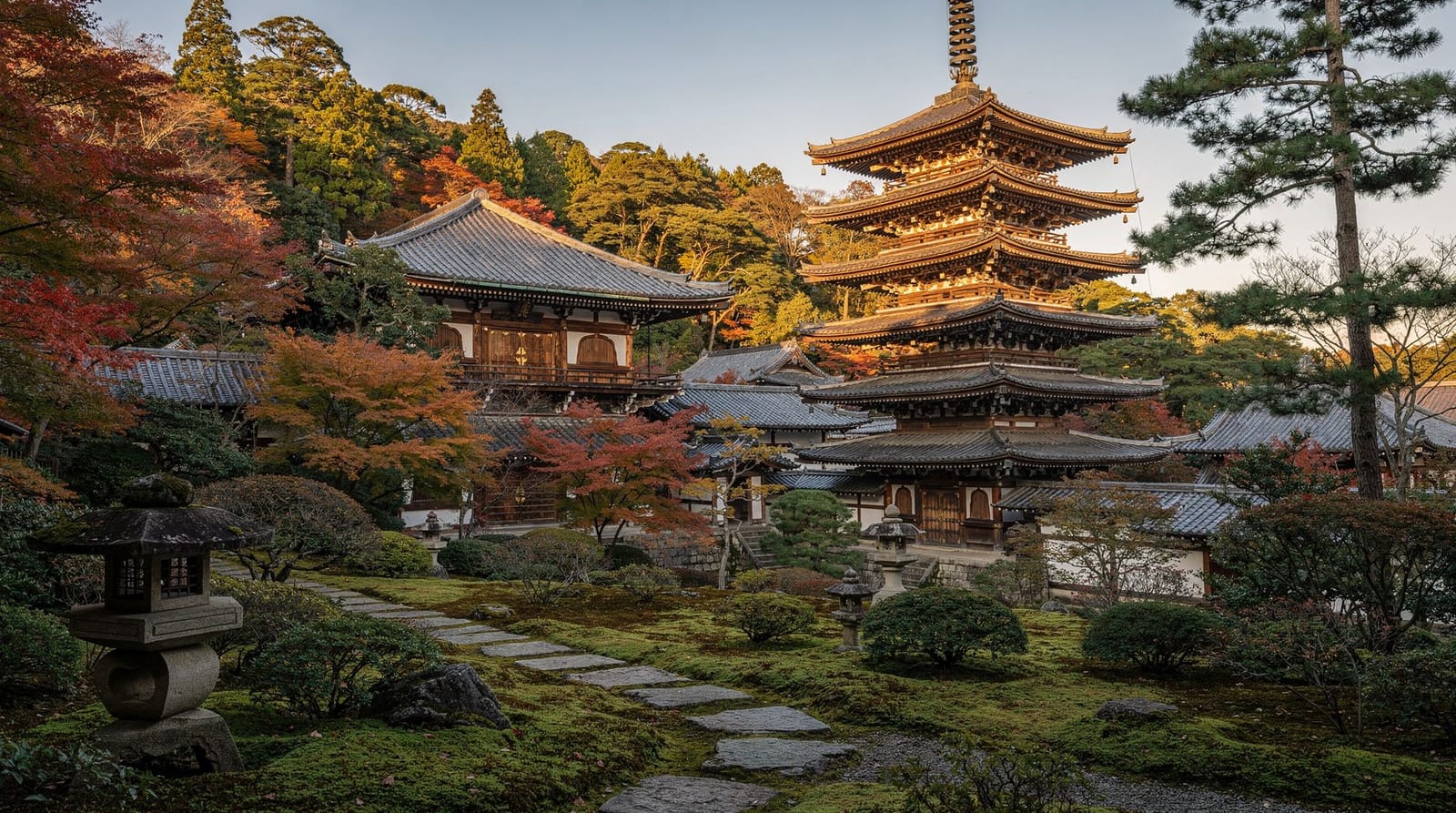
A short walk from Sanzen-in, Hosen-in is smaller and easy to underrate, but it holds two things worth deliberately seeking out. The first is a pine tree, said to be roughly 700 years old, pruned over centuries into deliberate cloud-like layered forms — genuinely striking, and the temple frames it as a “borrowed scenery” garden view from the tatami seating area, where admission includes a seated cup of matcha tea while you look out at the tree.
The second is the temple’s chi-tenjo, or “blood ceiling” — wooden boards salvaged from Fushimi Castle after a 1600 siege, retaining dark stains that are said to be bloodstains from soldiers who died there, later installed in several Kyoto-area temples’ ceilings as a memorial gesture. It’s a genuinely unsettling detail for a temple otherwise built around tea and garden contemplation, and Hosen-in is upfront about the history rather than downplaying it. Admission, including the seated tea, runs ¥800 (~$5.30), and hours are roughly 9am-5pm daily.
Jakko-in: a small nunnery with a tragic history
At the opposite, quieter end of the village from Sanzen-in sits Jakko-in, a small Tendai-sect nunnery associated with Kenreimon-in, a historical figure from the Heike Monogatari (The Tale of the Heike). After her clan’s defeat at the naval Battle of Dan-no-ura in 1185 and the deaths of her young son (the child emperor Antoku) and most of her family, Kenreimon-in reportedly retired to Jakko-in to live out her life as a Buddhist nun in seclusion and mourning — one of the more genuinely tragic footnotes in Kyoto-area temple history, and a useful counterweight if you’ve spent the trip so far absorbing only Tale of Genji romance rather than the harder edges of the same court-era literature.
The temple itself is modest — its main hall burned in a 2000 arson fire and was rebuilt, with some fire-damaged original statuary preserved separately — and it draws a fraction of Sanzen-in’s visitors, making it a good stop if you want a few minutes of real quiet. Admission is around ¥600 (~$4), roughly 9am-4:30pm daily, and it sits about a 15-20 minute walk from the main Ohara bus stop, on the far side of the village from Sanzen-in.
Ohara’s temples at a glance
| Sanzen-in | Hosen-in | Jakko-in | |
|---|---|---|---|
| Known for | Moss garden, warabe jizo | 700-year-old pine, blood ceiling | Kenreimon-in’s story, quiet |
| Admission | About ¥700 | About ¥800 (incl. seated tea) | About ¥600 |
| Crowd level | Busiest in Ohara | Moderate | Quietest |
| Time needed | 45-60 min | 20-30 min | 20-30 min |
| Best for | First-time visitors, foliage photos | Tea and garden contemplation | History, solitude |
Raigo-in and the origins of Buddhist chant
Further up the valley path beyond Sanzen-in, past Shorin-in, sits Raigo-in, a small and little-visited temple with an outsized historical role: it’s traditionally considered the birthplace of shomyo, the form of Buddhist liturgical chanting that later influenced much of Japanese traditional music, including elements of Noh theater. Monks are said to have developed and refined the chanting style here using the surrounding valley’s natural acoustics, training their voices against the sound of the nearby waterfall.
Raigo-in draws only a fraction of Sanzen-in’s visitors, and there’s little signage explaining the chant history in English, so it rewards visitors who already know the story rather than teaching it on-site — worth knowing before you go if the connection is what draws you up the extra few minutes of path. It’s a genuinely quiet, forested stop, and a good option if you want a few minutes entirely removed from any crowd, even a light one.
Shiba-zuke, farm stands, and the village itself
Ohara’s agricultural identity isn’t a marketing angle — walk the roads between temples and you’ll pass working rice paddies, vegetable plots, and small unstaffed or lightly staffed farm stands selling produce, pickles, and preserves on the honor system or with a single attendant.
Shiba-zuke, a purple-red pickle made primarily from eggplant and red shiso leaves, fermented with salt, is said to have originated in Ohara specifically and is sold throughout the village by small producers, typically ¥500-1,000 (~$3.30-6.70) per pack — a genuinely good, geographically specific souvenir, distinct from the generic pickle assortments sold in central Kyoto’s Nishiki Market. Several shops along the main approach road also sell fresh vegetables, mochi, and simple prepared foods aimed at day-trippers rather than pure tourists, and prices tend to be noticeably lower than equivalent items in central Kyoto.
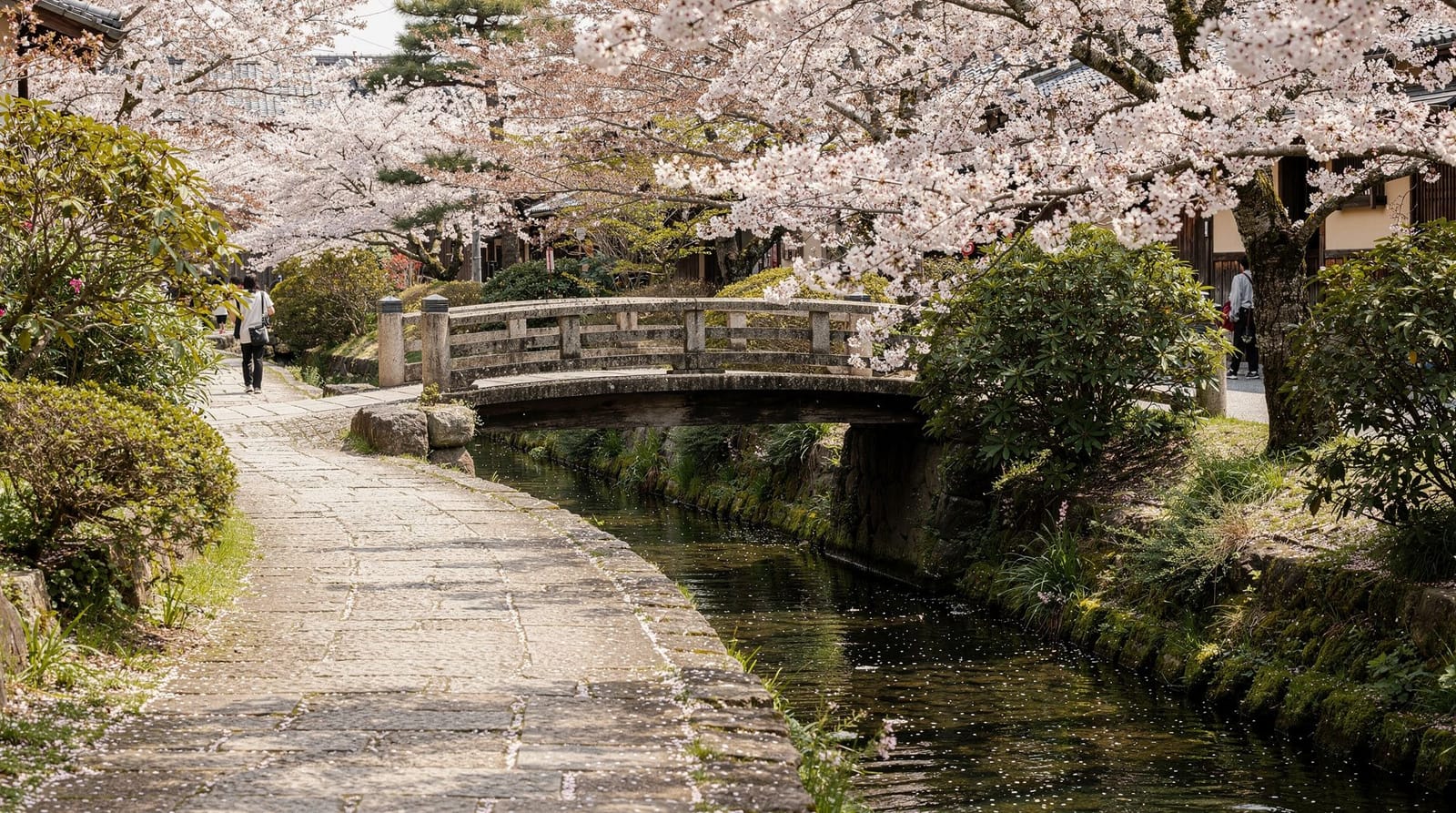
The pace here is genuinely slower — expect narrow roads, working farm vehicles, elderly residents tending fields, and very little of the retail density that defines Gion or Arashiyama. If you want a sense of what rural Kyoto Prefecture actually looks like, rather than a curated historical district, Ohara delivers that more honestly than almost anywhere else easily reachable by public bus.
A walking route through the village
Most visitors follow a fairly natural loop: get off the bus at the Ohara stop, walk roughly 15-20 minutes uphill along the approach road (lined with small shops, farm stands, and pickle vendors) to Sanzen-in, spend an hour or so in the moss garden, then backtrack slightly to Hosen-in and Jikko-in (another modest nearby temple sometimes visited alongside Hosen-in and Shorin-in), before deciding whether to continue on to Jakko-in at the far end of the village. The full loop, done unhurried with stops for food and photos, runs about four to five hours including the bus ride each way. If you’re tight on time, Sanzen-in alone justifies the trip; Hosen-in is the best second stop if you have even 30 extra minutes.
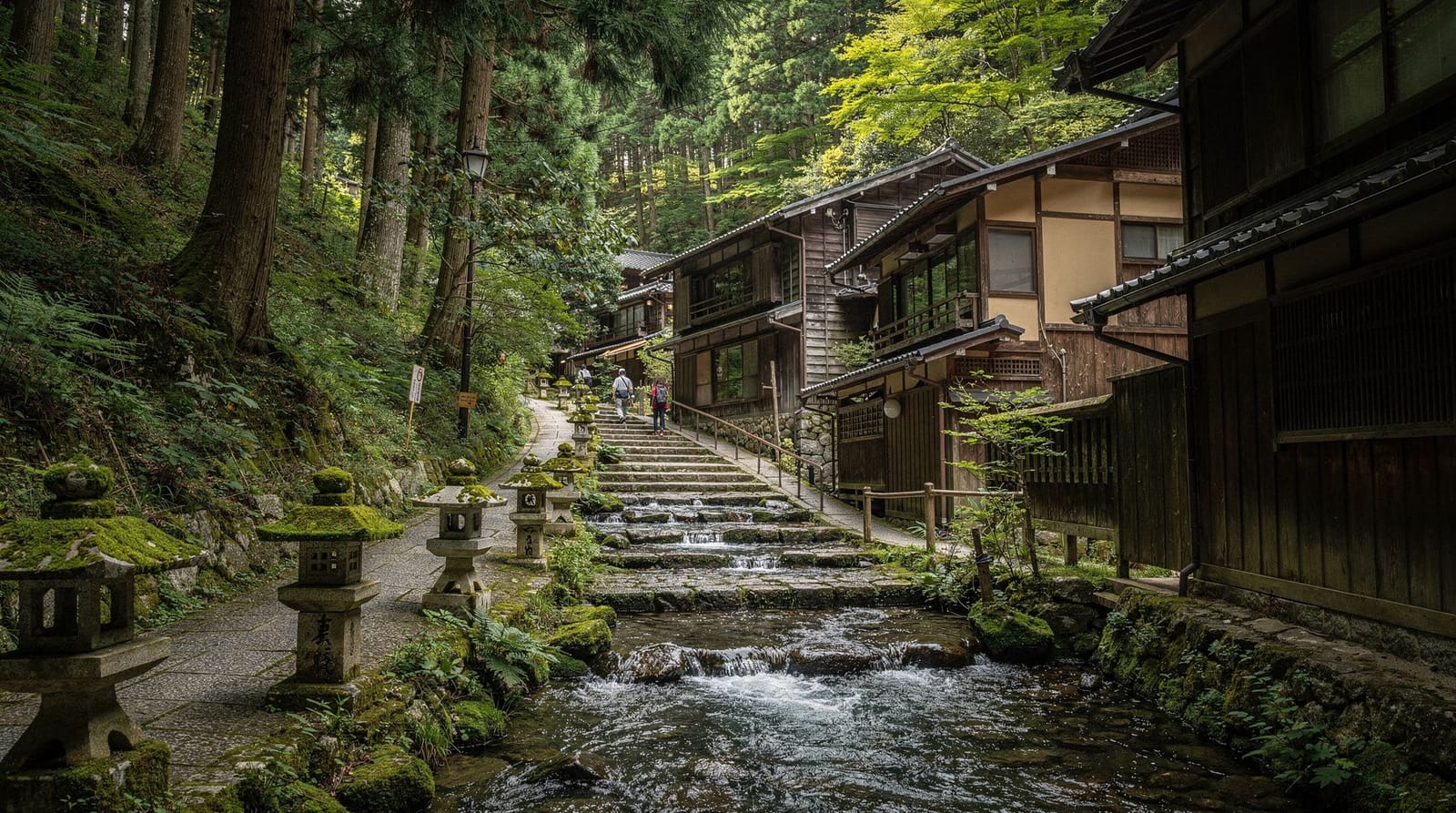
The walk itself is part of the appeal — narrow roads with almost no traffic beyond the occasional farm truck, irrigation channels running alongside the path, and views up toward the surrounding peaks that you simply don’t get anywhere in central Kyoto. Comfortable walking shoes matter more here than at temples with paved, level approaches; some of Ohara’s paths are gravel or uneven stone, particularly around Jakko-in.
Ohara compared to Kyoto’s other rural and mountain escapes
Ohara sits in a specific niche among Kyoto’s outlying destinations: it’s rural and agricultural rather than mountainous and active. Where Kurama and Kibune offer a hiking trail, an onsen, and a summer riverside dining tradition, Ohara offers gardens, temple history, and farmland — a gentler, more contemplative pace suited to travelers who want quiet without exertion. If you’re deciding between the two for a single free day, pick Ohara if temple gardens and a slower village walk appeal more than hiking and onsen bathing, and pick Kurama-Kibune if you want something more physically active.
Ohara is also worth weighing against central-Kyoto garden destinations you may already have planned. Compared to the Philosopher’s Path or the manicured grounds around Nanzen-ji, Sanzen-in’s moss garden feels wilder and less curated — a difference some visitors strongly prefer and others find simply less convenient. If your trip is five days or longer, a full day built around Ohara is a reasonable way to use a slower day without wasting it; see our five-day Kyoto itinerary for how a village day like this can sit alongside the busier temple-hopping days elsewhere in the plan.
It’s also worth weighing Ohara against Uji if slower-paced, less crowded destinations are the priority for a given day: Uji trades farmland and moss gardens for tea culture and a UNESCO temple with easier train access, while Ohara leans further into genuine rural quiet at the cost of a longer, bus-only commute. Neither is objectively better — the choice mostly comes down to whether tea history or garden contemplation appeals more, and how much you mind the hour-long bus ride versus a 15-20 minute train.
Honest planning notes: food, timing, and last buses
Ohara has real limitations that are worth knowing before you commit half a day to it. Food options are genuinely limited — a handful of small soba, tofu, and set-meal restaurants near Sanzen-in’s approach, plus the farm stands, and not much beyond that. Don’t expect variety or late hours; most places close by 5pm or earlier, and there’s essentially no dinner scene. Eat lunch here if you’re visiting midday, or plan to eat back in central Kyoto.
Last buses back to Kyoto Station or Demachiyanagi run earlier than many visitors assume, particularly outside peak tourist season — often the last direct service leaves Ohara somewhere in the early-to-mid evening. Check the current schedule at the bus stop or online before you settle in for a long lunch, since missing the last bus in a village with no train station and limited taxi availability is a genuinely inconvenient problem to have. During November foliage weekends, buses also run fuller and slower than usual due to both tourist volume and traffic, so budget extra time on both ends of the trip.
Ohara pairs reasonably well with a broader northern-Kyoto or off-the-beaten-path day; see our best day trips from Kyoto guide and off-the-beaten-path Kyoto itinerary for how it fits alongside other lower-traffic destinations, and our best temple gardens in Kyoto guide and best temples in Kyoto guide for how Sanzen-in and Hosen-in compare to the city-center options you may already have planned.
If crowd avoidance generally is a priority for your trip, our avoiding crowds in Kyoto guide covers the broader logic of choosing places like Ohara over the more heavily trafficked alternatives.
What to pack and practical tips
Because Ohara involves a longer bus ride than most Kyoto destinations, plan for it accordingly. Bring cash — while Kyoto’s central shops increasingly accept IC cards and credit cards, several of Ohara’s farm stands and smaller shops are cash-only, and the bus fare itself is easiest paid by IC card but backed up with coins if your card runs low. Dress for the season more deliberately than you would in central Kyoto: the valley runs a few degrees cooler than the city center, noticeable in both winter and the shoulder seasons, and temple interiors at Sanzen-in and Hosen-in involve removing shoes onto cold wooden or tatami floors, so bring socks without holes and an easy-to-remove shoe style.
If you’re visiting in November for foliage, expect the bus itself to be part of the experience-management problem: buses departing Kyoto Station for Ohara during peak weekends can be standing-room-only, and it’s worth checking whether an earlier or later departure gets you a seat, since the ride is close to an hour. Weekday visits, even during peak foliage, are noticeably calmer on the bus and at the temples themselves.
A few small restaurants and inns operate directly along Sanzen-in’s approach road, several serving kyo-kaiseki-style set lunches built around tofu, local vegetables, and mountain-vegetable tempura rather than the noodle-shop simplicity found at most day-trip destinations. Eating a proper sit-down lunch here, rather than rushing back to central Kyoto, is a reasonable way to lean into Ohara’s slower pace, though reservations are worth making ahead for a table during peak foliage weekends, when the handful of seats fill quickly.
Combine your visit with a stop at one of the roadside farm stands on the way back down from Sanzen-in — buying shiba-zuke or fresh produce directly from a grower is both a better souvenir and a small, direct way to support the village’s actual agricultural economy rather than a gift shop supply chain.
Frequently asked questions about visiting Ohara from Kyoto
Is there a train to Ohara?
No. Ohara has no train station and no rail line running through it. The only way in by public transport is Kyoto City Bus route 17 or 18 from Kyoto Station or Demachiyanagi, taking roughly 50 to 60 minutes.
What is the warabe jizo at Sanzen-in?
Warabe jizo are small, round-faced stone jizo statues scattered through the moss garden at Sanzen-in, added in the modern era. They’re one of the most photographed details in Ohara, often half-hidden in moss and undergrowth around the Ojo Gokuraku-in hall.
When is the best time to visit Ohara?
Mid-to-late November, for peak autumn foliage at Sanzen-in and Hosen-in, is the most spectacular and most crowded window. Spring offers fresh moss and calmer crowds. The village is genuinely visitable year-round, since its rural character doesn’t depend on any single season.
How much time should I budget for Ohara?
A half day (roughly four to five hours including bus travel) covers Sanzen-in and Hosen-in comfortably. A full day allows Jakko-in as well, plus unhurried time exploring the farm stands and eating lunch locally.
What is the blood ceiling at Hosen-in?
The chi-tenjo, or blood ceiling, at Hosen-in uses wooden boards salvaged from Fushimi Castle following a 1600 siege, with dark stains said to be bloodstains from soldiers who died there. It was later installed as a memorial in several Kyoto-area temples.
Is Ohara good for travelers who don’t want crowds?
Yes, generally. Outside November foliage season, Ohara draws a fraction of the visitors that central Kyoto’s major temples do, and even during foliage season it’s calmer than equivalent-tier sites like Kiyomizu-dera or Tofuku-ji.
What should I eat in Ohara?
Look for shiba-zuke, the purple pickled eggplant-and-shiso preserve said to have originated here, sold by small producers throughout the village. A handful of soba and tofu restaurants near Sanzen-in’s approach road cover lunch; don’t expect dinner options or late hours.
Can I combine Ohara with Kurama and Kibune in one day?
It’s possible with a private car or driver, since both are northern-Kyoto mountain destinations, but they aren’t well connected to each other by public transit — doing both by bus and train in one day involves routing back through central Kyoto in between, which eats a lot of the day.
What is Raigo-in and is it worth visiting?
Raigo-in is a small, quiet temple further up the valley path beyond Sanzen-in, traditionally considered the birthplace of shomyo Buddhist chanting. It draws few visitors and has limited English signage, so it rewards travelers who already know the history rather than teaching it on-site — a good option if you want a few minutes of genuine solitude.
Which of Ohara’s temples should I prioritize if I only have time for one?
Sanzen-in, without question — its moss garden and warabe jizo statues are Ohara’s signature sight and the reason most visitors make the trip. If you have even 30 extra minutes, Hosen-in’s seated tea view of its centuries-old pine is the best second stop.
Should I choose Ohara or Uji if I only have time for one rural day trip?
It depends on what you’re after. Ohara offers moss gardens, farmland, and genuine quiet at the cost of a longer bus-only commute; Uji offers tea culture and a UNESCO temple with easier, faster train access. Pick Ohara for slower contemplation, Uji for tea history and convenience.
Top experiences
Bookable activities with verified prices and instant confirmation on GetYourGuide.